Game Info
Collection
Your Tier
Loading…
Mechanic profile
Not enough video data yet
Vibe profile
Not enough video data yet
Description
No description available.
Featured Videos


Ask a Rules Question
Images

GID0453125.jpg

GID0453125_thumb.jpg
All mentions
Browse transcript mentions, sentiments, pros/cons, mechanics, topics, quotes, and references.
Total mentions: 4
This page: 4
Sentiment:
pos 0 ·
mix 1 ·
neu 1 ·
neg 0
Showing 1–4 of 4
Video v7W85oMqCKQ
Shelfside Review at 0:00 sentiment: mixed
video_pk 89877 · mention_pk 239382

Click to watch at 0:00 · YouTube ↗
Overall sentiment (raw)
mixed
Pros
- smooth simultaneous action phase
- rich set collection with hand management and progression
- free actions and foresight add tempo
- strong thematic feel with medieval hierarchy and peasants
- clear components (two-sided cards) and helpful rulebook glossary
- scales to five players with reasonable playtime
Cons
- rulebook sequencing issues and unclear set-size references
- faction balance uneven; some factions underpowered or overpowered
- solo mode lacks interaction and can feel robotic
- end-of-decade interactions can feel wasted; some cards don’t interact
- drawing two cards as an action can feel heavy on action economy
- endgame can converge too quickly due to repetitive card sets
Thematic elements
- rising through social hierarchy, wealth accumulation, and defense via warfare
- medieval kingdom-building across decades
- progression-driven with end-of-decade scoring and foreseeing
Comparison games
- Clash of Clans
- Gaia Project
- 7 Wonders
Mechanics (from transcript analysis)
- Compound Scoring — score is determined by best in each category across all players, including ties
- dominions / land acquisition — buy dominions that boost marks and provide special actions
- end-of-decade scoring / category-based points — score is determined by best in each category across all players, including ties
- foresight / end-of-decade planning — spend gold to foresee upcoming events and plan defense/harvests
- free actions / exhaustible helpers — many free actions from hand; peasant worker can be exhausted to speed up actions
- rank progression / faction abilities — ranks give abilities and increase income; factions give special bonuses
- Set Collection — collect sets of grain, towns, cities, etc. to increase victory points and income
- set collection / card-building — collect sets of grain, towns, cities, etc. to increase victory points and income
- Simultaneous Actions — each year you take two actions; all players perform actions concurrently during the action phase
- stance cards / defense vs income vs warfare — players choose a stance each round affecting income or defense against warfare cards
- two actions per year (and simultaneous play) — each year you take two actions; all players perform actions concurrently during the action phase
Video topics + discussion points
No key topics recorded for this video.
Quotes (from this video)
- kingdom building across decades simultaneous play what a combination
- the game looks pretty medievally good
- it's a bustling marketplace of kingdom building activity
- my personal score for antares kingdoms is going to be a 4 out of 10
- the simultaneousness here feels simultaneous for purely speed's sake
References (from this video)
No references stored for this video.
Video s8DDOE3V8XY
Getting Games Discussion at 2:10
video_pk 89894 · mention_pk 239456

Click to watch at 2:10 · YouTube ↗
Pros
none
Cons
none
Thematic elements
- kingdom building
- medieval fantasy world with 12 factions
Comparison games
none
Mechanics (from transcript analysis)
Mechanics unknown.
Video topics + discussion points
No key topics recorded for this video.
Quotes (from this video)
- it looks like this is a 60 to 120 minute game
- the balance between workers (which are warriors) and resources (which are livestock) are two sides of the same coin
- the more of uh one thing that you do the less of the other thing
- this is the next game coming out from delicious games
References (from this video)
No references stored for this video.
Video WVMFyI0HiUg
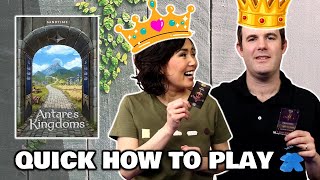
mipple university Rules Teach
video_pk 70645 · mention_pk 167654
Pros
none
Cons
none
Thematic elements
none
Comparison games
none
Mechanics (from transcript analysis)
Mechanics unknown.
Video topics + discussion points
No key topics recorded for this video.
Quotes (from this video)
- antares kingdoms is a quick playing game with minimal downtime as most phases are played simultaneously
- the game is at its core a set collection with a pool building element
- the most common actions are to draw two cards or to play one card into the building slot which corresponds to its time cost
- sets that are present at the end of 10 rounds count as achievements which are one of the only two ways that you can win the game
- coins are likewise a valuable and flexible commodity in the game
- or they can be spent on engine building such as drawing cards or expediting buildings as extra actions
- two actions or five coins let you glance at the next three events ahead
- this all comes down to a player's risk tolerance
- rank up to esquire and then take a choice become a trade master or climb the ranks of nobility
- after 10 rounds are done players count up their achievement sets on the achievement tracks then reset for the next round after three decades it's time for the end challenge
- antares kingdom can also be played solo with the player competing against an ai whose achievements and endgame challenge are drawn at random from the dominion deck
- we are using a prototype copy of the game so the rules and components may not be final
References (from this video)
No references stored for this video.
Video WVMFyI0HiUg
mipple university Rules Teach at 0:29 sentiment: neutral
video_pk 70645 · mention_pk 185196
Click to watch at 0:29 · YouTube ↗
Overall sentiment (raw)
neutral
Pros
- quick playing with minimal downtime
- clear core mechanic in set collection with a pool-building element
- economic system involving coins and dominion cards for multiple paths to win
- solo play option
Cons
- prototype copy of the game may not reflect final rules/components
- defense/warfare events can disrupt plans if players are unprepared
Thematic elements
- rival factions vying for influence across six categories over three decades
- medieval fantasy setting in the Antares pristine mountains
- set collection with pool building; simultaneous phases; euro-style engine feel
Comparison games
none
Mechanics (from transcript analysis)
- building slot placement — players play one card into the building slot which corresponds to its time cost
- Card Drafting — the most common actions are to draw two cards
- coin economy and dominion cards — coins can be spent to gain dominion cards, a second path to win
- cued card progression — cued cards progress one step at the start of each round, eventually entering the kingdom
- Deck Building — there is a pool-building element that interacts with coin generation and dominion cards
- defense and warfare events — round events can require defense when warfare appears, impacting strategy if you cannot defend
- Drawing Cards — the most common actions are to draw two cards
- End Game Bonuses — three decades occur, after which the end challenge is resolved and the winner is determined
- end-of-decade scoring — after 10 rounds, achievement tracks are counted, then the decade ends and the game progresses to the next decade
- endgame and decades — three decades occur, after which the end challenge is resolved and the winner is determined
- exhaust for engine actions — cards can be exhausted for their engine-building actions (extra actions)
- harvestable sets and coins — harvestable sets generate coins each round
- Narrative Choice — each round offers a stance that can grant extra defense or extra income
- pool building — there is a pool-building element that interacts with coin generation and dominion cards
- rank up system — players can rank up (peasant -> esquire -> trade master or noble) for bonuses and new strategic options
- Set Collection — the game is a set collection game as the core mechanic, with sets counted to determine scoring
- Solo AI — solo mode pits the player against an AI drawing endgame challenges from the dominion deck
- stance choices — each round offers a stance that can grant extra defense or extra income
- Tile Placement — players play one card into the building slot which corresponds to its time cost
Video topics + discussion points
No key topics recorded for this video.
Quotes (from this video)
- antares kingdoms is a quick playing game with minimal downtime as most phases are played simultaneously
- the game is at its core a set collection with a pool building element
- the most common actions are to draw two cards or to play one card into the building slot which corresponds to its time cost
- sets that are present at the end of 10 rounds count as achievements which are one of the only two ways that you can win the game
- coins are likewise a valuable and flexible commodity in the game
- or they can be spent on engine building such as drawing cards or expediting buildings as extra actions
- two actions or five coins let you glance at the next three events ahead
- this all comes down to a player's risk tolerance
- rank up to esquire and then take a choice become a trade master or climb the ranks of nobility
- after 10 rounds are done players count up their achievement sets on the achievement tracks then reset for the next round after three decades it's time for the end challenge
- antares kingdom can also be played solo with the player competing against an ai whose achievements and endgame challenge are drawn at random from the dominion deck
- we are using a prototype copy of the game so the rules and components may not be final
References (from this video)
No references stored for this video.
Transcript Navigation
Showing 1–4 of 4