



















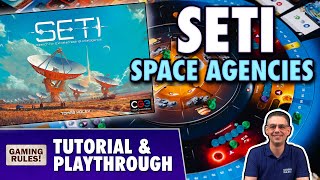



SETI: Space Agencies Deep Dive
What the Community Thinks About SETI: Space Agencies
SETI: Space Agencies has earned overwhelming praise from the board gaming community. Reviewers across multiple channels describe the expansion as not just an improvement to the base game, but as essential to experiencing SETI at its best. The consensus is remarkably unified: this expansion addresses genuine pain points in the original design while introducing systems that feel thematically authentic and mechanically compelling. The Dice Tower named it among the year's standout expansions, and the community recognized it with strong award attention. Most striking is reviewers' collective sentiment that they would not play SETI without this expansion going forward, suggesting Space Agencies has moved from optional add-on to canonical experience.
Core Mechanics That Define SETI: Space Agencies
Asymmetric Player Powers
The new organizations form the expansion's heart. Each player selects one organization at game start, each with a distinct asymmetric ability and modified starting conditions. These are not minor tweaks. Man vs Meeple described their impact as having "that level of impact" of Terraforming Mars corporations, genuinely pushing players in certain strategic directions. One organization might grant free probe movement, another might let players exchange cards from the market, a third might make scanning cheaper. Going Analog noted that even a first-time player new to SETI found the organizations made the experience so exciting they could not imagine playing without them. The elegance lies in how each organization's ability connects thematically to its name and mission, while mechanically opening distinct strategic paths. With numerous organizations available but only a handful in play per game, replayability becomes substantial.
Quick-Start Cards
The expansion directly addresses one of SETI's acknowledged slowest moments: round one. Instead of starting from near-zero resources and taking turns to slowly build capacity, quick-start cards let players skip the first round entirely and begin at round two with meaningful starter bonuses. These cards give players initial resources, some probes already positioned in space, or completed scans in certain sectors. Multiple reviewers noted this feels like the Terraforming Mars Prelude expansion did for that game, jumpstarting the experience and letting players immediately engage with strategy rather than resource accumulation. Going Analog described this as a head start that eliminates the slow slog of the opening and lets meaningful decisions happen from turn one.
The SETI: Space Agencies Experience
Accelerated Engagement and Decision Density
One of the most frequently mentioned shifts is how the expansion changes the pace and feel of play. The quick-start mechanism removes the first round entirely, condensing the standard game to fewer rounds. Yet despite this compression, reviewers consistently reported that games felt more engaging, not rushed. Going Analog observed that because players start with resources already flowing and probes already positioned, they face more consequential decisions in every round. The expansion transforms SETI from a game where an entire round is spent building capacity into one where players are actively pursuing winning strategies from the opening turn. This shift makes the game both faster and more satisfying, addressing what the gaming community had identified as a bottleneck in the original experience.
Variety and Replayability as Core Experience
Adding new alien species to the original roster creates a substantial deck of possibilities. Because each game draws only a couple of aliens at random, players can return to SETI multiple times and encounter genuinely fresh scenarios. The Dice Tower emphasized how this variety matters, noting that alien reveals continue to be a magical moment SETI delivers. Going Analog reviewers noted they played multiple games and encountered meaningfully different gameplay each time. The new organizations layer additional replayability on top: with many organizations to choose from but only a few in play, the combinations expand dramatically across plays. This density of variation keeps SETI from feeling like a solved puzzle even after dozens of plays.
What Makes SETI: Space Agencies Stand Out
Essential Refinement, Not Gimmick Expansion
Most expansion discussions include tension about whether additions feel integral or tacked-on. Space Agencies avoids this entirely. Reviewers consistently describe it as refining the core SETI experience rather than adding complexity for its own sake. Grant Lyon noted that the expansion succeeds precisely because it lets players skip the first round of the game and jump right into the action where SETI truly shines, while simultaneously adding strategic depth through the organizations. Going Analog explained it simply: they would always play with this expansion from then on because it made a game they already loved substantially better. This is not a situation where veterans merely tolerate an expansion; it is one where the expansion becomes part of what makes SETI complete.
Thoughtful Design Philosophy
Multiple reviewers praised the intentionality behind each addition. Man vs Meeple observed that the designer looked for where the base game could be improved and where a few things could be enhanced rather than fixed outright. The scan tokens add new tactical options without overwhelming the decision space. The quick-start cards eliminate a genuine drag point while giving each player a unique entry point into the game. The new aliens meaningfully alter strategy without requiring rule changes. This precision feels rare: every component in Space Agencies addresses something real rather than adding busywork.
Potential Drawbacks
Increased Complexity for New Players
While reviewers celebrated Space Agencies, some noted a caveat. The expansion adds layers of choice at game start: picking an organization, choosing a quick-start bonus, and learning a new ability all happen before the first action. A first-time player trying to absorb SETI's core systems simultaneously faces more moving parts. However, Going Analog qualified this by noting that even a brand-new player had no problem jumping right in with the expansion's bonuses and enjoying it immediately, suggesting the complexity concern is minor. Still, teaching SETI to newcomers requires briefly walking through what each organization does before diving in.
Organizational Power Balance Variations
One reviewer playing with the expansion noted that certain organizations felt noticeably more powerful than others, particularly one that started with extra probes beyond the base action's normal yield. Coupled with synergistic quick-start cards, that organization could create early snowballing advantages. The reviewer noted the game still balanced out narrowly in the end, suggesting the system evens out over time, but the opening moments could feel asymmetrically swingy depending on which organizations and quick-start cards come into play together.
If You Enjoy SETI: Space Agencies
Players drawn to SETI: Space Agencies will likely gravitate toward Terraforming Mars and its expansion Terraforming Mars Prelude, especially given how often reviewers drew this comparison. Both offer asymmetric player powers, heavy strategy, and that signature moment when a new card or ability recontextualizes a player's approach mid-game. Gaia Project similarly rewards deep strategic thinking about long-term positioning and delivers the thematic satisfaction of space exploration at higher complexity. The base game SETI: Search for Extraterrestrial Intelligence remains essential context, but Space Agencies transforms it from a solid experience into something reviewers describe as unmissable.
What Reviewers Are Saying
"This is another one that I won't play the game without because it feels essential to me."
— The Dice Tower
"I would always play with this expansion from now on. It's still a fantastic game without it, but it's just so much more exciting to get going so quickly, and one of the people we played this with was new to the game, and she had no problem just jumping right in with these extra things."
— Going Analog
"Think corporations in Terraforming Mars. They have that level of impact. They're definitely going to push players in certain directions, not to mention they give you variable starting resources and they really push things forward."
— Man vs Meeple