



Oath: New Foundations Deep Dive
What the Community Thinks About Oath: New Foundations
Oath: New Foundations is an expansion for Oath, the area control game designed by Cole Wehrle and published by Leder Games. Reviewers and presenters tend to treat it as a substantial structural revision of the base game rather than a simple add-on. In a conversation with The Cardboard Herald, Cole Wehrle described the goal as letting the game remember the decisions players made with far more resolution, which the designer compared to moving from an 8-bit to a 16-bit memory.
Heavy Cardboard approached the expansion as a five-game campaign, teaching it as though the base game did not exist because so many rules have changed. The hosts were clearly enthusiastic about the persistent elements, while also pointing out that the first game asks players to make some rulings that the rulebook leaves open. Box of Delights took a different angle. Its presenter, who is working on the solo and co-operative design, showed a single module called the order deck and stressed that it was still early in development and not yet a complete game. Across these perspectives, the consensus is that the expansion adds real depth and long-term investment, while the complexity and the work of learning it are the most common caveats.
Core Mechanics That Define Oath: New Foundations
Modular Board
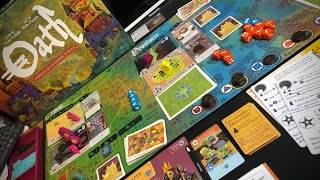
The map in Oath: New Foundations is assembled fresh at setup. Heavy Cardboard explained that the cradle, the provinces, and the hinterland are dealt out at random, with only one guarantee: at least one edifice, or homeland, must appear so the game has a starting anchor. Each site carries its own terrain and powers, and those details shape how the board plays. Coasts let players move cheaply between shorelines, islands require a ferry surcharge, mountains add a cost to entry, and homelands act as forges where a player can pay favor to draw a relic. Because the geography changes every time, the hosts treated travel costs and site powers as something to learn in play rather than something to memorize. The layout also determines which regions a player can realistically reach, so the same rules produce different strategic paths from one game to the next.
Legacy Cards and the Chronicle
The second defining system is the set of legacy cards, which turn Oath from a single contest into a sequence of linked games. At the start of each game, players receive legacy cards and keep one face down. If the condition printed on that card is met by the end of the game, the card flips face up and grants a lasting power in the next game. Heavy Cardboard emphasized that the setup itself changes over time. Certain foundational cards are double-sided, and some legacy effects flip one of them, so the rules for setting up the next game are not identical to the last. Winners score points that carry forward, and only the winner scores, which gives every game in the series a clear consequence. The hosts planned their five-game campaign around this structure, reading through every legacy card at the start of each session.
The Oath: New Foundations Experience
Agency Beyond the Chancellor
Heavy Cardboard described a shift in how it feels to be a player who is not in first place. In the base game, a player who is not the Chancellor or the winner has limited options, and the hosts said that agency used to belong only to the Chancellor or to the winner. Holding the new banners, the people's favor and the darkest secret, gives a player rules-based agency and a bonus at the end of the game, even when that player is not on track to win. The hosts said this gives players reasons to act throughout the game. They also described the game as feeling like a role-playing experience, with each action producing a small narrative beat.
Tension Over Banners, Relics, and the Oathkeeper
The tension in Oath: New Foundations comes from contested control. Heavy Cardboard described campaigns in which skull faces on defense dice can destroy war bands, so an attack that looks safe can cost a player a large part of its strength. Challenges are also constrained: a player who wants to take a banner from an opponent must be at the same location as that opponent, and the banner's favor or secret total must be exceeded. Heavy Cardboard also explained that relics can be kept face up for their power or face down to conceal them, and that a face-down card carries an inherent risk because an opponent may discover it. The supply track is the limiting factor for nearly every choice, so every action competes with the others for the same few points.
What Makes Oath: New Foundations Stand Out
An Automated Opponent Built on Paper
The order deck is the feature that Box of Delights presented most closely. It is designed to control an automated opponent without a computer, an app, or any extra components beyond the cards. Its presenter explained that the opponent takes actions from a flipped card and responds to the game state through suits. Actions the opponent can perform are linked to the suits it has access to, and those suits are influenced by its current mood, which changes with the visions and the Oathkeeper goal. The presenter described the result as a neat solution to a complicated problem, one that is otherwise difficult to solve without a computer. The approach is intentionally not a deep artificial intelligence. Instead, it aims for a middle ground between a fully deterministic opponent and a purely random one, so that the opponent stays responsive to the game state without requiring the table to pause for long calculations on its turn.
Legacy Persistence That Changes the Table
Heavy Cardboard singled out the legacy cards and the double-sided foundational cards as the features they enjoyed most. The reviewers described them as amazingly cool, and they liked that the effects persist across games. The result is a world that carries history from one session to the next. Cole Wehrle has described the same idea in terms of memory, with the game preserving the decisions made during play so that later sessions are shaped by earlier ones. For a group that plans a series of games, this gives each session a sense of continuity that a standalone game cannot provide.
Potential Drawbacks
Rules Gaps in the First Game
Heavy Cardboard raised several rules moments that were hard to resolve while teaching. The "Longlost Heir" card lets an exiled player become a citizen, or become the chancellor outright in a game with no chancellor, and the rulebook's advice to ignore certain powers in a first game left the group unsure whether that guidance covered this card. They worked it out at the table and moved on, deciding to ignore it for that session. The hosts also initially found the tie-breaking rule confusing: when multiple players are tied for the most sites and the oathkeeper is not one of them, the rules let the tied players choose who takes the title. These moments do not undermine the design, but they show that a group needs to be patient with the rulebook during its first session.
Setup Load and an Early Design Stage
Setup is a real commitment. Heavy Cardboard described a long process of removing base-game components, reading through the legacy cards, filling favor banks differently depending on the number of denizens on the board, and building a new world deck from six suits. Separately, Box of Delights was candid that its solo and co-operative module was in early design. The presenter stressed that the module is not a complete game, and that the solo and co-operative play would need supporting goals, scenarios, and other components that were still being developed. Reviewers who want a finished product on day one should weigh this, because some of the most ambitious ideas are still being tested.
If You Enjoy Oath: New Foundations
Players who value the order deck's approach to controlling an opponent may appreciate GMT's COIN games, which Box of Delights mentioned as a contrasting example of expansive flow charts that drive an automated opponent. Where COIN games rely on detailed logic, Oath: New Foundations keeps its automated play lightweight and tied to the card and suit system. Players who enjoy asymmetric, faction-driven area control and a world that grows through expansions may also appreciate Root, another Cole Wehrle design that The Cardboard Herald discussed at length in the context of how new factions and expansions can be added to a game. Finally, Arcs is the other Cole Wehrle game the same interview covered in depth. Its persistent campaign and modular expansions make it a natural recommendation for players who want to follow the designer's approach to long-term play.
What Reviewers Are Saying
"It's a neat solution to a very complicated problem that is otherwise impossible to solve without the computer."
— Box of Delights
"I'll be honest, that's honestly these two things are probably my favorite thing about the new version of the game. These are amazingly cool. Love those."
— Heavy Cardboard
"I wanted the game to remember those decisions better. I wanted it to go from like an 8bit memory to a 16bit memory. I wanted to increase the resolution of the game."
— Eric, The Cardboard Herald