




Heroes of the Shire: Light & Shadow Deep Dive
What the Community Thinks About Heroes of the Shire: Light & Shadow
Heroes of the Shire: Light & Shadow lands in a crowded marketplace for tactical combat games, and reviewers have mixed but cautiously optimistic reactions. The consensus is that this standalone sequel delivers sophisticated mechanics and compelling content value (50+ hours of gameplay per scenario), but struggles to differentiate itself in a genre saturated with similar experiences. Reviewers appreciate the thoughtful design and unique hero archetypes, but some find the game treading dangerously close to generic fantasy territory. Meeple University and BoardGameCo praise the mechanical depth and clear tutorial materials, while The Dice Tower panelists acknowledge the game's quality while admitting uncertainty about how it truly stands apart from competitors like Phantom Epoch and the board game version of Slay the Spire. The broader view: a solid, well-executed tactical adventure that works better in hand than it presents on paper.
Core Mechanics That Define Heroes of the Shire: Light & Shadow
Tactical Turn Order Combat with Cooldown Dice
The mechanical core of Heroes of the Shire is turn-order-driven combat where every action is deterministic. There is no attack roll; instead, damage flows from character stats (strength, intellect, agility, defense) and distance multipliers on the combat map. What makes the system distinctive is its cooldown structure. Spells are not freely available; each cast places a cooldown die on the card showing how many rounds before the hero can cast it again. During the upkeep phase, cooldown counters decrement by one. This creates a rhythm where players must carefully sequence their spells across multiple rounds, knowing which abilities will be available when. Movement cards add another layer: on each turn, the hero draws three movement options and keeps one, determining how far they can travel and what environmental effects (like placing bleed tokens) they can trigger before and after their spell. As reviewers note, the agility stat directly affects turn order throughout combat, and temporary modifications to agility can swing initiative, turning tactical positioning into a second form of resource management.
Hex-Based Exploration with Unique Tactical Combat Maps
Outside combat, players explore a region map made of hexes. When the party moves to a new hex and encounters enemies, they consult a binder where each numbered hex has its own full-page tactical combat map with unique terrain, obstacles, and environmental rules. This two-scale exploration design, developed by designer Damian and Senior Games, means the overworld feels abstract but each battle unfolds across a distinct arena with meaningful layout. Roaming mini-bosses add unpredictability: they move across the exploration map based on dice rolls, depositing encounter tokens that players can discover later. The exploration deck itself offers branching decisions through action cards that present story moments with binary choices, each triggering different narrative outcomes and rewards. Reviewers highlight that this creates substantial replayability because even returning to the same scenario yields different encounters, different map placements for treasures and enemies, and entirely different story moments.
The Heroes of the Shire: Light & Shadow Experience
Strategic Puzzle Solving Under Mounting Pressure
Playing Heroes of the Shire feels like solving a living puzzle where the board state grows more complex with each round. Each character has access to unique spells with asymmetric cooldowns and effects, and the collaborative challenge is figuring out how to sequence character abilities so that the group's combined damage, healing, and crowd control maximizes impact while enemies grow more dangerous. ReviewersBoard mention that once the ruleset clicks, the game rewards planning and pattern recognition. The pressure comes not from dice rolls but from the finite turns before cooldowns expire and from managing the agility track, which determines who acts next. Temporary buffs and debuffs (glowing, paralyzed, etc.) stack on character boards using a token-tracking system, and the visual management of stacked conditions becomes part of the cognitive load. This is a game of high interactivity and constant calculation, suited for players who enjoy tactical optimization.
Character Progression as Personal Narrative
Each scenario spans 20 to 25 hours, during which heroes level up from 1 to 8, unlocking new spells and permanent stat boosts at each tier. The spell mastery tree for each hero is branching; when you level, you spend a power cube to either deepen an ability you already have or branch into an entirely different spell suite. This structure means two players running the same hero can arrive at vastly different capability sets by endgame. Combined with quest objectives tied to each party member (protect an ally, capture a legendary enemy, seek out specific encounters), the campaign becomes a story of personal transformation. Reviewers note that the game provides solo, cooperative, arena, and villain-controlled modes, and the tutorial alone spans three hours, suggesting that Senior Games invested heavily in pacing player onboarding and making the ruleset feel natural over time rather than punishing early mistakes.
What Makes Heroes of the Shire: Light & Shadow Stand Out
Unconventional Hero Archetypes Free from Generic Fantasy Tropes
Where many tactical fantasy games reach for familiar classes, Heroes of the Shire offers the Raven Goddess, the Hydromancer, the Clairvoyant, and the Beastmaster. Reviewers explicitly praise this choice; The Dice Tower panelists note that avoiding the stock fighter-mage-ranger triangle is a deliberate swing for visual and mechanical differentiation. Each character's spell suite reflects their archetype visually and mechanically, so the Hydromancer's abilities cluster around water elemental summoning and defensive shields, while the Raven Goddess has an entirely distinct mechanical identity. Reviewers found this approach refreshing in a crowded genre and appreciated that it extended to character artwork and flavor text, which leaned thematic without retreating into fantasy cliches.
Modular Combat Map Binder with Genuine Environmental Storytelling
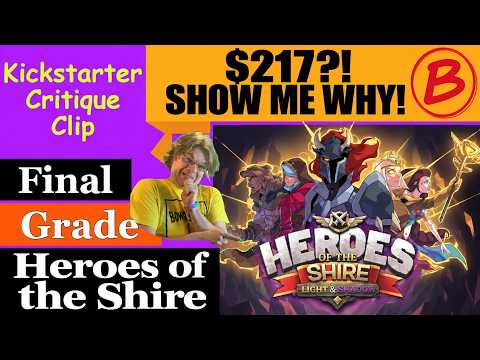
The spiral-bound binder containing 22+ unique combat maps (with plans for fire, earth, water, and ice regions) impressed reviewers as a physical and design achievement. Each map page includes terrain that meaningfully affects combat: cliffs that block line of sight, resource tokens that grant buffs when occupied, and thematic details that ground encounters in the world. Kickstarter Critique and the Dice Tower both called out the quality of the map design photography and presentation. Rather than every combat feeling like a symmetrical arena, each location poses distinct tactical challenges. Reviewers appreciated that this production choice makes the physical act of playing feel substantial, and the maps are not just functional but genuinely interesting to study before and during play.
Potential Drawbacks
Dense Rules and Steep Learning Curve Despite Quality Materials
Multiple reviewers acknowledged that Heroes of the Shire is not a light game. The player board is crowded with stat tracking, permanent buffs, equipment slots, and spell mastery connections. The ruleset covers token upkeep, dice upkeep, movement card selection, cooldown management, and conditional spell effects all within a single turn. Kickstarter Critique and The Dice Tower noted that while the game provides excellent tutorial videos (including a full 15-minute condensed how-to by Meeple University and a 3-hour walkthrough), the cognitive load remains high for the first few scenarios. One reviewer compared the initial learning experience to "playing in the negative space," where the meaningful information feels obscured by visual complexity. For players expecting a streamlined tactical game, the overhead may feel excessive, even if it ultimately rewards deep engagement.
Naming and Positioning Create Confusion in an Oversaturated Genre
The Dice Tower panelists raised a fair concern: Heroes of the Shire arrives in a market already occupied by Phantom Epoch, Slay the Spire: The Board Game, Leviathan Wilds, and others pursuing similar tactical-adventure-with-progression templates. The name itself invokes Lord of the Rings (despite no direct connection), and reviewers felt the marketing on Kickstarter/GameFound did not adequately spotlight what actually differentiates Light and Shadow from its siblings. One reviewer noted that after watching footage, they still struggled to articulate what made this game unique compared to alternatives at a similar price point (USD 200+). While the actual mechanics deliver distinctiveness, the presentation of that distinctiveness remains muddled. In a crowded field, positioning matters, and several reviewers wished the campaign had frontloaded the cooldown system and hex-map architecture rather than burying those insights deep in the campaign page.
If You Enjoy Heroes of the Shire: Light & Shadow
Reviewers recommend these related experiences. Fans of the original Heroes of the Shire, released in 2024, should note that Light and Shadow is a standalone sequel with updated components and new scenarios; you do not need the first game, though add-ons allow importing new content into older campaigns. If you enjoy Slay the Spire for its deckbuilding roguelike structure and repeated runs with different builds, the board game version offers a different strategic experience but shares the "run and adapt" loop. Phantom Epoch appeals to similar players and was mentioned as a direct comparison by multiple reviewers; both games blend exploration, progression, and tactical combat. Hero Quest, the classic dungeon crawler, influenced Light and Shadow's design DNA, and fans of modern interpretations of that formula will find familiar ground. Twilight Imperium and Leviathan Wilds chase epic scope with similar complexity profiles, making them natural recommendations for players comfortable with rules-heavy experiences.
What Reviewers Are Saying
"There's nothing about this game that I do not adore. It's got the swept up in the theme, the intra mechanics, the generally wonderful gameplay. There's nothing about this game that I do not adore."
— Kickstarter Critique
"This looks like an interesting shot. There's a lot of stuff in there. I'm just not sure I'm seeing how this one is standing out from all that bloat that's already out there or on the way."
— The Dice Tower
"It plays quite intuitively. And from our experience of playing the game, once it clicks and once you get used to it, it does all make sense. But you can see from here these each character is unique."
— Watch Review