






Phantom Epoch Deep Dive
What the Community Thinks About Phantom Epoch
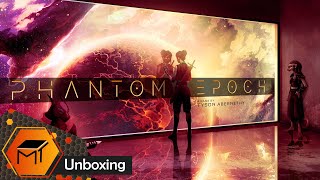
Phantom Epoch, the sci-fi campaign dungeon crawler published by Doteira Games, has earned strong consensus from reviewers: it succeeds as a streamlined alternative to Gloomhaven that delivers engaging tactical combat without overwhelming complexity. Reviewers consistently praise its elegant design philosophy and clean mechanical systems, though they offer measured takes on its narrative depth and progression pacing. The game clearly resonates with players who want the cooperative dungeon-crawl experience with lighter rules burden and faster play. Not everyone was sold from the crowdfunding pitch alone: on The Dice Tower, one host found it an interesting shot but questioned how it stands out in a crowded market of campaign and arena combat games.
Core Mechanics That Define Phantom Epoch
Action Card Play and Initiative
At its heart, Phantom Epoch uses card play to drive both character actions and pacing. Each player assembles a hand of action cards and selects several cards to play on their turn, up to an action point cap that varies by character. The elegance lies in flexibility: any card can be converted into a basic move or basic attack if tactical circumstances demand it, letting players adapt when their planned sequence becomes obsolete. Initiative flows directly from the action point costs of the cards chosen, creating interesting tension between playing efficiently and acting quickly. Reviewers appreciated this system as fast and intuitive while still offering meaningful choices about tempo and positioning.
Dynamic Enemy Activation
Enemy activation deserves special mention for its ingenuity. Rather than using lengthy stat sheets, each adversary is defined by two cards: one for species and one for class. The species card provides core attributes, while the class card lists what that enemy does on its turn. Cleverly, the class cards have four color variants, and the color of an enemy's base determines which actions it takes. This means two archer enemies of the same type might behave completely differently depending on whether their bases are red or yellow. Reviewers found this system created dynamic variety without adding cognitive load, keeping combat from feeling rote even across multiple encounters with the same enemy types.
The Phantom Epoch Experience
Narrative-Driven Campaign
The campaign unfolds across a persistent spaceship and three distinct planets, with story told through map books and narrative unlocks. As players complete missions and make choices, they gain access to new areas of their ship and new missions on different planets. This structure integrates narrative beats smoothly with scenario setup, so the story and gameplay reinforce each other. Reviewers noted that while the narrative does not reach the dramatic intensity of some competitor titles, it maintains steady intrigue through a slow drip of revelation and mystery about what is actually happening. The approach of allowing skippable tutorial missions on replay campaigns respects player time while preserving the campaign structure for newcomers.
Tactical Puzzle-Solving
Combat in Phantom Epoch feels like solving a spatial puzzle. Terrain, line-of-sight, destructible objects, and hazardous spaces all factor into tactical choices. Initiative flexibility means deciding whether to move quickly to seize the advantage or play more cards for raw power. Ranged attacks introduce additional tension through accuracy rolls when line of sight is blocked, creating memorable moments where friendly fire becomes a real hazard. Reviewers appreciated the scenarios offered genuine variety beyond just killing enemies, including survival objectives, escort missions, and multi-phase boss encounters.
What Makes Phantom Epoch Stand Out
Health Tracking System
The spinning dial bases for tracking health have won near-universal praise. Character and enemy standees sit on reusable bases marked with numbers that you rotate to track damage. Extra rings stack beneath the base to track ten-point increments, making it trivial to manage health totals of any size without tracking tokens. One reviewer called this "a genius system" that should become standard across dungeon crawlers. This small innovation eliminates fiddly token management and makes the board state visually cleaner while actually improving usability.
Character Progression and Flexibility
Each character class offers a unique deck of action cards and role on the table. As players progress through the campaign, they unlock advanced classes that branch from their starting class, expanding their deck options and playstyle. The elegant part: players can swap their class between missions without penalty. This flexibility lets players experience all the character options across a single campaign and experiment with team compositions freely. Reviewers found this design choice excellent for groups wanting to explore the full roster without committing to single characters for the duration of a 40+ mission campaign.
Potential Drawbacks
Dice Randomness and Fumbles
Combat resolution relies on dice rolls, with players choosing between a standard die and a risky die. The risky die offers higher odds of critical hits but also more fumbles. Fumbles do not just cause a miss; they end all subsequent attacks that turn. Reviewers found this mechanic unsatisfying when an elaborate setup gets derailed by a lucky roll, comparing it to similar frustrations in Gloomhaven. The publisher has released an official variant to reduce the sting of fumbles, suggesting this concern resonates with the design team.
Campaign Pacing and Structure
Progression between missions felt slow to some players. New action cards unlock gradually, meaning multiple scenarios may pass before a player acquires a fresh deck option. This can make the early-to-mid campaign feel repetitive, especially for those accustomed to rapid equipment progression in other dungeon crawlers. Additionally, mission unlocking through completion and event triggers can make it unclear which missions represent the main narrative arc and which are optional, mirroring organizational challenges that some reviewers experienced with Gloomhaven.
If You Enjoy Phantom Epoch
The touchstone every reviewer reached for is Gloomhaven. Hungry Gamer described Phantom Epoch as giving Gloomhaven vibes through card play, cards that go away, and initiative set by the cards you play, but in a lighter and more forgiving package. Players who want that tactical card-driven crawling without Gloomhaven's weight are the clearest audience. On The Dice Tower, one host felt the card-driven play was faintly Spirit Island-ish, and the other admitted to sensing the same vibe. For story, Hungry Gamer was candid that Phantom Epoch's narrative is not at the level of Madara, Familiar Tales or Tales from the Red Dragon Inn, so players who come for a gripping story should look there, while Phantom Epoch suits those who want the story as a slow draw alongside the tactics.
What Reviewers Are Saying
"I love this. So, how both the character minis in the game work and the standies for the enemies is that they click in these little spinning bases with numbers around them. And you keep track of the life total of each figure just by spinning these around the base. Look how smoothly that works. You can also put their status effects in these little extra holders here. Yeah, this is a genius system."
— One Stop Co-op Shop
"If you're thinking, 'You know what? It's just a little bit much. It's a little bit too brain burny.' Then, this actually might be the one that you really want to check out cuz it does give me a lot of that vibe, a lot of that feeling with not quite so much heft and crunch."
— Hungry Gamer
"This looks like an interesting shot. There's a lot of stuff in there. I'm just not sure that this game that is in a very crowded market right now, these arena combat games or campaign games. I'm not seeing how this one is standing out from all that bloat that's already out there or on the way."
— The Dice Tower