




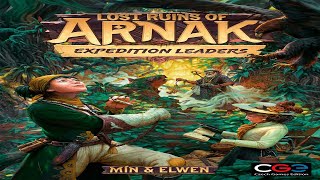






Lost Ruins of Arnak: Expedition Leaders Deep Dive
What the Community Thinks About Lost Ruins of Arnak: Expedition Leaders
The Expedition Leaders expansion has become essential for Lost Ruins of Arnak enthusiasts. Reviewers consistently express that this expansion transforms the base game by introducing six asymmetric leaders, each with distinct abilities and starting decks that fundamentally change how players approach their expeditions. What strikes most reviewers is that while the base game is already solid, playing without these leaders now feels incomplete. The expansion has earned its place as a staple addition rather than an optional module.
The new leader abilities push players toward genuinely different strategies. The Captain provides an extra worker for straightforward added power. The Baroness focuses your deck toward items with permanent income. The Falconer relies on a ticking falcon mechanic. The Professor pursues unique artifact-only strategies. The Explorer uses mobility over worker count. And the Mystic takes a riskier path through fear-card rituals. This variety means that not only do players get new leaders to explore, but each one invites distinct gameplay patterns, keeping the core experience fresh even after many plays.
Core Mechanics That Define Lost Ruins of Arnak: Expedition Leaders
Six Asymmetric Leader Abilities and Starting Decks
The heart of this expansion is its six leaders, each with completely different starting decks and board layouts. The Captain is noted as the best entry point for new players, simply giving an extra worker without complicated rules overhead. The Baroness generates income and puts items directly into your hand, creating immediate use for cards you buy. The Falconer has a falcon that tracks up a sequence, granting various bonuses when activated. The Professor draws three unique artifacts at game start and manages a briefcase that constrains which resources can purchase artifacts. The Explorer relies on a single worker but compensates with snack tokens that let them move to unoccupied sites. The Mystic, by contrast, accumulates fear cards and converts them into ritual actions with escalating payoffs. Each leader comes with custom assistants, cards, and idle board positions tailored to their mechanics, ensuring asymmetry runs deep beyond simple ability text.
Alternative Research Tracks and Temple Variants
Beyond leaders, the expansion includes two new double-sided temple tracks (the lizard temple and the waterfall/monkey temple). These are overlays that swap out the base research track, offering different point distributions and special mechanics. One track forces your magnifying glass and book to move up different paths on each side. Another includes locations that punish you for not advancing quickly or offer shortcuts for specific resource combinations. Rather than revolutionizing strategy, these tracks add welcome variety to a mechanism that, by the tenth base-game play, can feel predictable. The new temples reinforce exploration and resource management in subtly different ways, ensuring that veteran players still face novel puzzle-like decisions about how to allocate effort.
The Lost Ruins of Arnak: Expedition Leaders Experience
A Game That Opens Up After Repeated Play
Reviewers note that the base game, while excellent, begins to feel familiar after about ten plays. The same core paths emerge: maximize temple track progress, collect key artifacts, juggle the research curve. The Expedition Leaders expansion transforms that experience by introducing genuinely different win conditions and card synergies tied to each leader. The Professor decks toward artifacts entirely. The Baroness leans into item recursion. The Explorer uses movement and exploration where others use standard worker placement. This variance isn't just mechanical novelty; it's permission to try strategies that would be suboptimal with the generic leader. The expansion also includes more filtering and card-draw mechanics than the base game, giving deck-building more granularity.
Best at Smaller Player Counts; Solo Shine
While the expansion supports the full 1-4 player range, reviewers emphasize that it shines brightest as a solo or two-player experience. With three to four players, the limited worker-placement interaction means turns feel comparatively solitary; players mostly pursue their own engine-building rather than denying each other opportunities. This isn't necessarily a flaw, but it's worth noting if you value player interaction. The solo mode, by contrast, becomes exceptionally tense, with the bot opponent forcing real decisions about when to advance and when to hold ground. Notably, the expansion also facilitates a free print-and-play campaign called Search for Professor Coutille, which adds narrative flavor to the euro-game skeleton and gives players a guided multi-chapter journey with specific chapter-based challenges.
What Makes Lost Ruins of Arnak: Expedition Leaders Stand Out
Accessible Asymmetry with Real Complexity Scaling
The expansion does something tricky well: it makes asymmetry accessible. The Captain, Baroness, and Falconer read simply and introduce new players to each leader's core concept in a handful of turns. Yet the game doesn't sacrifice depth for accessibility. The Professor requires careful management of a limited artifact pool and the decision of when to reshuffle. The Explorer demands efficiency calculations on how many sites a single worker can reach. The Mystic forces players into puzzle-territory, where understanding the ritual economy and timing its payoffs requires genuine mastery. This spectrum means a table can include both newcomers and veterans, each playing at a challenge level that suits them.
Leaders Prompt Emergent Card Synergies
By providing each leader with unique cards alongside the shared pool, the expansion creates card combinations that weren't possible before. The Professor benefits from artifact-generating cards that sit useless in other leaders' decks. The Baroness has a special delivery card that returns to her hand endlessly, enabling loops. The Explorer's snack-token cards have effects that make movement-heavy strategies viable. These synergies don't break the game; they're tight enough that optimization matters but loose enough that suboptimal play is still rewarding. Reviewers note that this card interconnection is particularly satisfying because it emerges organically from trying to pilot each leader, rather than feeling like forced theming.
Potential Drawbacks
The Mystic Leader Feels Unintuitive and Punishing
While five of the six leaders land intuitively, the Mystic presents a steep learning curve. This leader accumulates fear cards (normally a liability) and converts them via rituals into power. The challenge is that fear cards clog your hand if you're not constantly exiling them, and the only ways to generate exile effects are baked into your starting deck. Reviewers report that the Mystic feels like the sixth-hardest leader by a cliff, not a slope. Several reviewers speculate the Mystic is so fiddly that even winning with them feels like you're working harder than everyone else at the table for the same victory. This makes recommending the Mystic to newer players risky and can create uneven skill expression at mixed tables.
The Expansion Feels Nearly Essential, Making the Base Game Feel Incomplete
This expansion has become so popular that reviewers note it's almost essential. One reviewer states they play with Expedition Leaders in every single game. This popularity creates an awkward dynamic: the base game, which is excellent on its own, now feels like an incomplete product to many players. The lack of leader variety in the base game, while not a flaw, is thrown into sharp relief once Expedition Leaders exists. Additionally, the expansion doesn't radically transform Lost Ruins of Arnak; it simply adds welcome variety to an already-solid formula. Some reviewers lament that they wished for a future expansion that unlocked entirely new strategies, such as a focus on guardian-hunting or pure exploration that could win without racing the research track. For players with limited budgets, the expansion's near-mandatory status can feel like a high barrier to entry.
If You Enjoy Lost Ruins of Arnak: Expedition Leaders
If the asymmetric leader puzzle appeals to you, Dune: Imperium shares a similar worker-placement foundation, though it trades the deck-building and exploration focus for house politics and intrigue. Where Arnak explores an island and optimizes your deck, Dune emphasizes blocking your opponents at key political moments. The games feel like cousins: both are elegant, both reward tight play, but Dune is grittier and more competitive, whereas Arnak is more about solo optimization wrapped in a shared space.
Obsession offers deck-building in a social-deduction wrapper and shares Arnak's attention to card economies and engine-building. It's a heavier, longer game that rewards deep planning and reading your opponents' hands.
Wingspan, while thematically unrelated, shares Arnak's commitment to accessible asymmetry and beautiful production. Both games invite casual players to the table and give them meaningful decisions without demanding mastery to have fun. Wingspan's bird-building engine mirrors Arnak's card-synergy loops, just with less conflict and a meditative pace.
What Reviewers Are Saying
"I would never play without this one. I think it's a must-have for Lost Ruins of Arnak."
— Allies or Enemies
"This game was phenomenal. I thought everyone's abilities, we all got something pretty much the entire time. Like it wasn't, like everyone felt really, really cool."
— Board Games UnLocked
"I highly recommend this expansion. I think if you enjoyed the base game at all, you 100 percent should get this. It's actually elevated the base game up much higher than it was. I already enjoyed the game, but now it's one of my favorites, to be honest with you, and it's one of my favorite solitaire experiences."
— Drive Thru Games