












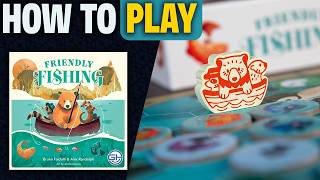






Friendly Fishing Deep Dive
What the Community Thinks About Friendly Fishing
The board game community has embraced Friendly Fishing with genuine warmth. Reviewers consistently describe the game as charming, approachable, and genuinely fun despite its simplicity. The game's defining innovation, the neighbor-scoring mechanic, sits at the heart of its appeal, creating a design that Bethany from Ryan and Bethany Board Game Reviews called "so charming and so much fun." The reviews reveal near-universal appreciation for how the game's rules are easy to teach, making it accessible to players of all ages, while still offering enough strategic depth to engage experienced gamers. Several reviewers note that this is a game they're keeping in their collections, a testament to its staying power. Where reviewers diverge is primarily on the depth of the movement puzzle itself; some find it consistently satisfying, while others wish the board state offered more ways to execute clever plays. Overall, Friendly Fishing presents as a game that succeeds at what it sets out to do: create a friendly, cooperative experience where winning means helping your neighbor.
Core Mechanics That Define Friendly Fishing
Neighbor Scoring
The central mechanic that makes Friendly Fishing memorable is its unique scoring system. In games with three to five players, your final score is not calculated solo; instead, it combines with the score of the player seated to your left. This means your neighbor's success directly impacts your own victory. Designers Bruno Faidutti and Alex Randolph use this mechanism to create a subtle but profound shift in how players think about their actions. Rather than pursuing a purely selfish strategy, you find yourself incentivized to support the player to your left while simultaneously being supported by the player to your right. This scoring structure echoes the elegance of games like Between Two Cities and Between Two Castles of Mad King Ludwig, but applied to a set collection framework with its own distinct flavor. The mechanic transforms the game from a simple tile-collecting race into a careful balancing act: you must get what you need, but you must also consider whether your moves will set up your neighbor for success. Two-player games revert to traditional individual scoring, making the neighbor mechanic specifically valuable in the game's sweet spot of three to five players.
Boat Movement and Tile Collection
Friendly Fishing's turn structure is deliberately streamlined. On your turn, you move a shared boat token to an adjacent tile, then collect whatever is there and place it face up in front of you. The boat can only move to spaces containing tiles, creating a spatial puzzle where the available moves shrink as the board empties. When no adjacent move is available, the boat returns to the central island and can move from there to any adjacent space. This reset mechanic introduces a clever dynamic: sometimes controlling when the boat returns to the island can be strategically valuable, as it lets you potentially reach fish that would otherwise be cut off by the board state. The design ensures that the movement puzzle remains relevant throughout the game while keeping rules simple enough to explain in seconds. Reviewers praise the clarity of this mechanism and appreciate how it creates genuine decision-making without overwhelming complexity.
The Friendly Fishing Experience
Light and Accessible
Friendly Fishing delivers a refreshingly approachable experience. The ruleset is minimal, move the boat, collect a tile, making the game easy to teach to players unfamiliar with modern board games. Setup takes minutes, and a full game plays in approximately 30 minutes. Reviewers from Tantrum House emphasized that "super easy rules" are one of the game's strengths, opening it to players ages 10 and up. What makes this accessibility meaningful is that the game doesn't feel dumbed down; simplicity here is a feature, not a limitation. The game avoids complex iconography or fiddly interactions, instead letting players focus on the strategic and social dimensions of play. The double-sided board also supports this accessibility by allowing players to choose game length based on their available time, with a smaller island for shorter games and a larger island for extended play. This is the kind of game that works equally well in a casual family setting or as a lighter title in a game night with experienced players.
Encourages Strategic Kindness
The neighbor-scoring mechanic creates an unusual emotional tenor for a competitive game. Because your neighbor's score matters to you, you find yourself hoping they get good tiles and take strong turns. This creates genuine moments of mutual support: you want them to succeed not out of altruism, but because their success is your success. Might I Suggest A Game captured this elegantly, calling the game one where "you have to be friendly to win." Reviewers describe the resulting play experience as charming and warm. There's an implicit negotiation happening on every turn: yes, you're pursuing your own collection goals, but you're doing so with awareness that your left neighbor will benefit from your success and your right neighbor is positioning tiles for you. Tantrum House noted how special tiles introduce "interesting strategic options" such as the ability to "lock another player into taking a turn," creating moments where you can influence the sequence of play without directly stealing from others. The design encourages players to think outward toward their neighbor, creating a collaborative undercurrent even within the competitive framework.
What Makes Friendly Fishing Stand Out
The Neighbor-Scoring Mechanic Creates a Unique Hook
While games with shared or linked scoring exist, Friendly Fishing's application of the concept to a set collection game in this form is genuinely distinctive. The mechanic is not merely a scoring twist; it reframes the entire social and strategic arc of play. Every tile you collect, every arrangement you make, happens in the context of knowing that your neighbor will benefit from your positioning. Reviewers consistently highlighted this as the game's most memorable element. The elegance lies in how it aligns player incentives without requiring complex rules or special conditions; the shared scoring system itself creates all the strategic friction needed. For players who have experienced the warm competitive dynamics of games like Between Two Cities, Friendly Fishing offers a fresh entry point with a faster playtime and simpler ruleset.
Variable Setup with Randomized Special Fish Tiles
Friendly Fishing avoids monotonous repetition through its variable tile setup. The game includes several sets of special fish tiles, and only a subset are used each game (two sets for the smaller board, four for the larger). This randomization means that the strategic landscape shifts from play to play. One game might include tiles that award bonus points for collecting the most of a certain fish, while another might feature tiles that let you steal points from opponents or modify the board state itself. Reviewers appreciated this variability; it ensures that no two games feel identical and encourages players to adapt their strategies based on what special tiles are in play. The core set collection mechanic remains consistent and easy to understand, but the variable special fish layers on strategic variety without increasing teaching burden.
Potential Drawbacks
Limited Movement Options Create Constraint Rather Than Elegance
Not every reviewer found Friendly Fishing's movement puzzle equally satisfying. BoardGameCo's Alex Radcliffe noted that the "potential movement pool is more limited than what I actually would like," resulting in fewer opportunities to feel clever. The constraint of moving only to adjacent tiles, while thematically fitting, means that in practice you often have only a handful of legal moves on any given turn. Reviewers who prefer games with rich decision trees may find that the game feels somewhat deterministic once you understand the board state. Making what Radcliffe called "a super cool move" happens, but it's "infrequent, more the exception than the norm." The limitation is not a flaw per se; it aligns with the game's mission to be light and accessible, but players seeking deep positional puzzles may walk away slightly underwhelmed by the depth of interaction between the movement rules and the spatial board state.
Board Complexity Does Not Always Reward Deep Play
Some reviewers felt that while the neighbor-scoring mechanic is clever, the board itself does not offer enough interesting spatial puzzles to justify deep engagement. Radcliffe observed that "the board itself was not interesting enough," leading to a situation where the interesting mechanic (shared scoring) did not fully compensate for a board state that could have been more dynamic or puzzle-rich. The board's role is primarily to serve as the canvas for tile placement and boat movement, but it doesn't introduce its own meaningful strategic layers: geography, resource distribution, or board-specific advantages. For players who gravitate toward games where board state and spatial strategy are paramount, Friendly Fishing may feel like its mechanics could have been paired with a more elaborate board design or additional spatial constraints that would elevate the puzzle experience.
If You Enjoy Friendly Fishing
If Friendly Fishing resonates with you, seek out Between Two Cities and Between Two Castles of Mad King Ludwig. Both games share the core innovation of linked scoring where your success depends partly on a neighbor's performance. Between Two Cities uses tile placement and card drafting to build neighborhoods, while Between Two Castles employs hand management and auction mechanics to construct whimsical castles. Both are slightly heavier than Friendly Fishing but reward the same mindset: strategic generosity toward your neighbors. If you prefer a lighter entry into the space, Friendly Fishing itself is the more approachable gateway, faster, simpler rules, less teach time. But if you love the feeling of the scoring mechanic and want to explore games that deepen it, these two titles offer natural progressions into design territory that values cooperation within competition.
What Reviewers Are Saying
"What's really cool about this is the entire game you're actually just setting up the person on your left. So you're wanting to take a turn and you're wanting to collect a fish. You have to do that. But you also know that you're setting up your opponent. And sometimes you don't want them to take something. Or sometimes you want them to take something. But also you want them to do well because that's going to be your score, too."
— Ryan and Bethany Board Game Reviews
"This one's a super fun game where you have to be friendly to win, and I think that is fantastic."
— Might I Suggest A Game
"You can mix in special tiles which will give you one-time actions when you collect the tile during the game. And these introduce some interesting strategic options as you lock another player into taking a turn so that you will get to take the special tile on your turn, take the action, and maybe swap some tiles."
— Tantrum House