








Jolt Deep Dive
What the Community Thinks About Jolt
Reviewers across the tabletop gaming community describe Jolt as a delightful surprise in the mass-market dexterity space. TheGameBoyGeek, who regularly evaluates mainstream board games, notes that most mass-market titles fall short, but Jolt breaks that pattern. The consensus is clear: this is a genuinely fun, tactile experience that engages players from ages eight and up. Danielle from DaniCha emphasizes the multigenerational appeal, describing it as perfect for family play. Let's Table It praises the hands-on nature and solid component quality, while Jamie from Tabletoptiktok celebrates the lingering sense of wonder that magnets evoke. The common thread: reviewers repeatedly express surprise that a mass-market release achieves such polish and engagement.
Core Mechanics That Define Jolt
Magnetic Polarity System
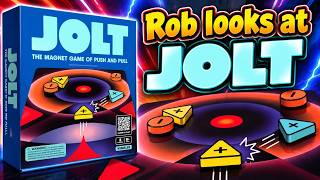
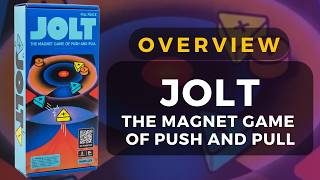
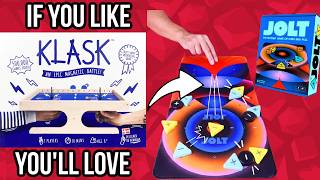
At Jolt's heart lies its polarity mechanic. Each player controls five triangle-shaped magnets marked with a plus sign on one side and a minus sign on the other. Before each shot, players choose which polarity to present, fundamentally shaping their strategy. Opposite poles attract, causing magnets to snap together, scoring zero points. Identical poles repel. Trap magnets placed by card each round add another layer of consideration. TheGameBoyGeek emphasizes that choosing your polarity creates "tactical things" that reward skill and planning. You might use a same-pole repel to push opponent pieces away or an opposite-pole attract to deliberately snap your magnet to a trap, sacrificing your turn to deny opponent points. This binary choice, multiplied across five magnets and three rounds, creates surprising depth within a simple framework.
Two-Sided Board, Two Distinct Games
McMiller Games included a double-sided board that transforms Jolt into two distinct experiences. The side-by-side orientation places both players on the same edge of the neoprene mat, creating a more combative, direct-interaction style where shots pass right by your opponent's launch zone. The head-to-head orientation flips the board so players shoot from opposite ends. TheGameBoyGeek calls this "so well thought up," noting that it actually feels like two completely different games rather than mere cosmetic variation. Each side has double-sided trap cards that correspond to its layout, ensuring the challenge adapts to the board orientation chosen. Reviewers appreciate that this flexibility accommodates different preferences without requiring separate products.
The Jolt Experience
Tactile Magnetic Satisfaction
Reviewers return again and again to the physical sensation of play. Jamie articulates it simply: "I still find magic in magnets like I did when I was a kid." Let's Table It praises the hands-on nature and notes that the magnets are "nice and heavy" with real pulling power. The neoprene play mat glides smoothly, allowing magnets to travel surprising distances. TheGameBoyGeek describes the moment when flicking a magnet hard results in a magnet that "just stops in its tracks and pushes multiple magnets forward" as genuinely amazing. That haptic feedback, the clack of magnets snapping, the smooth slide of a well-aimed shot, the visible repulsion of same-pole encounters, creates a visceral reward structure independent of scoring. The game makes players want to play it again just to feel that interaction.
Dexterity Tension and Strategic Friction
Jolt walks the line between a pure skill game and a strategic puzzle. Reviewers describe the experience as trying to make the right shot while using the right polarity, capturing how physical execution intertwines with decision-making. Players must read the board state, anticipate magnet interactions, and judge the exact pressure needed for their flick. Opponents can deliberately block high-scoring zones, snap their own magnet to a trap to deny points, or use repulsion to clear space for the next turn. This creates a push-pull rhythm where every action invites a reaction. TheGameBoyGeek notes that the game rewards getting "used to the strength" of the magnets, suggesting a learning curve that keeps play fresh across sessions.
What Makes Jolt Stand Out
Perfectly Calibrated Magnetic Strength
TheGameBoyGeek dedicates significant analysis to the magnetic engineering itself. Magnets that are too weak would fail to create exciting interactions, while magnets that are too strong would send pieces flying off the board uncontrollably. The developer achieved balance that enables tactical precision. Players can make subtle nudges or aggressive sweeps, and the magnets respond predictably. This attention to component physics is rare in mass-market games and elevates Jolt beyond gimmick territory into genuinely purposeful design. Multiple reviewers emphasize that the magnetic strength is what makes the game work, transforming what could have been a novelty into a genuinely engaging experience.
Flexible Board Layouts with Asymmetric Play
The double-sided board is a standout feature. As TheGameBoyGeek observes, sometimes players want to sit side-by-side (like many dexterity games), and sometimes they prefer face-to-face. Rather than forcing one setup, Jolt accommodates both and makes each feel meaningfully different. The side-by-side mode rewards direct combat and interference, while the head-to-head mode emphasizes distance management and long-range accuracy. Each round's trap card configuration adds fresh variables, ensuring that no two games of Jolt feel identical. The trap magnets themselves are subtle obstacles that transform the scoring landscape without overwhelming the core mechanic.
Potential Drawbacks
Turn-Order Advantage in Rounds Two and Three
TheGameBoyGeek identifies a meaningful balance issue: the game lacks explicit rules for determining turn order in rounds two and three. Because the player who goes last in a round gains a massive advantage (they can react to everything their opponent played and make the final, uncontested move), whoever goes second becomes favored to secure that final turn. TheGameBoyGeek has adopted a house rule where the trailing player goes first in subsequent rounds, which creates an interesting "sandbag" dynamic reminiscent of Power Grid where players don't always want to be ahead. The fact that this crucial rule is absent from a mass-market game is puzzling, though most casual players may not notice the imbalance.
Limited to Two Players Only
Jolt is explicitly designed for exactly two players. TheGameBoyGeek expresses a desire for a four-player variant, either through a larger board or a team format where teammates alternate turns or sit on opposite sides. While the core two-player experience is strong, the lack of scaling options restricts who can enjoy Jolt at a given table. A larger edition supporting four players would broaden its appeal as a party or family game, though McMiller has not announced such a variant. For groups larger than two, Jolt remains a spectator game rather than a full-table experience.
If You Enjoy Jolt
If Jolt resonates with you, Crokinole is the natural next step. Multiple reviewers draw this comparison explicitly. Both are dexterity-focused, reward repeated play to master aim and timing, and create high-touch, analog gameplay. Crokinole offers more depth and a larger community, but Jolt's magnetic twist makes it feel fresh and speeds play considerably. Klask also appeals to Jolt enthusiasts. TheGameBoyGeek describes Klask as "air hockey without the air" and notes that it harnesses magnets to create a physical game of push, pull, and table presence. Both Klask and Jolt emphasize tactile satisfaction and quick rounds suitable for casual gatherings. For players seeking a different kind of precision dexterity, Catacombs and PitchCar offer similar tactile depth, though without magnets. Finally, Patchwork, while abstract, shares Jolt's elegant two-player design and rewarding mechanical interactions.
What Reviewers Are Saying
"They're not too weak. They're not too strong. They're just right that you can sometimes you can really whip that magnet down the board and it's amazing how it will just like stop in its tracks and push multiple magnets forward."
— TheGameBoyGeek
"I love how the game is hands on and the magnetics are nice and heavy. They actually work. They actually have a good magnet magnetic pull. They hold a charge and they will do what you are planning to do."
— Let's Table It
"I still find magic in magnets like I did when I was a kid."
— Jamie, Tabletoptiktok