





Party House: The Deckbuilding Game Deep Dive
What the Community Thinks About Party House: The Deckbuilding Game
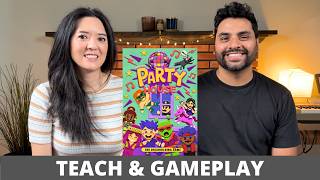
Party House has found enthusiastic appreciation among board game reviewers, though perspectives vary on its standing within the crowded push-your-luck and deck-building landscape. Board Game Animal embraces the game's chaotic energy and finds it delivers exactly what it promises: engaging, ridiculous fun that keeps players entertained throughout each turn. BoardGameCo takes a more measured view, recognizing the game's accessibility and solid mechanics while questioning whether it offers enough innovation to break through the competition. Before You Play demonstrated the game through extensive gameplay, highlighting its thematic cohesion and the various strategic layers available to players. Across all channels, reviewers agree on one point: Party House works exactly as intended, whether that intention thrills a given table or simply satisfies depends on their appetite for push-your-luck chaos.
Core Mechanics That Define Party House: The Deckbuilding Game
Push Your Luck Drawing Phase
Each turn, players draw guest cards one by one from their deck, deciding moment-to-moment whether to continue or end their party. Cards generate popularity and money, currencies used to recruit new guests, but they also carry trouble. Accumulate enough trouble symbols and the cops bust the party, forcing players to end immediately and forfeit their rewards for that turn. This core risk-reward tension defines the entire experience: players must balance the temptation of drawing one more card against the mounting danger of going too far. The mechanic creates the game's signature tension and entertainment value, as opponents watch and often encourage riskier play.
Deck Refinement and Card Recruiting
The deck-building phase transforms Party House from a simple push-your-luck game into an engine-building experience. After resolving the party phase, players spend their accumulated popularity and money to recruit new guest cards from a rotating market display. These new cards enter the discard pile and cycle back into the deck over time, improving future parties. Cards offer varying abilities, some let players peek at upcoming cards, discard troublemakers, fetch specific cards from their discard pile, or neutralize trouble. This deck-refinement layer means early-game sacrifices pay off in later turns, rewarding strategic foresight and allowing players to build synergies between card effects.
The Party House Experience
Ridiculous, High-Energy Fun
Party House prioritizes entertainment and table energy over cerebral depth. Reviewers consistently highlight the satisfying chaos of pulling off unexpected card combinations, the thrill of narrowly avoiding a bust, and the memorable moments when someone pushes their luck too far. The artwork and character design reinforce the playful tone, with guests ranging across a variety of wild party archetypes. The game invites table talk and speculation: players openly encourage or discourage draws, celebrate successful parties, and laugh when busts occur. Whether winning or losing, the focus remains on enjoying the shared experience of watching parties succeed or spectacularly fail.
Straightforward Accessibility
Despite its multiple modes and card variety, Party House teaches in minutes and plays intuitively. Reviewers emphasize that players new to deck-building or push-your-luck games can grasp the fundamentals immediately, yet the card effects and economic balance between money, popularity, and trouble create meaningful decisions. The game respects player intelligence without demanding extensive rules memorization or turn-order complexity. This accessibility means the game works equally well for casual gamers seeking fun and experienced enthusiasts who enjoy mechanical optimization within a forgiving framework.
What Makes Party House Stand Out
Multiple Distinct Play Modes
Party House ships with several modes beyond the standard competitive experience. Solo play offers a timed challenge without removing the core push-your-luck satisfaction. The team-based Block Party mode emerged as reviewers' favorite way to play: it fosters cooperation, shared celebration of good turns, and joint decision-making during party phases. Rather than forcing all modes onto every player, the game makes it easy to choose what suits the table, giving the design flexibility and replayability that adapts to different groups and moods.
Thematic Execution and Satisfying Card Combinations
The game's theme, throwing the ultimate party while avoiding trouble with cops, maintaining popularity, and managing finances, isn't merely window dressing. Card names and effects reinforce the fiction, with guests whose abilities mirror their role at a wild party. This thematic coherence, combined with cards that chain together in surprising ways, creates moments of mechanical elegance. Players learn to recognize and exploit synergies: pairing certain guests, using abilities in sequence, or saving money for key purchases that unlock future combos. The game rewards both strategic planning and tactical improvisation.
Potential Drawbacks
Uneven Card Cost-to-Power Balance
Some reviewers expressed concerns that not all cards feel equally valuable relative to their cost. Certain abilities may be overcosted while others offer disproportionate value, creating pressure to pursue specific strategies or chase particular cards. While this imbalance may be corrected between the version reviewers tested and final release, it represents a friction point for players seeking tight economic design. Experienced players may find themselves gravitating toward a narrow set of efficient choices rather than exploring the full card roster.
Limited Innovation in a Crowded Genre
Party House executes push-your-luck and deck-building mechanics competently but without groundbreaking design. The combination of these systems isn't new, and the game doesn't introduce mechanics that fundamentally challenge how these genres work. For players fatigued by similar offerings or seeking a game that breaks new design ground, Party House may feel like a well-made but ultimately familiar experience. It succeeds best for tables encountering the push-your-luck-plus-deck-building formula for the first time, or for groups prioritizing entertainment over mechanical novelty.
If You Enjoy Party House: The Deckbuilding Game
Consider Quacks of Quedlinburg, the genre-defining push-your-luck bag builder where players draw components from cloth bags and decide when to stop before busting. Tea Witches offers a different flavor of personal deck building with a slower, brewing rhythm and ecosystem-building focus. Don't Go in There delivers push-your-luck thrills around a ghost-infested house theme. Party House itself began as a video game before this tabletop adaptation, in the same spirit as the Bitewing Games adaptation of Baba Is You, a two-player rules-warping puzzle game that serves a completely different kind of table but shares the same commitment to bringing its source material's spirit onto the tabletop without requiring familiarity with the original.
What Reviewers Are Saying
"At the end of the day, what Party House brings to the table is it's a lot of really, really ridiculous fun. If you like push-your-luck games and the idea of building your own push-your-luck engine, then this one is going to absolutely hit for you. The artwork and characters are fun."
— Board Game Animal
"It is a really enticing time around the table watching and trash-talking or encouraging others to just try and push it. You can pull off some of the most satisfying combos of card effects and have great entertaining moments as people bust or if people pull off something that seems really impossible and just have a perfect turn."
— Board Game Animal
"Everything it does, it does well, but both things are true. I really couldn't find much to criticize here. It does what it wants to do well, but I also had nothing that wowed me."
— BoardGameCo