



















-60° Deep Dive
What the Community Thinks About -60°
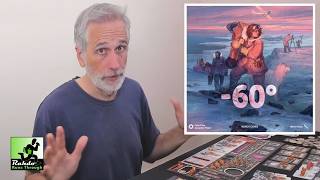
-60° has captured the attention of board game reviewers as one of the most intriguing and unexpected releases heading into Essen 2026. Across multiple channels, there is consistent enthusiasm for the game's fresh Antarctic theme and its pedigree. Alexander Fister's involvement alone drives considerable excitement, and reviewers appreciate that the game offers something genuinely novel. The consensus centers on three points: the mechanical depth, the striking artistic presentation, and the thematic coherence that ties exploration to systems. Some reviewers express cautious optimism given Fister's track record, while a few note that the production, though beautiful, leaves minor questions about component execution.
Core Mechanics That Define -60°
Worker Placement and Station Building
At its heart, -60° is a worker placement game where players direct a team of scientists and explorers across the frozen Antarctic landscape. Players place workers to take actions that allow them to build a network of research stations and upgrade their expeditionary infrastructure. The Board Gaming Ramblings reviewer notes this involves "placing workers, upgrading stations," which shapes the core arc of each player's expedition. These stations don't exist merely for flavor; they provide ongoing benefits and capabilities that define how each player's strategy unfolds across the three-hour journey toward the meteorite impact site.
Push-Your-Luck Card Draws
What distinguishes -60° mechanically is how it layers push-your-luck tension onto the worker placement framework. On each turn, players draw cards from a personal deck composed of exploration cards and storm cards. They draw one at a time and choose when to stop, but every storm card drawn covers up a base on the player's board that would otherwise provide a valuable special ability. As one reviewer explains the system, "the harder you push each round, the more you risk." This creates constant tension: press forward to explore more, gather more resources, and make progress toward the meteorite, or pull back and consolidate what you have already built. The mechanic ties directly to the Antarctic theme, where prolonged exposure to extreme cold becomes increasingly dangerous.
The -60° Experience
Exploration and Discovery
Players don't simply move pieces on a map; they navigate a thematic expedition where every card draw carries weight. The game presents the experience of scientists at the edge of human endurance, racing against deteriorating conditions and limited resources. The exploration unfolds through tracking temperatures on individual hexagonal spaces and managing supply chains. The Dice Tower team notes the "little guys" have "their snowshoes on and everything," grounding the abstract resource management in a visible, relatable world of bundled-up explorers.
Race Against the Environment
The emotional core of -60° is the constant negotiation between ambition and survival. The Antarctic wasteland is never forgiving. Players must balance the lure of reaching the meteorite with the practical reality of maintaining functional bases and keeping their teams alive. The long play time, two to three hours, allows this tension to develop naturally rather than rush through it. Reviewers recognize that this measured pacing creates space for meaningful decisions where every card draw feels consequential.
What Makes -60° Stand Out
A Genuinely Fresh Theme
Board game reviewers frequently encounter civilization games, exploration games, and resource management games. But -60° arrives with a theme that feels genuinely novel. The Antarctic meteorite impact setting is not a well-worn path in the hobby. One reviewer explicitly states the theme is "interesting. Peter Prince is the co-designer with Alexander Fister is the guy who did Thieves. I consider those two very different kind of weight of designers typically." The specificity of the setting, combined with the alternate-world framing where a meteorite has struck this frozen continent, gives the game identity beyond its mechanics.
Alexander Fister's Design Pedigree
Fister's involvement alone signals quality. Board game reviewers who have played Great Western Trail, Marbo, Skymines, Port Royal, Blackout Hong Kong, Broom Service, and Oh My Goods recognize a designer who consistently delivers mechanically sound, thematically coherent games across a wide range of weights and complexities. One solo game reviewer who specifically tracks Fister's catalog notes, "I'm a big Alexander Fister fan with Great Western Trail being one of my favorite games of all time. He consistently puts out great games year after year, and I don't see this year being any different." This is not blind hype; it is informed respect earned through years of finished work.
Potential Drawbacks
Miniature Design Questions
Not every element of -60° arrives without reservation. The Board Stupid reviewers, who otherwise praised the production and striking box art, noted hesitation about "the look of the miniatures. They look like cartoony while the actual box art is very striking." The game features stylized character miniatures whose aesthetic differs noticeably from the more grounded, realistic tone of the painted cover art. For players who prize visual coherence across all components, this tonal mismatch could disappoint, even if the miniatures themselves are well-crafted.
Play Time Commitment
At two to three hours, -60° is not a casual evening game. For some players, that length is a feature, allowing complex systems to breathe. For others, it is a barrier. One reviewer mentioned being excited about the game but cautious because it is positioned as "a long game." The floor for entry is reasonable, but the ceiling demands a table that can commit to the full experience. Groups that prefer tighter, faster-paced Eurogames may find the runtime a limiting factor.
If You Enjoy -60°
Players drawn to -60° are likely exploring why Alexander Fister's catalog resonates with them. Those who found Great Western Trail's economic depth and thematic integration compelling will see similar ambitions here. Marbo and Skymines offer mechanically rich experiences with exploration elements that parallel -60°'s push-your-luck tension. Port Royal and Oh My Goods deliver shorter but still meaty experiences of risk management.
Reviewers who appreciate worker placement games with genuine integration between mechanics and theme have found homes in Broom Service and Cloud Age, both published by the same house that brings -60° to market. The designer's collaboration with Peter Prince also invites comparison to Thieves, which suggests -60° may offer the kind of intricate, layered decision-making that appeals to players comfortable with heavier rulebooks and extended play sessions.
What Reviewers Are Saying
"A meteorite has fallen in Antarctica and you are building your own team to go and discover what that meteorite hides. The first thing that happens in the game is you will get new cards. You can pull them out and swap at any time and then place them in the line right here. Plus also during the game, you will all be able to upgrade your team or your industry, your faction by building up new buildings and here you go, placing them on the map and so on."
— Board Game Hangover
"You will use scarce resources and technical expertise to develop a network of stations and scout out dangerous and freezing landscapes. Balancing risk and bravery will decide between triumph and disaster. On your turn, you'll draw cards from a personal deck made up of exploration cards and storm cards. You draw them one at a time until you decide to stop. Each storm card you draw covers up a base on your board that would normally provide you with a special ability. So, the harder you push each round, the more you risk."
— Totally Tabled
"Alexander Fister is one of the co-designers. So this is probably the heaviest game on my list. Because it's a heavier weight, I haven't gotten to my heaviest game yet. He did Great Western Trail and Sky Mine Zombasa."
— Tantrum House