

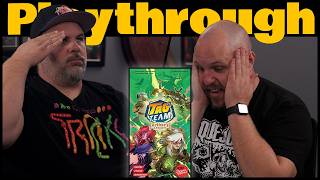


Tag Team: L'Héritage d'Arthur Deep Dive
What the Community Thinks About Tag Team: L'Héritage d'Arthur
Tag Team: L'Héritage d'Arthur is a standalone box from Le Scorpion Masqué that adds six new Arthurian fighters to the two-player tactical auto-battler deckbuilder. Its six fighters are Morgane, Merlin, the Dragon, Perceval, the Green Knight and Excalibur. Both The Brothers Murph and BoardGameCo describe it as fully compatible with the original Tag Team, so the new fighters can be mixed with base game characters. The Brothers Murph played a two-battle session that paired new fighters with base game fighters, and the reviewers treated cross-pairing as a central part of the fun.
Enthusiasm is the shared tone. BoardGameCo calls the original Tag Team a phenomenal auto-battler with easy entry and variable characters, and says the Arthurian box has the same appeal. The main reservation from that channel is scale. Six fighters makes the release feel like a smaller version of the system, although BoardGameCo notes it is still playable on its own and could serve as a good entry point. The Dice Tower keeps its take brief within a Gen Con preview, and states plainly that its hosts love Tag Team.
Core Mechanics That Define Tag Team: L'Héritage d'Arthur
Simultaneous Card Sequencing and the Build Step
The defining system is the card sequence. Each player starts with the starting card of each of their two fighters, and orders those cards before battle. As The Brothers Murph explained, this order is locked in: players cannot rearrange cards later, so the opening choice shapes the entire fight. Once battle begins, both players reveal the top card of their deck at the same time. An attack checks whether the opponent played a block, and damage equals the attacking fighter's power. Blocks trigger their own bonuses, and fighters can heal or take character-specific actions.
Between battles, the build step adds tension. Players draw three cards from a deck that combines both fighters' cards, secretly choose one, and insert it at any point in their existing sequence. Previously placed cards stay where they are. The two cards not chosen go to the bottom of the deck in an order the player selects, so they can return later. Because a new card can be slotted into the middle of an opponent's plan, reviewers describe the step as a way of disrupting what the other player has been building. Knocking out an opposing fighter wins the game instantly, which gives every placement decision real stakes. The Brothers Murph also noted that drawn cards are revealed to the opponent before placement, so players get a short preview of what is coming.
Character Engines and Partner Interactions
Each of the six fighters runs on a distinct engine, and reviewers spent much of their time explaining these individual puzzles. Merlin uses a skill-tree-like track of movable markers, where activating a marker triggers its effect and reaching the end of a branch grants a new marker. The Dragon gains scales that absorb incoming damage, and Perceval's attack grows with each personal card already played in the fight, which means its cards always include themselves and never start out worthless. The Green Knight works on risk and reward, with regeneration and an attack that rises as its health falls. Excalibur flips into the Broken Blade once it reaches the bottom of its track, gaining power while dealing direct damage to its partner.
The partner links are where the mechanic gets chaotic. Direct damage can reach a teammate, and several cards act on both fighters at once. The Brothers Murph's session showed how a single misplaced card could push a partner toward knockout, so the reviewers treated the pairing as a decision that goes beyond each individual fighter.
The Tag Team: L'Héritage d'Arthur Experience
Tense Clock-Watching Suspense
Reviewers repeatedly describe a feeling of dread as health totals drop. The Brothers Murph reached a point where their fighter was one hit from knockout and voiced worry at each reveal, calling several lines "scary" as the health track moved toward zero. This suspense comes from the sequence, because a player cannot always see the opponent's next reveal and must plan around it, counting toward a threshold the opponent may be pushing just as hard.
Playful, Chaotic Table Banter
The other prominent feeling is light, loud fun. The Brothers Murph played Excalibur on a random draw, laughing at how a rock-solid fighter wields an immortal sword, and joking about dragon fire and "spicy" moments as the battle escalated. The random pairings pushed the table into unexpected territory, which the hosts embraced. Even the losing side of a tense battle ended with the table celebrating a clever sequence. BoardGameCo's enthusiasm reads similarly, with its focus on the satisfaction of working out each character's puzzle.
What Makes Tag Team: L'Héritage d'Arthur Stand Out
Cross-Compatibility Across the Tag Team Line
Reviewers praise the fact that the Arthurian box does not stand alone in practice. Because it is compatible with the original Tag Team, players can pair Excalibur with a base game fighter or run two Arthurian fighters against each other. BoardGameCo says it plans to mix and match the box with its existing copy, and sees the design as an open system that could grow through future characters.
Variable Characters That Are Easy to Learn
BoardGameCo highlights how approachable each fighter is. The reviewer describes the game as easy to dive into, with each character presenting a small puzzle about how to build the deck and then letting the auto-battle play out. That approachability is paired with variety, since the six fighters play very differently from one another. The Brothers Murph's sessions with Merlin, Perceval and the Dragon showed that a new player can understand a fighter's core loop quickly, even when the interactions become complicated later.
Potential Drawbacks
A Heavy Memory Load on Sequencing
The most common concern is remembering what happened earlier in the fight. The Brothers Murph repeatedly stopped to recall when a particular effect had triggered, saying it is hard to remember exactly when something happened. The sequencing that makes the game engaging also makes it demanding to track, and reviewers suggested that players will need to keep a close eye on the board and on the order of their own cards.
Mandatory Effects That Can Hurt Your Own Side
Several character abilities carry downsides that cannot be declined. The Brothers Murph pointed out that card effects are mandatory and that many of them are bad for the player who resolves them. Excalibur's Broken Blade deals direct damage to its partner, and that risk profile rewards players who plan ahead, but it also means a misplaced card can hurt the player who placed it, which some reviewers found frustrating during play.
If You Enjoy Tag Team: L'Héritage d'Arthur
Players who enjoy the character-puzzle design of Tag Team will find related satisfaction in Dice Throne, which BoardGameCo raised directly as a point of comparison. The reviewer likes Dice Throne but admits its heroes can start to feel too similar after enough plays, and holds up Tag Team's small, frequently varied fighter boxes as the healthier alternative: a new character arrives in a slim expansion rather than another full-sized box, which keeps the roster feeling distinct instead of repetitive.
What Reviewers Are Saying
"Keep in mind all the things on your cards are mandatory because there's a lot of ones that are bad for you. You can't ever choose to not do so."
— The Brothers Murph
"This could be like a Dice Throne system, but like with the benefit of Tag Team is so easy to have a new character that's much less content. You don't need a giant big box each time you add new characters."
— Alex Radcliffe, BoardGameCo
"Tag Team the expansion Arthur's Legacy. I love Tag Team."
— The Dice Tower