Top Board Games from PLAYCON Australia! ❤️🍃☺️





Transcript
Have you ever been to a board game convention, especially one held here in Australia, the land down under? Well, today I'm going to do my Playcon 2026 roundup video that will share my experiences, my thoughts, and interactions that I had across this amazing board game convention held in Australia across the weekend. Hi, my name's Danny. I'm an avid modern board gamer from Australia. Love sharing my passion for this hobby with you, my friends, and my family. Come and join me for this journey. And don't forget to subscribe for more wholesome board game content.
Whenever you go to like a board game convention, you kind of ride off the end of the convention both tired but actually super excited. You're pumped full of energy, anticipating for this threeday game weekend to come around, and then all of a sudden, you're immersed in it, and then before you know it, it's gone. Everyone's flown home, and you're back at home sitting, "Oh my goodness, I've got so many board games." And I wish I could just go back and play. And there's some really interesting things about board game conventions, especially here in Australia. I haven't been to any American conventions or uh you know spiel or even Tokyo game market. So I can only really speak about my experiences here at PAX and Playcon. So from an Australian perspective and that is there is a huge sense of community.
Everyone comes together uh when you walk through the hallways you're like hey I remember you from last year. Hey I remember you showed me your game last year. Oh how are you doing? Oh my goodness you've got a baby now. That's me. So there's just this whole sense of community that follows these conventions around. And now there's been a few big changes with Playcon this time around. Uh over the last 2 years it was kind of like in a small little cozy RSL club. And this year they've upgraded it uh the venue to the IC Sydney which is a big convention center right right in the middle of Darling Harbor. And so they've got a lot more bigger hall space. So way more tables, way more shops and boos, uh an expanded game library, giant versions of different games. Uh Asthma Day were there, Good Games Publishing, Let's Play Games. So there was a whole range of not only indie publishers represented, Australian indie publishers represented in the convention, but also the distributors and the big publishers as well. And so there's lots of game demos.
Uh a lot of the hall is dedicated to just play space cuz it is playcon rather than shopcon I guess. Uh and the idea that you can bring games and a lot of people connecting on an app called aftergame which allows them to kind of find people to play games that they want to play. When you go to these conventions, you have these grand plans of trying to like play as many games as you want, but in reality, there's only a certain amount of time that you've got, and being able to play um some demos as well as balancing out with playing some indie games, as well as playing some games from your own collection can be actually quite tricky. We have designers from overseas. uh Coowly, you had all these really cool local uh games that were being showcased. There was Aqueduct, Sugar, uh Aisle of Feathers, uh there all these really cool games to explore. And I think one of these uh one of the things I like about, you know, conventions like Playcon is the fact that you can discover games that may not necessarily have appealed to you or you didn't really know about. And so I know my recent shift in interests in board gaming uh more recently has been into Japanese style games or games created by Japanese or Southeast Asian designers.
Uh cuz that's just something I'm passionate about and that's something I want to be able to support through my channel just through the sort of games I want to be able to present. But it was also really good just seeing Australian designers really trying to make their mark. And Aqueduct is a really cool game where you actually slot the cards together and you it's got kind of like a Roman theme but with like rubber duckies I guess and you're trying to build these tableau and these towers and then you're trying to hydrate your city by building these aqueducts. It's got this really cool 3D presence to the game as well as the little city that you're building has that really cool puzzly nature to and the abilities of the cards really synergize well, but also the table presence is kind of amazing. Imagine like a house of cards. I don't think I've ever seen any other board games actually do that. So yeah, and it's definitely it's not a dexterity game. So it's definitely like a city building game with a bit of table presence. The other thing I really got to enjoy was actually uh playing games like Santael.
I really wanted to It's I don't know. I'm drawn to like the nature themed game. Santael is a game about walking along the beach of I think Santael. I think it's a particular location. You're gathering shells and then they're falling Tetris style into your bag. Except the shape of all these shell pieces are romboids or parallelograms, triangles, and hexagons. And each of the different types of shells or sea creatures that you find score in different ways. You know, the shark teeth all score based on the number of shark teeth in the connected group. Uh the brown shells is basically how many you've got in your entire bag. The pink, sorry, the orange shells are ones where you connect them together, but as long as they're unique species, they'll get one point each. And throughout the game, it seemed very easy breezy. In fact, when I was playing um Santael, every time we replenish some of the shells out on the beach, we kept making the tide sounds and just to give it that sense that, oh, these are shells that are being washed up ashore. And so, yeah, it was just a really fun cruisy experience. And I really like the puzzly nature of that game. There were two people that were from a game group in Sydney, uh, and there were and I was also playing with a friend as well. And so it was a nice experience to get to know different people. And this is another thing about Playcon is you everyone is willing to accept and allow different people, strangers to join their game. And this is how you build these connections at these conventions
and these friendships. And it's just really nice to know that everyone is so welcoming and so um inviting. And Playcon, I guess, is a really good platform because it's not citybased. It's actually trying to be a bit more national and potentially internationally based where people are flying in from Western Australia, Adelaide, Queensland, Victoria to come to Sydney and to actually play board games across the weekend. Things change in a year. I've got a 8-month-old baby now. He's playing in the play bed over there. So, if you hear any noises in the background, that's that's my son. Uh yeah, he's playing with this like giant cube at the moment. But yeah, so places like Playcon are really good platform and I know that with this upgraded space, there were a lot of people in previous Playcon experiences who weren't able to attend the convention because of the space limitations of the previous venue. And this space was very different. In fact, I would say it's had a bit more of a PAX-like feel to it where it's like a big exhibition hall. You're in the middle of the city. You're in Darling Harbor. Uh they play concerts next door.
You know, there's just this whole different vibe to it. In fact, it felt very elevated the idea that, you know, you're walking into this expansive hall. There are tables everywhere. They've got the booths that they often have at conventions now. It just Yeah, it was just really good to see the tabletop presence here in Australia really expand. And I know in the coming years they're going to get bigger and bigger and there's a lot more room to grow and as more interest has gathered and that was the thing. I met a lot of people along the way who said this was their first convention. Oh, they didn't go last year or they did go. A friend went last year and now they wanted to come this year to actually um experience a 3-day convention. Yeah, that just makes my heart feel really warm because it's like, oh, this community of board gamers is really really expanding and it's actually gaining the interest of lots of other people who are around. I I know I was at a restaurant getting lunch and I was wearing the Playcon lanyard and someone was asking me about Playcon and what it was about and what sort of things and they all of a sudden were really interested and they were like, "Oh, next year I I really want to go to Playcon cuz they were talking about some of their gaming experiences and they didn't realize that it was on and now that you know that's one other person that you know I just walked past who saw the little Playcom badge and they're like, "Hey, can you tell me a little bit about Playcon and that's what really is cool about these sort of conventions, the connections and then also once
Playcon is ended, you build these friendships and then you kind of meet up and you know play tabletop games outside of the convention or at the board game barbecue days and it yeah it just has such great positive vibes about and that I just really really love. So this year at Playcon I actually did three teachers. Now, in the past couple of years when I've gone to Playcon, I've mainly gone to just kind of for the experience, immerse myself in the moment, see who's there, see what games are available, sit down, try a game. It was a little bit more impromptu, but this year there was well, the Playcon team did reach out to me uh to say, "Hey, Danny, do you have some board games that you would be passionate about teaching?" And I thought, "Yes, I do. In fact, I don't have one. I got two." And then later on I was like, you know what, I've got three. And so I just got super excited because I'm a teacher in my day job. And so I don't often get to teach many board games to just new people. And so this was a great chance to be able to do that. So I'm going to take you through the three games that I taught across the weekend of three different levels of difficulty. Starting with the most challenging one to probably the most simplest one. Rosalie was a game I taught on the Friday. Um there were three of us that played a game of Rosalie. It took about 3 hours to get through the game but also do the teach.
And it was actually my first playthrough. In fact, when I prepared for my teach of Rosalie, I actually created my own little player aids and summary cards so that the flow of the game would be really good. Now, Rosalie is all about tendering and building a rose garden and then deploying robots and your caretakers to go and look after those roses season after season. So, there's a lot of different moving elements to Rosley, but at its heart, it's an economic game. you start in massive debt and you're constantly getting debts throughout the game and at towards the end of the game you're trying to pay off all those debts and get a big return. Now to give you an idea of the final scores of this game, the winner of the game got 107 points. I got 30 points and the person who came third got 10 points. you. That expansiveness of victory points really goes, "Oh my goodness, this game was challenging." Like, not challenging as in like to play, but challenging to be like, "Oh, I really want to do this, this, and this." But in order to do that, I need to work out how I'm going to manage my debts and my finances in order to do this ongoing management system that happens in Rosalie. So basically, you have these clipboards that have about eight different actions on them. You choose an action, resolve it, pass the board on to the next person, and then you take a clipboard
from the other person who's also already previously chosen an action. And so there's an interesting worker placement dynamic where the player in front of you chooses maybe the build action. you're like, "Oh, I wanted to do the build action, but now it's filled up and you're forced to kind of work tactfully to choose a different action or pay a very expensive cost to do the action that your previous player who passed you your clipboard has given you in order to do the thing that you want. Also, if you want to do an action twice, it will cost a lot. And some of the actions are releasing robots from your automation track, uh, buying roses and placing them in your garden, or if they're not ready to be placed, they kind of go in this little sprout area. And you can also deploy buildings, so windmills give you electricity to power your robots and your green houses. You can build expansive gardens. You can build green houses that kind of protect your roses during the autumn and cooler uh, seasons of the year. Uh, you can also move on the flower fair track. There's a lot of things you can do or you can get more caretakers and the more caretakers you release, the more expensive it is to pay their wages. And then you move into this caretaker phase where basically all of your carers and your robots get allocated to roses that have different care values. And any rose that doesn't have enough care will wither, flip over, and die. And they're worth negative seven points at the end of the game. And so you're trying to manage not over only your funds but the actions and the expansion. And then after that whichever flowers survive they bloom. And each
flower has particular colors and they give you these tokens which used to fulfill contracts. And the contracts basically is a sliding fulfillment mechanism where you fulfill the contract once get a bonus fulfill it again get a bonus fill it again get victory points. And so you're filling the same contracts essentially multiple times throughout the game. Then you got this fair track where if you can breed some of your lower end flowers to make hybrid flowers, you get a lot of income on this track. And then there's this big grid, this flower marker where you're moving like an award marker and a charm marker. And the intersecting markers will give you victory points and so forth. What's really interesting about the game is that each character has their own ability. They have their own bonuses. One rewards you money for fulfilling contracts. One is based on charm. one is all about deploying buildings, but at the beginning of the game, you get all these cards and you pick four cards that go into the top four slots that give you kind of like an asymmetric combo power.
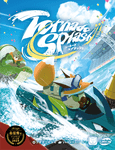
And so the gist of the game is build out and expand your gardens, pay off your debts, and hopefully get a lot of victory points at the end of the game. And that is Rosaly in a nutshell or a box shell because it I came away from the game not only incredibly satisfied with the thinkiness and the crunchiness, but also quite tired because I was like maybe I should have taught this in the morning. But yeah, fantastic experience. It definitely is very really deep and crunchy and there's a lot of mental calculations that are involved in this game. So be prepared for that. But a really really fun experience and the two people I played with absolutely so much fun to be able to chat with you guys. If you're watching I hope you enjoyed Rosley because it was a big experience. Second game I taught across the weekend is a racing game called Tornado Splash. And if you've ever played Wave Racer on Nintendo 64, you're basically these animal characters riding jet skis and you're racing around a race course from start to finish. So in the game, whoever's coming first draws up to four cards. Whoever's coming last draws up to six cards and then you're playing cards out and you're moving your wave races along uh a little bracketed track up to three spaces and then once per game you can use a boost to go a fourth space.
What's really interesting about this game is how close the game actually is. There was one player when I was teaching this who kind of went away from the start line and did this massive outward curve and at the beginning you're like, "Oh my goodness, you're totally coming last." But that allowed him to draw a hand of six cards each and every time. Whereas the other players kind of who smoothed their curved around kind of took the lead a lot and so they were restricted by how many cards they could get. cuz if you're first, you only drop to four. And so this player that was coming last ended up cutting across three or four other players uh towards the mid game because he just had so many cards and so many different options to try and get that re-entry around this curved track um a lot more easily. And so it's fascinating because as you play the game, you get to see where your races have traveled along the tabletop.
And so you're like, "Oh, I can see where you started. Oh, you made a little bit of a turn. Oh, you try to cut in front of me. There's that little commentary that happens. And I think this definitely plays best at five plays because of the commentary that happens between the players and how you kind of interact. It's actually such a really fun game to watch um people play. I do feel like some of the characters need their own unique abilities or there could be items that are out on the field that if you cross the item paths, you can collect those items kind of just like in Mario Kart. But yeah, such a fun experience and everyone, it was really tense because the person who was leading throughout most of the game didn't actually come first. Um, and second place kind of went over and it was just like, "Oh my goodness, who's going to win? It's so close. Who's got the right cards?" The last game I taught across the weekend was Aqua Garden. Basically, you are managing six tanks in your aquarium. You're trying to attract visitors uh through using event cards and displaying certain types of species.
Uh you are also trying to make sure that the oxygen level of your tanks is manageable for the species that are in it. As well as making sure that the carnivorous fish are not eating or like you know the sharks are not eating the smaller fish and the turtles are safe and the seahorses are happy and the seaweed oxygen level is the right amount. So, what this game is really similar to is if you've played games like parks, it works on this idea that if you're the last person in the um on the track, you get to take the next action. And so, what incentivizes you to go quickly around the track is options to pick up fish that best fit your tank. And what's interesting about Aqua Garden is the fact that you got two rondell's. You've got the main market rondelle or the fish market and then you've got your own little mini rondelle where you're moving your worker one to three spaces around your aquarium because wherever your worker ends up that those two tanks that are adjacent to that worker is where you're going to put those fish.
And so that makes for a very puzzling multi- rondelle laid experience uh to the game. And so it is a very cruisy game. It is all about just going, "Oh, I'll try and take this." But there's a racing element, too, because there are four big contracts where there are compositions of fish that you want in your tanks, and if you're first to get those, you'll get the victory points. And so, I just really like the not only how gorgeous it looks off the table, but the idea that you're trying to manage where these species are going to go. And then with your feature tanks, every time you circuit, you know, your playerboard once, you'll get extra money, which you can spend in order to buy more coral, more seaweed, particular species that are in the ocean. In our uh game, basically, every animal that was in the ocean was completely harvested. So, I'm I'm not sure what message that sends about like, you know, keeping animals in tanks and then releasing back in the ocean. We literally harvested everything from the ocean. The ocean board was completely empty. I think at the end of the game there were only two clown fish left. We had every other whale, shark, and fish in all our tanks. Yeah, really, really fun experience. And the group of people were super, super excited to play. And I really, really enjoyed getting to know the players at the table. And yeah, now on to the exciting part, and that's going through my Playcon board game haul. Now, my approach for buying board games this time was a little bit different. I didn't just want to buy every kind of game that I saw. I only really wanted to
get games that I know that I would table later, easy to teach, very portable, and also quite accessible. Because I'm a father now, the time um I guess for learning bigger games is a lot more narrower. Um and so now I'm more looking for quick games I can play with my hubby and my friends and my family. So I actually only got four games in this Playcon experience. And the first game is a card game centered around a theme that I'm actually really really passionate about and that's fish keeping. Um I hope they do create a big LERTA level, you know, aquacaping game one day because that would be a theme that I think definitely needs a little bit more love. But the game I got is actually called Sea Scroll. And Sea Scroll is really simple. You're basically got a reef. you're drawing two cards on your turn and playing um I guess a matching fish species card to one of the uh reefs that are already out there or starting a new school. And basically, you're creating these pools of identical species of cards and then deciding when to take that school into your possession because you'll only be able to take a school three times throughout the entire game. So you everyone's contributing to these different species and then you're deciding when to take them because at the end of the game, whoever has the most number of that particular fish species will score points and whoever has the least number, if you've collected some of that species, you will
lose points. And so it's deciding when to keep building up the school of fish and when to actually take that school of fish and secure as your endgame. And so the nifty thing is, and I think this is like the flavor of the month, is to create card games where you know the number 10 card, there's 10 copies of it. And I know Flip Seven's done this, and the number four card, the Regal Tank, has four copies of it only in the deck. This is kind of the structure of the way the composition of the fish deck is composed of. There's only four Regal Tang. So, if you know you can grab three of them, then you know that anyone else who grabs a regal tank later on is going to lose points or you've I guess secured that win. But because there's only four of them, the point scoring value is going to be a lot lower than if you try and compete for say the clown fish where there's like 12 of them in the deck. And so there's this kind of triangular scale of scarcity to commonality of different species of fish. And the more you add, you're like, am I gonna time it right in order to grab that group and place it in front of me? And because I can only get three schools of fish in the entire game, when is the best time to do it? It does remind me a little bit of herbaceious where you kind of contribute one to the public area and one to the private garden. Then you're kind of potting herbs as you go. I also wanted to mention that Sea Scroll has this whole deck of cards here that really adds variable rules to the game. So, it might be when taking for the reef, you must discard an additional card to the
reef. The next game I got is by a claimed Japanese designer, Sashi and Sashi, whose wife actually does the illustrations to his games, and they often have a very unique theme. They're usually a deck of cards, and there's often some simple set of rules, but some deep strategy. This one is all about making pairs and asking, "Shall we dance?" So, Shall we dance is got an interesting thematic connection that links to the way the cards are played in this game. So, there are a few caveats I have about this game, but I'll go through how we'll play and then talk about some of the caveats at the end. Basically, what you're going to be doing at the beginning of the game is setting up six piles of decks. Three of in a circle.
Three of them are going to have their cards face down and three of them going to have their cards face up. in in an alternating fashion, kind of like a little bit of a clock. And so what you're going to do is you're going to either play cards of a new color in front of you or cards of an ex one to three cards of an existing color to build up your color set in front of you. You can only play one gender. So, for example, if I play three gentlemen or in red or two women in yellow and play them in front of you, the idea here is that you are trying to pair them with a partner, a male and female partner. And so, because you can only play one gender and one color, it's going to be really hard to try and pair them up. And so what will happen is after you've played your certain color, you then look and see if you can create pairs and then you'll actually look around the table at the other players tableau and see if there are any free individuals that can pair up. And so if I've played three red gentlemen and my the next player has, you know, one free uh red woman card, then those two are going to pair up. And basically, you'll say to that player, "Shall we dance?" And she'll come over and my free gentleman card will pair up with my opponent's free red woman card.
And my opponent will get a point. And at the end of the game, I will get a point for my pair. Uh, each of the different suits of cards or colors of cards have numbers on them that represent how many copies of that card are in the deck. There are actually eight colors in the game, so there's lots of different combinations and opportunities to try and match people. And then after your turn is complete, after you've try and matched up all of your free individuals with other players, then you will be drawing cards back to your hand size by picking one of the decks from the central area, the foyer area, and then drawing cards in a clockwise direction and taking them into your hand. So some of the face up cards that you take, you'll know what they are or your opponents will know what they are. But the face down cards, your opponents won't know what could be in there. And so there's a little bit of open information, hidden information in the game. And so where the theme really shines in this game is the fact that you're pairing up people on a dance floor. You're I guess dancing around the voyer as you're like drawing cards at the end of your turn and asking players, "Shall we dance?" Now, my caveat for this game is uh the fact that you have to pair male and female individuals together. And there isn't really any other representation of other um people in this game. And I guess it more comes down to the setting. I guess it's kind of like a Victorian setting, kind of like a Bridgetton style setting where
it's like men and women are I guess defaulted to connecting together. I feel like there could be a little bit more representation of diversity in the actual characters in the game, but that's my main issue. Me and my hubby, we are same-sex couple, so it does, you know, irk me a little bit. The next game that I acquired at Playcon is a game that was designed in Vietnam. And as someone who is Vietnamese, who both my mom and my dad, they were born in Vietnam and, you know, they left during the Vietnam War in the ' 70s. Um, there's a strong connection. I've been back, I guess, to Vietnam and did a whole trip with my dad 30 years after he left the country to go back and see what had what has changed. Um, there's a strong cultural connection that I have with my dad and with the mother country, I guess. And so, whenever there are games that have a Vietnamese theme, I really feel passionate and strongly about showcasing those games, especially because they're not commonly shown in a lot of modern games. So, this is a game that's based on the Vietnamese zodiac chord stem and branch. And if you're aware of, you know, the Luna New Year and the different animals, there's 12 of them. But Stem and Branch works on a 60-year cycle calendar where each of the animals is paired with a different element. So, I think there's fire, wood, water, metal, and earth. And each of
those five elements have a yin and yang side to them. And then those elements are paired up with each of the 12 different animals of the zodiac. And over a 60ear cycle, each of those pairings will appear once. So a unique pair will appear. And so this game really taps into that combination using the animals, using the elemental ranks to then be able to create this huge little cool tugofwar game um that's set out in this in this box. And I'm going to really explain this a little bit more in detail, but it's actually quite easy to learn and play. Basically, what you'll do is there's a market area, which is like the stream of time. Um, as you're contributing to the tree of etern as you're contributing to the tree of eternity, you'll take new animal cards into your hand. And each of the animal cards comes in the five different elements. And so what you'll do is you'll place a animal card from your hand out onto the grid. Now, the grid has is open at the beginning of the game, and there's some little elemental tokens that you can collect if you place an animal there. But basically, once you place an animal in a spot, all the other animals of that type will have to go in that spot. So, if I place a monkey in the middle, all the monkeys will have to go there. And if I wanted to play a monkey, I have to play one of a higher rank. Now, when you play a card into the grid, you will need to pay the rank cost. And the rank cost is paid by discarding other cards from your hand using little elemental wooden tokens
that you pick up throughout the game or connecting that animal next to other elements of the same type. So if I play a fire monkey by placing that first fire monkey down on the main board, if I connect it to other fire elemental animals that are adjacent to it, connected by the branches, it will make it cheaper for me to play that fire monkey out. And so the idea here is is that it's almost like a 12-way tugof-war. You're placing these cards out and when you have dominance, you gain a wooden token that represents your control or your connection to that animal. And so at the end of the game, whoever has the most control, which accumulates throughout the game as victory points because when you gain control of an animal, you get points equal to the number of animals you've got in control plus the different types of elements that you've got, which uh is represented by a little score track, which coincidentally enough goes only up to 60 because that's one of the endgame triggers. You can either get to 60, trigger the end of the game, or the deck of cards runs out. And so the number 60 really plays into the theme and the design of Stem and Branch.
And this is one that I think is really unique. And I really want to highlight the fact that there are lots of games out there where you're playing cards, paying their costs, but the fact that as you're collecting more and more tokens, you're accelerating the amount of scoring points you're going to get. The idea that you can outrank um an existing animal and then kind of take control of that animal from the other player means there's a bit of an eb and flow with the way you're building your strategy. So whilst the game has quite simple straightforward rules, it actually has a lot of depth to the decisions that you're making throughout it. Now if you followed this channel for a long time and there's a reason why it's called Board Game Sanctuary, cuz it's a safe place to play games. This next game is by an Australian couple who I actually saw their game on Kickstarter a while back, but then for some reason I forgot about it, so sorry about that. But then after my first day at Playcon, I saw that they actually were selling their game at Playcon. I was like, "Oh my goodness, that is a game that I need to get." And so the next day I went straight to I think the Delta Phase game store booth and um one of the designers was actually I think Daniel was actually demoing his game there and I saw the presence I was like yes this looks like Danny's sort of game. Uh so the game I'm talking about is of feathers a love letter to strange birds. Yes, I don't think all the birds
in here are actually real birds, but you can kind of make up uh I guess what the species are doing, and they're inspired probably by real birds, but they're a conglomerate of different features uh meshed together. But basically, what you're doing here is you're building an island uh as a collective group. You've got uh an ocean mat and then you've got uh sand tiles, which begin in kind of like a plus formation be beginning of the game. And then throughout the game, you can add more sand tiles to the map. You can then go on to level two, which is adding grass, or level three, which is adding cliffs. You can then also add vegetation tokens uh on top of some of the tiles in order to create patterns in order to deploy bird cards or bird tokens onto the actual island. And so each player will have four bird cards except for the active player who I think has five bird cards. And you'll be trying to create those patterns. um of landscapes or habitat. So then you can put a token out in that spot and get points at the end of the game. Now it sounds like hm we've heard this sort of game before. You've create you create your little habitat, you put little pretty birds out, but there's something a bit different about this game.
Whenever you complete a bird or you deploy the bird out onto the island, there's little tokens that you can acquire. Also, if you're not pursuing a particular bird, you can actually discard uh one of your bird cards from your hand to take one of the bonus actions that are listed on there. So, there's a little bit of flexibility and the fact that you're all creating this like carcassesque 3D island means that you are changing and evolving the island, which kind of interrupts uh how other players decide to plan their turn. And so you've got to respond tactfully to what the player in front of you does. You need to think about how can you evolve the island, not let the player next to you know that's what you might be trying to v for.
But the bonus abilities allow you to destroy parts of the island. Um allow you to add vegetation, allow you to take another third action. Um, and the fact that the active player has five choices and that at the end of your turn, you're passing one of your cards to the next player means that that option becomes available to them. So, there's a lot of interesting nuance dynamics and yes, it is a pretty pretty game. I mean, who doesn't want to put little cool little wooden birdles out onto a beautiful wooden island structure? And then at the same time, the idea of playing these cards has this really great puzzly strategic effect. And I think I really like the idea that you're playing on the same island. A lot of games often now require you to create your own little separate area that doesn't really have anything to do with the other players. The fact that you are constructing the same island means you're trying to shape the island so that you're creating a habitat that is going to allow your species of bird to survive. And I think that is cool because it's like, oh, the weather conditions have changed. Someone's eroded that, you know, cliff away, but I needed that clifftop. Oh, we need to grow some trees here. You know, there's a whole new interactive element. I know some people might complain about the fact that ooh, you know, you've taken the spot that I wanted or you, you know, there's a little bit of take that where you've destroyed something that I needed.
I feel like it's part of this game's experience. The idea that, you know, it is it taps into that sense of survival and being able to make sure that your strategy and your habitat combination is going to be the one that rises to the top. So yeah, I'm super excited to try this. And uh the game designer really summed up the game for me so precisely. I was like as soon as he finished his breath, I was like, I'm buying a copy. So I just wanted to share some final thoughts about my Playcon experience. This is the third PlayCon that I've been to. I think I've been going since it began, and I've just really enjoyed seeing how the community has grown. um how lots of different game groups and PlayCon provides the avenue for lots of game groups to come together to the one location once a year to just enjoy games and also how inviting it is to new gamers. It was really really great to see the amount of um existing game designers, uh Australian designers, new and upcoming designers. I I think one thing I'd like to do in the future is get over to the designer alley and book into those games more. There was one really cool game that had like a 3D like volcano structure with 3D like pathways.
I need to find a picture of it and share it with you because it looked fascinating. Um it was also good uh seeing um other designers that I'd seen in previous years. I do want to say congratulations to Lee. uh he had a game called Packed Flat that he'd been demoing and kind of showcasing for so long and this year it was announced that All Play have picked up his game and it's now called No Assembly Required. Um it's just so good to be able to follow people's journeys in different ways. Whether you're a designer, you're a family gamer, you're a strategic heavy gamer, you're an 18xx gamer like or if you just like any sort of game. It was just great to meet gamers, the families.
There was a few stories about, you know, looking after babies because like I've just become a father in the last, you know, 7 to 8 months. It's just been such a joyous experience. And this and this kind of convention would not be possible without people like the board game barbecue team uh for being able to create these safe spaces, for being able to create um such a fun and energetic vibe, uh such a welcoming vibe. And so, you know, thank you to the team for being able to put on these conventions each and every year because, you know, it's with the world in the way that it is at the moment with all the negative things that are happening, we need some good positive fun in our lives and you know, if it is just getting out a copy of Katan, you know, Lego katan or a giant version of harmonies, then so be it. you know, tabletop games are great way to uh rekindle that social connection, but also have a great time as well. Now, if you are someone that went to Playcon or you're interested in going to PlayCon, please leave uh your thoughts and comments in the comment section below. Um I'd love to hear them.
Love to start a conversation. Love to share a story with you. Um, otherwise I hope you found uh this Playcon 2026 roundup um a fruitful experience and I hope that your next board game convention will be as exciting and as fun and as enriching and enlightening as the one that I've had. This is Danny Sun. Now, don't forget if you really want to support the channel, please consider liking subscribing to my channel or buying me a coffee a month over at my Patreon page. This is Danny Sun. I hope your next board game experience is an amazing one. See you soon.