I Played 5 Campaign Board Games at the Same Time So You Don't Have To!
Games in This Video
5 games are featured in this video — they unlock as you watch.


Transcript
Yep. That's me. You're probably wondering how I ended up in this situation, surrounded by some of the best campaign board games, swarmed by dice, drowning in an endless wave of cardboard status tokens. Well, at first, I just wanted to play one really awesome dungeon crawler. But the deeper I got into the game, the more I started thinking, "Why shouldn't I play more campaign board games all the same time?" And so, I added another one, and another, and another, and one more. Five great campaign games in total, all played within the last few months. Oh. Oh, lord. Yeah.
Oh, the box is so big. Oh, okay. This was easily the greatest idea I've ever had in my entire life. We have the new hotness that is sure to bring down a hellstorm of angry comments when I'm done. Lands of Everlasting. Lands of Everlasting is a hybrid RPG board game experience that lets players enjoy grand, richly narrated open-world adventures without a dungeon master, complete with dungeon dives, skill checks, and loads of components. Combat here is relatively light and simple, and it's certainly not pushing any boundaries. And I I understand it's not trying to. The game wants you to focus on the story, and keeping the fighting straightforward feels like a deliberate choice to maintain that focus. I'm not a fan of lightness, but I do appreciate the action bar. Your combat cards are sit there doing basic stuff, and as you level up, you slide in new ones. It's a clever little system that doubles as character customization, and it makes combat fairly intuitive. You perform the action printed on the card, you flip it over, boom, you're done. I just wish there was a bit more room to maneuver on these mats. The battlefields are incredibly small, which I think cuts down on the kind of positional tactics I need to actually feel engaged in a fight. Because when I'm looking at all these standees and all these miniatures, I'm just asking myself, what are they here for? If I'm not doing anything like trying to check line of sight and doing really interesting things with terrain, it all just kind of feels I don't know, it just feels empty. But that lightness gets more disappointing once you factor in setup. It's It's strange to assemble this many components
for what essentially feels like a storybook game. There's There's nothing wrong with a storybook game on its own, but I found myself wondering what the point of all this stuff was when I wasn't going to use it in interesting way. I'd often walk straight at a boss and just like kill it in like a turn or two. And that wasn't like that wasn't just in the intro. That was That was a lot of combats went that way. And it just made the setup feel a little wasted and then the narrative a little anticlimactic. And I don't feel it got that much better when I moved on to to Ashes of Heavens. And that feeling of component redundancy sort of carries into the exploration. I'm I'm setting up this little board with a time wheel thingy and then moving around these little plastic miniatures to figure out where I'm going to go and what I might run into. But in practice, it's just me reading story bits based on where I placed a piece. Why do I need any of these components if nothing interesting is happening mechanically? The puzzle is so light, it just starts to feel rather pointless.
Yeah, there are roaming enemy miniatures, which provides something at least to engage with, but they're not always on this map and I often left wondering like why I bothered setting anything up in the first place. There are moments when this part gets used creatively and I won't spoil anything, especially in the second, more advanced missions. I just found the moments Okay, I'll spoil one thing. Okay, there is one where you're saving people from I think it was a fire. That was enjoyable. That was interesting, but those moments that happen on this campaign map that you move around and you set up and put all the time into they're pretty rare. And the skill checks you make between combat and story reading are a little bland and they get really repetitive fast. There are very few choices to make here to make you feel clever as to who in your party should make the check is usually pretty obvious. The system works, it's just shallow and that's a feeling running through every mechanical piece of this game. But I suppose you're not really here for dice chucking and really in-depth mechanics.
The very word Ever shade is a lie, meant to comfort simple people. One day, the broken sun will eat through the body of the goddess. One day, the light will come and wipe us all away.
Now of course this is a narrative first game. Essentially the antithesis of Elder Scrolls. Heavy on story and pretty light on gameplay. You're going to be doing a ton of reading here. Thankfully, like D&D, there's still real effort poured into the lore and background of nearly everything you encounter, which makes the world feel genuinely alive instead of just decorative you sort of interact with between combat. I love the character creation this, but it was sort of a a mixed bag. I spent so much time building my characters that at the end I was sort of wondering why I even bothered. In a lot of cases, they just sort of feel like stat sheets. Aside from brief mentions here and there about something about my character, like you know, the race or whatever, it might as well been an a bland NPC. Even the decisions I make seem a little uninspired because every bit of story felt like I was being railroaded towards a specific goal. In a game heavy on mechanics, that's totally fine. But this is a game trying to emphasize role playing, story, and immersion and I'm dozens of hours in.
I do think the writing here feels like a big improvement over Waking Realms last big narrative game, Dragons of Eclipse. The writing's better, the characters are a bit more interesting, and the pacing is well done. I especially love that when you get into the later campaigns, your achievements start being used within the story. This is a game that knows exactly what it wants to be, even if the story it's telling is a little cliche at times. It's all still enjoyable to go through as a solo gamer. This is going to be an adventure a lot of people are going to enjoy, and I can see that without having experienced much of that myself. Next, we have one of my favorite campaign board games, Elder Scrolls. The Elder Scrolls: Betrayal of the Second Era is a three-session cooperative campaign set in Tamriel during the Three Banners War, where you build and level up your adventurer across episodic self-contained quests just to have fun doing it all over again. Nothing is better than Elder Scrolls' character creation. It's probably the best I've seen in almost any dungeon crawler, and it's all because of this character dashboard.
It's sort of like this tug-of-war. You've only got a few spots to work with, and pushing a skill higher makes it pricier while taking away a space for a skill sitting opposite it. It's fairly simple and intuitive, and yet it makes the entire creation and leveling process its own little interesting puzzle that I just really enjoy. And there is so much variety in races and classes, and many things are so creative that you want to keep coming back and starting from scratch to make a new one and try a different sort of combination. But, combat here is almost as good as character creation. In fact, aside from Gloomhaven, this is probably some of the best combat I've had in a campaign-style board game. It's a mixture of tactics and luck. You plan the perfect roll, you use a weapon or skill to recover a die, uh take a fatigue die to take swings again, use other dice to lock down huge monsters, all while your cooldown track keeps filling up, which I think is a huge improvement over Too Many Bones.
And when your plan inevitably falls apart, your class and skill gives you enough ways to mitigate the problem and recover. The entire experience in combat is fast, and it's interesting, and it it's pretty damn tense at times. Obviously, with dice, you're going to get a feeling of randomness, especially with the variability. But, there is just so many ways to mitigate results and sort of optimize your character that you don't you don't really mind. There are so many synergies and combos available to you in this game that you're excited and sort of motivated to keep playing and feel challenged to rise above whatever fate delivers you when you toss those dice. It is an incredibly rewarding experience.
This caravan provides a brief respite, but it can't fully shield you from the land's strange effects. A merchant approaches you with a creepy story on his lips and a recommendation to buy his survival gear at a generous discount.
I've said this a lot in previous videos. Elder Scrolls respects my time. Everything is episodic, so I can walk away for a month and come back and I still get that classic 3X structure every single session, which helped when playing all these games all at once. It's more like a collection of side quests in a video game. At the start of the campaign, you pick which area of Tamriel to explore. You never visit every location on the map during a single run, so you're incentivized to come back for another campaign and experience different locations you haven't seen yet. The game at its core though is a combat game. You're not spending much time in town and most of your session is either gearing up for a fight or fighting. But, if you came for great combat with some pretty good writing sprinkled in, you're going to have a blast. I think where the narrative actually shows up is in the world building helped along by the existing lore from the video games. Each region feels distinct and enemies can be unique to an area and a lot of locations sort of have their own flavor that mixes up how you play. Skyrim is under siege, so every town encounter feels a little unsafe. Weather slows you down in Black Marsh. Unrest shapes encounters in High Rock. Forest Blight adds cards and dread to Valenwood. That's Elder Scrolls' version of storytelling. It's less a choose-your-own-adventure text and more like more like a world that changes depending on where your current location is. It's a really cool experience and one that I was very happy to get back to between all the other games.
As his eyes poured over the wall of text disguised as a board game. He drifted into a deep sponsored slumber wearing his silk mask for Mantis Sleep. Once upon a time on a bright sparkling day, Mr. Sun spotted little Mikey wearing his perfect fit sleep mask.
What is this fool doing? Sleeping [clears throat] while I'm out here doing my radiant business. It's mad disrespectful.
Mr. Sun shined brighter, but couldn't get past the 100% blackout protection of the Mantis Sleep mask.
I won't be defeated so easily. Even if those eye cups are fully adjustable for maximum comfort. Damn boys.
And so Mr. Sun sent his minions to attack the Mantis Sleep mask. But it was no use. They couldn't penetrate the durable and naturally breathable silk fiber shield.
I give up. That Mantis Sleep mask is way too powerful. Visit the Mantis Sleep store to get yours today.
Next we have the hiking hippie simulator, Earthborne Rangers. Earthborne Rangers is a customizable cooperative deck builder set in a far future wilderness valley where you shape your ranger's identity through cards before setting out to explore a branching sandbox style campaign. Now most of this game is storytelling and deck building and building your ranger to formulate some semblance of an individual identity. You pick your aspect card that sets your main strengths and weaknesses like maybe you're fit, but you're completely oblivious to everything around you. Then you throw in some personality cards like compassionate or inventive to give yourself a bit more depth. I think the whole character creation process comes together really nicely and I enjoy the interaction with the draft. Although I played it solo so I was just I was just sort of interacting with myself.
If you're very good at immersing yourself, you'll find that you start feeling less like a block of stats and and more like a person. And I think the game does a really great job of facilitating that because I think it's also just really important if you're going to invest so much time in this thing. For the gameplay, you're essentially just playing cards or triggering something already on the table. And most of the time it's it's a test and then making the tough choice as to how much energy or fitness or whatever you're willing to burn now, knowing that you might actually need it sometime in the future. It's It's essentially resource management, but it is enjoyable and it elevates the game beyond a simple like choose your own adventure flip card thingy. Exploration is is probably why you're here in the first place. You are constantly flipping through that path deck excited for whatever encounter you find next. And it's cool because it's not like It's not like a generic monster deck waiting to attack you. A lot of what you draw can actually just be left alone entirely.
And threats don't even come at you automatically. They trigger off symbols on challenge cards. So, sometimes a predator lunges at that annoying kid who has been following you all game and asking you questions instead of yourself, and that's just using children as meat shields. I mean, what more do you need from a role-playing game? And it's moments like that where the game does a great job of reminding you that the world doesn't revolve around you, which makes the environment feel a lot more alive and immersive.
You hear the voices of your ancestors. You can feel them with you. You can feel their support and their love. You hear them speak, and they remind you of your best qualities, who the person you truly are.
Sadly, there isn't much of conventional narrative in this game. It sort of just feels like a collection of event cards. But, there is a huge element of exploration, and that exploration makes the entire valley feel more alive and interesting. The exploration is the story, and if you're not sold on that feeling, you're not going to enjoy this game. As you flip cards, you can chase the obvious story path or or wander off and pick flowers if you like. The freedom it's it's there, and it's it's charming and it's enjoyable. More importantly, it's better than Vantage. I've always believed that the best game stories are the ones that emerge organically from what you do within the game, like Robinson Crusoe, where the story comes from your choices rather than paragraphs somebody wrote in advance. Earthborne Rangers tries to sort of have have both ways, and it doesn't always succeed. The emergent story is there in the mechanics, and it's it's pretty damn cool, but layered on top of that is a lot of pre-written flavor text. You sort of like stop playing, find the section, read the flowery segment, then repeat for a good number of cards. It can feel like it's sort of grinding the session to a halt. That said, I was pretty damn impressed with how cards can interact with one another within the story. It was pretty clever. For as open as this game feels, however, the main story is actually pretty linear. It branches in a few places, but every branch feels like it's moving towards a similar outcome.
The real freedom comes from choosing not to pursue the main story at all, and just sort of chilling in the valley. And there's a lot of unpredictability that sort of shows up in the missions, which are often at the mercy of whatever the path that deals you, with rewards that can be incredibly or completely useless depending on your ranger, which I suppose emphasizes what I liked about the game in the first place. You're not necessarily that important to the story, and the world sort of exists without you.
Next, we have the manga and anime-inspired narrative of Madara: Unintentional Malum. Madara: Unintentional Malum is a dungeon crawler where you build deeply customizable heroes and fight through a 500 page narrative campaign, chucking lots and lots and lots of dice. Madara is an anime-inspired dungeon crawler with a character creation system that's pretty damn close to Elder Scrolls level quality. Multiple disciplines, each with several levels of unique abilities, and every single one feels genuinely distinct rather than a sort of zombie-like reskin. The weapons aren't just like add plus one whatever. They kind of change how you approach a fight, which just makes character customization feel tactical and and really damn fun. Madara is seriously drowning players in options. For some, it's going to be very overwhelming, maybe even a little off-putting, but for me, that's exactly what I want out of a dungeon crawler, especially when character creation is my favorite part of every single role-playing game. I can't be alone in playing every single PC RPG and never actually like finishing them because I just keep resetting to do character creation all over again. I have seriously finished maybe like two RPGs in my life. And combat here offers a pretty interesting puzzle from time to time. You have room to maneuver on most maps instead of being sort of crammed down halls. Here you have action points to manage, you know, bonuses for flanking. It rewards thinking about your movement, not just your dice rolls.
But there is plenty of dice here. This is a dice chucker at heart, I think, with a fair amount of mitigation. It reminds a lot of playing Descent for for good and for bad. Thankfully, here you're not just, you know, walking up to whatever is near you and whacking it like a lot of crawlers. You're sort of weighing the risk of dangerous positioning in battle, doing your best to maximize damage while being keenly aware that a teammate might set you on fire. And by teammate, I mean myself when I get so bloodlusted by the chance to do a giant area spell that I stop giving a about strategy and the well-being of my characters. But that just might be a me issue. But like Descent, I wish combat Madara had a bit more depth and creativity. Given how long this campaign runs, fights start to feel a little repetitive at times. And the very rules-heavy design certainly doesn't help. There's a mountain of keywords tied to weapons and and abilities. I'm fairly deep in the campaign and I'm still sort of flipping back to the rulebook somewhat consistently, which can sometimes get in the way of the story that I'm like trying to experience at the table.
They didn't have to go far before the path widened, running along the edge of a dark pond. Remy reached out with one boot. Water splashed. Ripples echoed across the dark surface. They weren't alone.
This game is certainly not hiding its anime inspiration. You are fresh out of water protagonists figuring out the world, each other, and themselves, delivered with all the sloppy melodrama that implies. It reads a lot like a young adult novel in tone. But if you're in the right mood, the narrative is a lot of fun. And the illustrations here are almost as important as the prose. It's an aesthetic that fully embraces its pulpy influences. And I imagine it's upset plenty of prudish content creators along the way. But, it's fantasy, and I love it for its unabashed revelry and and muscle men and badass violence and and vicious monsters and scantily clad women. It's the kind of anime you'd sneak away from your father to go look at at a Blockbuster. Then, trick your parents into renting for the weekend because it's it's just a cartoon, Mom and Dad. It's just a cartoon. Thank you, tasteful Ninja Scroll's VHS cover.
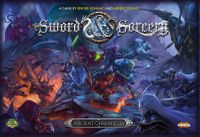
Thank you. But, the story isn't without issues. Madara can be a sort of cacophony of words crammed onto the page detailing literally everything. Which sometimes makes it feel less like storytelling and more like describing a a very detailed crime scene to a police officer. I still love the writing, though, because it's clearly chasing the feeling of reading a good manga. It's melodramatic, but once once you understand the influence it's drawing from, that melodrama sort of becomes charming in its own way. And it helps that there is deep, lovingly crafted lore here, too. Original in a way that's refreshing when you're surrounded by, you know, Western elves and orcs from other games. And next to my mad campaign to ruin my sanity by remembering five different systems all at once, Sword & Sorcery. Sword & Sorcery: Ancient Chronicles sees players controlling heroes awakened from the dead and made immortal by the will of the gods. On a mission to destroy corrupted deities scattered across the starless stone ceiling realm of the Under Reign.
Sword & Sorcery is a cumbersome and heavy, heavy game, for good and for bad. There is always something to keep track of. Your soul gem tracks health and how many power and talent cards you can hold, and how many combat and action activities you can get per turn. Thematically, leveling up is you regaining the abilities you had before you died. And if you die, you get to come back as a super cool ghost. It is a lot, but it is also just a lot of fun. There's good tension in how the powers work, too, since every ability needs to recharge after use, turning face down for a set amount of time depending on the strength of the power. And like everything else, there are a ton of abilities. A lot here is overwhelming, at least at first, but it does come together eventually, and you do start really enjoying the abundance of the experience that it provides. The system is a little older, and maybe that's why combat feels genuinely nostalgic here.
You're spending dice symbols to trigger abilities, stacking modifiers, staying aware of positioning, and handing out icons and statuses that sometimes can get a little tedious. But, it all stays focused on the present, which gives every battle a real sense of immediacy. And the AI running the enemies, it's it's pretty damn good. It's varied and dynamic, rather than predictable. But, there are a ton of modifiers, and tracking recharge timing on top of everything else can sort of slow around to a crawl when you're facing a lot of monsters. And that's before you even factor in the pauses for story breaks. Listen, nobody on the planet would call this game elegant. It is a complete mess at times. But, it's a charming mess to play in, and it really stood out among the four other campaign games. This was the hardest game to get back into while I was rotating between all five. Not because it's bad, but because it's genuinely heavy, and it's just buried in rules.
But, once things clicked, I was sort of I was invested, and I was excited to play every single time. Sword & Sorcery was a lot of fun to play solo.
A bolt of mystical light awakens the ancient heroes from the sweet oblivion of their eternal sleep. All that once was has come to be again. As they open their eyes, the heroes contemplate ethereal worlds, blurred and wrapped in a translucent white mist. A few moments later, the eternal silence for the infinite is broken by a choir. Three voices sing together in their minds.
The best part about the story in this game is that unlike a lot of other dungeon crawlers where the story acts as a sort of bookend where you read your intro, do your dungeon crawl thing, then read your ending, Sword & Sorcery maintains a narrative throughout the actual dungeon crawl. Bits of story trigger at waypoints and story events via the Book of Secrets, which makes the world feel a bit more alive and independent of me. Like it exists even if I stop playing. And that really helps with immersion. Those scripted segments are a bit of a two-edged sword though. On one side, it feels organic and immersive, but on the other, it brings the game to a halt and forces you to read, which can be jarring if you're still in combat mode mentally. The issue I have with the narrative though is that the branching and choices feel mostly illusionary. Your Law of Chaos alignment technically forks which version of the story book you read, but in practice, exploring tends to just trigger story beats you were just going to hit regardless of what you chose to do, which means I can't see myself going through all of this over again. Some of the writing also has a tendency to lean hard on fantasy pop culture references that felt more immersion-breaking than than charming, an issue I have with millennial writing in general. But that's a that's a whole different topic.
The other thing that sort of bothered me was the game's namesake. It is named after a very specific literary genre created by Howard's Conan, my favorite book series of all time. Sword & Sorcery is supposed to be low magic, you know, morally gray mercenaries and personal stakes like treasure, revenge, or just surviving. In this game, we're resurrected heroes made immortal by the will of the gods on a mission to hunt down and destroy corrupted deities. The sweep of the narrative isn't quite the same, and the characters are far more high fantasy than sort of gritty and violent Sword & Sorcery. This feels more like a Forgotten Realms campaign than Conan. Although, I acknowledge that this is an issue that likely only bothers me as a fan. Regardless, I I still enjoyed the game and the story so far. And these were the five campaign board games that I have been playing over the last few months. There has been tons and tons of manual reading and story book reading and moving around miniatures. Uh but it was all worth it cuz this this was a lot of fun even if I didn't thoroughly enjoy each of the games. That is all for today. Be sure to like, comment, and subscribe. And if you haven't, join the Patreon and and fund this.
Whatever this is, you can pay for it. You can You can give me money so I can just waste more hundreds of hours playing campaign board games. All right. I'll see you guys later. Peace.
[sighs and gasps]
Now I got to clean all this up. Yeah. Great. I'll hire like a Molly Maid service or something.