Seven Short Reviews - with Tom Vasel
Games in This Video
7 games are featured in this video — they unlock as you watch.





Transcript
Hey everybody, I'm Tom Bassel and today we're going to be taking a look at seven different games here of different shapes and sizes and mixes about sand art and a garden and trick-or-treating and trying to work hard in your job but at the same time as poorly as possible. We'll take a look at these seven games and I'll tell you what I think. Let's get started. Bomb five. Kind of an odd name here uh in a sense. I mean, it tells you exactly what the game is. Put some tiles down that equal five and then a bomb. Let me show you. Each player is going to get seven cups of their color. Each of these shows a symbol on the other side. And there is your trophy cup that you'll have. You'll put a bomb in the middle of the table from a stack of bomb tiles and then these numbers around it that are going to go from 1 to four. players will have a hand of tiles and on your turn you will play a tile down. Now when you play a tile down it's going to connect to other tiles and rows and columns and you can never make more than a number five. In this case I did make the number five. So when that happens I'm going to put a cup of mine at one end of it which is important because I'm trying to get these on the board and then a bomb at the other end. Although that bomb will immediately flip over and do whatever it says on the back here. Now what this does is it flips all the cups in this direction. There are no cups in those directions, so I'm fine. So, if you put out a number, let's say I put a two here, and that makes a row three, nothing will happen. And you're not allowed to go above five. Let's say someone placed a one here. The the they would then put one of their cups at the end here, like this, uh, the cup, and
then they would flip the bomb, and this bomb says, "Flip any cup in play." Well, they'll flip the red one. Now, if I was the red player and had done that, and this was face down, I could flip it face back up. And that's what's going to happen. If something happens to finish this row here, for example, let's say another two is placed here. I'll put my cup at the end of it. And then this gets flipped face down. Doesn't do anything. So, it won't go off again unless someone else, let's say someone puts a three here, would make it to flip face up. And there's all different bombs that will take out everything in different directions, picking the tile on a board and so on. What you are trying to do is you are trying to get a certain number of your cups in the middle. If you have five of these with the cup face up, then you win the game. So this game is sort of a not scrabble, right? But almost has a scrabble feel where you're trying to make groups of five and you look at the board and say, "Can I make a group of five right now?" Because honestly, if you don't make a group of five on your turn, it feels like a wasted turn.
That's that's the one small negative I have. The other stuff is just kind of silly fun. If there's nothing on either side, you add a bomb on one side, you add your cup on the other. If there's a bomb on the one side, you add your cup on the other. Uh and so on. And you you then flip the bombs back and forth and they're exploding and flipping your cups back and forth. It's basically just a lot of different flipping. And there's a little bit of memory because if you flip a bomb over later on, you're like, I get to unflip one. which one. You know, my mom might say, "Flip another bomb." You're like, "Oh, I flipped that one. Oh, that made one of my cups go back face down." Or using a bomb to flip your cup face up. So, there's some silly interesting ideas here. It's very portable. It's just shy of something that I want to play often. I'm giving this a 6.5 because there's some interesting ideas, but I don't know that I would want to play it all the time.
But, I will say it's a nice pocket game, and you can play this several times quickly in a row if you want to. It's pretty easy to teach, but it also doesn't feel like there's a lot of strategy, per se, in the game, but I can see some people liking it. That's Bomb Five. The O. This is a game about making loaves of bread and also being a slacker. Uh, in this, you are in a bakery working hard. Well, no, I'm sorry. You are, as the joke is, hardly working. Um, but you need to work just hard enough you don't want to get fired either. In this game, each player is going to get a set of 11 cards or 12 cards that go from zero to 11. This shows how much effort you're going to be putting into cooking. And everyone's reputation starts at zero. You have a good chef or a happy chef and an angry chef here. A good boss and a bad boss.
And you'll have a deck of order cards. You'll flip one of these cards over and this shows some rewards and stuff, but you're looking at the cards on the top of this deck and the number of players. Let's say we're playing a four player game. We need a total of 24. So everybody is going to all the players are going to simultaneously play a card in the middle of the table. We turn them over, add them up. So eight, 19, that's it. We did not make 24 because two people put in zeros. So these cards are discarded and the boss is angry. So that goes over here. Now, if the boss is in a good mood or a bad mood is going to change things. If the boss is in a good mood, then everybody the the basically the players who played the highest card, whoever played highest card, let's say they were in a good mood, then this would be they would go up in reputation equal to their card minus the average between everybody. And in the case of a negative boss, which is going to happen now, anyone who played the lowest card, so these two people who played zeros are going to lose reputation equal to theirs and the average. So in a four player game, it's 19 divided by four is four.
So, they're going to lose four reputation points, both of those players. So, they would move down on this reputation chart. Also, this might cause the card that's tucked under here might cause something to happen immediately or end of game. In this case, at the end of the game, anybody who has a negative reputation is going to lose three points. And then you go to the next card and continue doing this. This one, for example, has a media effect. Whoever has the highest reputation is either going to gain or lose depending on how annoying how annoyed the bosses are. When one of these bosses has five cards underneath it, the game ends. If there are five cards underneath the bad boss and they're angry, anybody with negative reputation is immediately fired and can't win. And if it's a good boss, nobody's fired. But either way, you will take the value of all the cards that are left in your hand, add them up, plus any bonuses you have here. It's hard to read, but it's 2, three, four, five for having a positive reputation, plus any other bonuses that might be in effect from these cards. And whoever has the most points is the winner. This is an amusing game. I like the theme of it.
You have these high numbered cards. You You don't want to get fired, so you need to play these cards every once in a while, but all it takes is one slacker, and then the whole mission fails. And in fact, you'll see kind of a wave back and forth as people start off, maybe they slack and everyone slacks and you all lose reputation. You're like, we we better work hard. So, you work hard, you do a better job, and you're like, but I don't want to give up my best cards cuz those are worth points at the end of the game. You can win though by being the only person not to be fired. But see, once someone knows that, they're like, I'm just going to use my cards. I won't get fired. Then someone else goes, well, I will also do that, but I'll work a little less hard than you, and then I'll win. and the person next person's like, "Well, I work a little less hard than that." And so the theme here is actually pretty strong. The only disadvantage of this game, I think, in a sense, is that you have to look up those symbols sometimes to see what they mean. And those tokens don't fit very well in that scoring track. Uh, but other than that, I'm amused by this game. It is kind of chaotic and it's kind of wild and it's one of those games I think probably works best at full count. Goes two to six. as a two-player game. Eh, there's some back and forth thought, but you want more of that chaos. It's almost a party style game that I think is a little bit, you know, interesting the theme, but fun to play to. A seven out of 10. That's LA uninvited guests at a wedding. So, this is a game from India where you're invited to a big giant Indian wedding. And uh from talking to the designer of this game, they were telling me how people show up at these weddings because you're a poor college
student and there's a buffet and you it's a big wedding. So maybe get lost in the crowd, but the aunties are going to get you. They're going to yell at you and kick you out. And so in this game, you are an uninvited guest at a wedding, but you're also in a bunch of selfies and different pictures of people, and you want to kind of get rid of the evidence. Let me show you. Each player is given a secret identity card. That is who you are sneaking into the wedding. It's possible with some players that some of the cards that no one gets are turned face up so everyone knows who is not one of the suspects. On your turn, you have you must do one of the two things. You are going to either remove some evidence. So, I might take this picture and put it face up in front of me. And at the end of my turn, I'll put a a new card up there. And this card stays in front of me. At the end of the game, this card will be worth the number of points it shows in the corner if I'm on the card. So, if my secret identity matches the card, so let's see. Let's say I have the let's say Maya's my secret identity. She's on this card. I will get two points at the end of the game. If I take one that I'm not on, then I'm going to get negative one point for that at the end of the game. But the fact is you might take those cards anyway because another thing you do is accuse someone. You go through the suspect cards, give it to them secretly and says, "Are you Samar?" And if they are, they're out of the game. You get their card. You'll take the card that they are. So let's say they are Samar.
you'll take this card from them and keep it face down in front of you and they're out. If you're wrong when you accuse somebody, then you're out of the game. So, you have to be careful when you accuse somebody. Now, if everyone's eliminated but one person, it ends the game and that person wins. But otherwise, after five rounds of this, you start turning over tip off cards. It says, "Reveal one of the secret identity cards that were not enough." The tip off card might not be anything, but if you get through all six tip off cards, then simply of the remaining people who haven't been accused and kicked out of the wedding, you just count up your points and whoever has the most points is the winner. This is a very, very simple deduction game. I mean, basically, it is I take a card and I go, am I in that card? Why would I take a negative point? But maybe I'm trying to throw someone else because if I take two cards and there's only one person between those two cards, you will automatically assume that's me. But I might have way laid you. And that's the game. That's really the whole game. It usually the games I've seen played, everyone's eliminated after a while except for one person. But it can last the whole time. And because of that and people knowing that, you're going to take the points the the points uh the higher point cards have fewer people on them. So it narrows it down. But again, I might have taken it just to mess you over. You also know who you are. So, I might be trying to mislead you by using a picture with you in it. But then if I know that, you know, you know, there's some things going on. But it's very simple. It's an easy one. It's a fun theme. Uh, this is a cool little game from Mosaic. I give it a seven out of 10. Also, where's the buffet? Tricky
Treats is a Halloween themed game from Cranio Creations in which you are dressing up your kids that you have. You have a bunch of kids in front of you. You're dressing up for Halloween and going out trick-or-treating. That's a fun theme. A lot of games do it, but usually little card games. This is a bigger board game, and this one's definitely geared towards kids. Let's see how it plays. In this game, each player is going to have a pile of trick-or-treaters here. Five of them to be exact. And you're going to be collecting candy of a secret goal. Like my goal, for example, is I get four points at the end of the game for every combo of these that candies that I get. But you can get more than that. On your turn, you are either going to take a costume card or you're going to visit a house. Now, the costume cards are really shiny in this video, but they're basically just clear cards that when you take them, you'll put it on one of your characters. And each of these children can have up to three things. They don't have to match or anything. Although, if they do match at the end of the game, like if this person gets all three of the dino outfits, you can get more points. In fact, at the end of the game, you can see the points here. If they're all the same color, four points. All different colors, different themes, two points. All the same theme, six points.
And all the same theme and color, which he has, that'd be worth eight points. So, that's one way to get points. Another way is on your turn, you can go out and visit a house. To visit a house, you need to meet the requirements of the house. So, this one needs shirts, for example, and you need at least three shirts. So, I can't do that because I only have two of them at this moment in time. But if I had a third one, let's say she was wearing one, then I could visit that house. When you visit a house, you put a footprint on it because you can only go to it once. Three shirts gives me one on the green candy track. I would move this up one. And if I'm the first person there, I also get this bonus two points. And I can never go there again. If I'm the first person to go to all three houses in a row or column, I'll get the bonus there. Flip it over. Anyone who does it in the future will just get a smaller bonus. I can also go to these trick houses here and visit them. But to do that, I need to have three of that trick on my cards.
So, right now, you see I have two eggs face up. I would need to get a third one where we're throwing eggs at a house. And then I can go to that one. And at the end of the game, that's another bonus tile for me. So, at the end of the game, you're going to score points for the candy that you've gotten. You're going to score points for the costumes that you're wearing, the bonus tokens that you've taken, your scoring token, and the other scoring tokens. And whereas most points is the winner. Component-wise, I there is an issue in this one here. I mean, most of the components are fantastic. Those little tokens and the tracks are great. Everything looks really good, but the plastic cards stick together like all get out. Good night. I had to go through and peel them apart one by one. Then I shuffled it, shuffled it, shuffled it, shuffled it, shuffled it, bent the card, shuffled it some more, and then it worked okay. Then the next time we pulled it out, the cards were sticking together again. I was like, "Gh, that's kind of a pain." Other than that though, I think it works really well. It teaches kids a lot of good principles because you're initially going to go, "Hey, I want to just get the right outfits on these kids. I have I need purple to go to that house there. So, I want as much purple outfits of my kids to go there.
But you know what? If I go there first, I get two points. That's a big deal. I might go there before I my kids are completely in their outfits. Also, how do I score these outfits? Oh, I want you want the matching outfit, but that may never come out over the course of the game. So, it might be better for me to just take an outfit that's all the same color and get points. And then also, do I want to get these tricks out here on the top so that I can go to one of those scoring houses to score more points at the end? This stuff is pretty heady stuff for a kids game, but because of the theme, it's pretty easy to get into. And so kids are going to understand these aspects of get being the first out gets you more points. Uh making a row is is more points. Dressing up your kids' points. It's almost like a little point salad game for kids and they get points from different ways. But that theme carries the mental cognitive load of what they need to figure out to play.
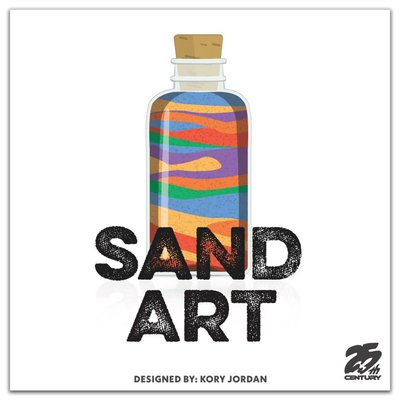
And adults aren't going to be bored playing it either. It also doesn't overstay. It's welcome. The box says 45 minutes, but it could easily be 30 minutes too. So it's a nice game other than those sticking cards and that is an issue. So, you got to keep that in mind. But I like it. Other than that, a 7 out of 10. Tricky treats. Sand art is a gorgeous thing. I really like sand art. I like looking at it. I've never made one, but I find that process fascinating. And I was excited to see this. Uh it's it's a drawing game. I was about to say roll and write and flip and write. It's neither of those. It's a move and write. Let me show you. Each player is going to get a sheet. And there is a ton of sheets, although only single-sided for some reason. You also have a set of pencils. I do want to talk briefly about these pencils. You'll notice, for example, that this yellow pencil is much shorter than this one. It comes with a sharpener, but you can use another sharpener. It doesn't matter. The reason why this one's much shorter than the other is, well, these have been used the same number of games, but these pencils are really terrible. They break really easily. Um, they they're just some of the worst pencils I've ever used in a game. So, if I was going to keep this game, I would probably buy another set of pencils. All right. The game itself works up here on this line of cards that you're going to put out, and it will change the number of players and so on.
And you have a hand that is yours and has a thumb pointing a different direction. On your turn, you can move as far as you want and pick an action. And then you'll flip your hand to the other side. And you must always go in a direction up the thumb. So, if I move all the way here, I can go if I go here, and you can see how that works. You're always going to be able to move all the way down to the end of a row. But if you only move, for example, if I'm here and I take the action here, well, this has to be my next action that I take. You also when you go, you can go to the top or the bottom of a card, but only one person can be on each spot. And except for these end spots for as many people can be. Some actions just give you basically helpings of sand. This will give me three red and three blue or five red. And when you take those, let's take I take the three red and the three blue.
I'm just going to mark these off with one line each way like that. When you use sand, you'll cross it off the other way. For example, if I went to this spot, that's I could spend as much red and blue as I want. So I spend three of each and then I go to the bottom of my sheet. And now I have three purple, but that is a completely separate action. The main action that you'll be doing often will be these funnel actions. This is any color sand that you want or maybe a very specific type of sand. And you're going to use your sand and fill it in the bottom. So let's say I'm using purple. I decide to use all three of my purples. And you'll notice at each of these spots here. Well, that's not a good pencil. No, that one's broken.
Anyway, uh you'll color in this has a single dot. So that takes up one of my purple sections of sand. I can fill in this one too at the same time because there's no dots in it. And then let's say I fill up this one here. So there we go. I've used all three. And I would obviously color much nicer as I did this. But sand also comes from the top to the bottom. So you have to kind of fill evenly as you're going up. The other actions you have, you can go to the three-point layer or the five-point layer card, which will give you one of the face up cards that's near the board. And I can take these at the end of the game. And I can put them next to the board on any side on either side. And if the colors match up, so if this was yellow, blue, and green, I'm going to get five points. I can do it multiple times. And I can use the same card for both sides if those colors match up.
There's also going to be some objectives here on the board that if you form these exact shapes with those exact colors at the end of the game, you get points. The first person to fill their entire jar is going to get points. And then there's going to be points for having the most of each of the different colors at the end of the game. There's also a shake action which lets you refresh the point layer cards, but also you can shake sand from the top and add it into other sections. kind of just like spreading out the sand. And then once you fill past a line here, you'll get extra bonuses. Take an extra scoop of sand. Uh when you go to a card, when you're on a card, rather than move off the card, I can just go to the other side of the card if it's free and just flip my thumb and go take an extra action and things like that. So, these all are going to give you extra bonuses. I like the extra scoops. I like being able to choose either side of the card as you move up.
When someone fills up the bottle completely, that is going to end the game and you'll add up the points and whoever has the most is the winner.
Ah, poor components. The pencils really do bring this down a bit for me. I would like it more with better pencils. It It's really a problem because the thing about this game is it's about coloring. I love the concept in the middle, the thumb with the hand going back and forth. That's a really clever mechanism. It does get muddied as you get more special abilities. It's like I can move and then move again and I can go to the top or bottom or I can stay on the same card and you're like okay you have those special abilities and there are a few rules in the game that are a bit wonky. The shaking the glass to settle the sand is just such an unclear rule. It I just that rule I I I I just I maybe that rule is a thematic rule that you actually do that with these bottles, right? But they could have dropped that rule from this game and I don't think it would have changed it at all. And then the fact is you get so caught up in doing the sand that the scoring on the sides. You have to keep an eye out for that. You take this card. I need blue, yellow, blue.
Okay. So, I'm just making the sides that it doesn't really matter what's in the middle except for those things at the top. And those are very exacting things. So, that is combined with the idea of, hey, I like to go back and forth and I like to pick up the sand and I like to pour it in the jars and and the board looks cool and there's a there's such a mix of this is cool, this is not. I was really pumped about this when I first heard about it. I'm a little disappointed. I don't dislike the game. I'm giving it a six out of 10, but it feels like it could have been more. The shaking is unnecessary. The scoring, I think, could have been stronger and how it works and even how it's explained, putting those cards in the side. I feel like there could have been other things, but the main mechanisms of moving that hand back and forth and taking the actions, that's really good. So, it's kind of a mixed bag here for me. That's Sandart. Check it out. Gazelle is a city near Moscow and this game is based on that because they're known for making these paintings of these white vessels with these little blue flowers all over them. They're pretty cool and beautiful and that's what this game is about. It's kind of an abstract game about rearranging your board. Each player gets their own set of tiles here. They're all blue and they have uh five different blue flowers on them. The orchid, the poppy, the rose, the bell flower, and the tulip. The way you tell who's is whose is because you each have a blue stamp on the back of your tiles uh that matches your score token, which incidentally are all blue.
And um so you have two boards you'll have randomly. One is diamond shape and one is circle shape. And all the boards have that on both sides. You kind of have the two random boards with different patterns in the background. Leaf lace, floral, and grid. One of these, the one that's shown on this random card, you'll leave open. you'll put the rest out and you have one face down as a stamp. On a turn, you'll have these cards out like this and a player will pick an animal. So, let's say for example, I pick hedgehog. So, I will take there's a hedgehog here. I'll take off all the tiles next to the hedgehog. And here are the tiles next hedgehog. Everyone does the same thing. They take these tiles off. They then are going to put these tiles back on the board. And they can kind of put them anywhere they want.
Now you are trying to match the scoring on these cards. This one has to do with your diamond board. So for and and this one has to do with your circle board. And this one here, you want to have the same flower on as many of these spots. I can even put the stamp here on the board if I want to. So this one for example, I'm going to look pick one flower. So I pick the the bell flowers. I have one, two, three of them on this lattice background. So I get two points. this one here as if I have this shape anywhere in this in my circle area, I'll get two points. Why didn't it even come close to that? I don't think. No, I don't. Yeah. Then, by the way, you might wonder what are these flowers? You can't see them. That just means two of the same flower. So, I still don't think I pulled that off anywhere. And then on this card here is going to give me points. And this one only goes for this one. And again, there's a a thing in the book that explains all these cards, and that's pretty important because honestly, I forget, but you pick one type of flower that's around these figures and get one point for each type.
Then a different flower. So, I might say, for example, it's on this board here, the hedgehog, I'll pick this flower, and I get one point. And then next to the fox, I'll pick the bell flowers, which gives me two points. So, everyone's going to score those points and then you'll start another round. Now, there are these stamp tokens. You can always put a stamp token on a board to do a couple things. One, you can pick a different animal than the one that the person whose turn it is. Everyone's pulling their t tiles off the board, but whoever goes first will pick which one. You can pick a different one. You can also move a token or you can switch two tokens by spending a stamp. The problem with stamps is when they're on the board, if someone picks swan, I'll take these three off. This one doesn't come off. It simply flips over and it will come out a future turn, but it's kind of stuck there for a couple extra turns. If I don't want to put out all my tiles, maybe I just put one here and I could put two more stamps so I have usage of those. You do this for eight rounds and whoever has the most points is the winner of the game. This game has a flaw for me in it and that flaw was so big it actually causes me to dislike the game.
I'm giving this game a five out of 10 and I would like the game otherwise. And that fact is this game is just an assault on the eyes. It's hard to see so much blue. Now, to be fair, I know an argument could be made and said, "Hey, this is what colorblind people deal with all the time." And I get that and I sympathize, but why would we deliberately make a game like that? The five flowers all blend together on the board. The backgrounds all blend together. The symbology they use in the cards is just awful. They'll use a picture of another flower to just symbolize two flowers. And that's confusing because you look at that card and go, "Where is that flower? Wait, that the flower doesn't even exist." And then when you flip the cards over for the stamp, those aren't so easy to see. The whole thing is just a sea of stuff.
The the base concept, you pull some tiles off the board and then you put them back on trying to score points for the three different things, which by the way, you need to be concentrating saying, "This one matches this board. This one matches this board." Again, I know that this is a theme thing. I know. I mean, it would be weird if these were all different colors, I suppose, because it wouldn't work on the bowls and things, but something needed to change for me to make this one something that I want to play. The concept of the cards flipping each round, the card flips over, so it changes, you know, the scoring for the different things that that that's kind of interesting. And I like to pick an animal and you pull them off and I'm like, "No, I'll pick a different animal and pull these off." And then you sit there in this very analysis paralysis because this game has zero interaction between people. This you play it solo. It's the same as playing with other people other than they're going to pick a different animal than you might want. And you sit there and put everything on and then you score score and then move your scoring piece which looks like everyone else's scoring piece but mine's a circle. Yours is an oval. Wow. This is definitely a case where the components ruin the game. So, I want to like it more than I I mean, it's it's not it wouldn't be amazing anyway, but it would be a pretty good solid game, I think, but because of how it looks and it's so hard to play, I just cannot recommend it. Garden Lake is a new tile laying game from Uve Rosenberg. This is his 20,000th tile lane game. That's not true. But he has done a lot uh from very complex games of Feast Froden to much simpler games uh like the the his the spring autumn
summer series New York Zoo. He's known for this. So this is another one with the koiish pond as the background. That doesn't mean it's bad. Let's take a look. Each player gets a board and in the middle of that board you can put one of these gardens or you can just use the one that's preprinted here. You'll put 16 of these random pieces around your board in this kind of shape. And on your turn, you may take the piece that's on either end or the piece from the players next to you, the one that's closest to you, which by the way is a little confusing sometimes. Like this you, this one's closer to the person my left and this one's closer to the person my right, I think. Maybe I should have it like that. I don't know. But you figure out pretty soon which end you can draw from. Once you take these pieces, you can put on the board anywhere you want.
Once you put it somewhere, uh you can flip it to either side, you're done and it can ever move again. And this is going to be tricky because these pieces are all sorts of funky shapes. But there's a couple things. If you form a line all the way, I'm not going to do it right now, but if you form a a horizontal or vertical line, then the tile that it is touching, so this one here, let's say I filled that one, I would get this tile. I can use it right away or save it. You can only ever save one tile at a time. Every tile is double-sided. It shows fish on one side and uh little lily pads on the other. Also, if you cover up these shapes here completely, then you will get a tile that matches that shape or this one. And again, you can put these wherever you want, adding them to your board. This is going to continue. You'll be taking these tiles.
There's some rules. If your tiles run out, you can draw more from the bag. And also if you're using one of these boards here, there will be pieces on these that if you completely surround the different pieces on these boards, then you can take that matching piece. There are these special pieces here that will go on there and just fit on the board. So if I surround this completely, then this just comes out and fills in those spaces. Anyhow, the game ends. And when you're going to get a point for every complete row and column and then for every group of lily pads and or fish that is seven or more, you're going to get two points. Whoever has the most points is the winner. Wow, those tiles are an assault for me. I have difficulty with those tiles. In fact, when we first got it, the first game of this I played, I was playing with my my family and I said to my son, I said, "You know what?
These tiles are hard. I completely understand. Do not expect to fill your whole board in." And indeed, I did not fill my whole board in. He did, though. So, that's me being a big dummy because as you put these pieces in, if you cover up that stuff, you get the other little tiles and put them in. And and that's that's cool. The groups of seven is a trickier rule. I don't love that rule because you're already trying to put these things in this board and then I'm like, I'm going to put together a group of goldfish. Okay, that has seven now. So, I don't want to add any more to that, but I'm also combining that with these pieces. And then that whole U shape that you put or a C or whatever the letter is. And you can take one from either person. So, I'm looking at that. It makes it hard to work ahead because a tile that I might take, you might take.
So, I can't really plan on what tiles are out there until my turn, which slows the game down a bit. Now, I say all this, the game works fine. It is another tile laying game for Muay Rosenberg. Does it stand out amongst his other ones? No, not not not for me anyway. It's intriguing. These are weird shaped tiles. The idea of covering things up to get the little tiles that are so easy to fit in your board and fill things in, that's great. And I'm sure other people will enjoy this more than me. But I thought this was just okay. It's a 6 out of 10 for me. Again, it's not a bad experience, but it's also not one that I'm going to go back and go, "Oo, that sounds fun. Let's play it again." So, this is one though I think that mileage may vary. I think other people may like this more than myself. Although I would argue strongly that whether you like this or not, in a few years no one's going to remember this one unfortunately because there's so many out there. And in my opinion, the dial games he's done that are very good um like Cottage Garden and so on. Those have kind of faded with time as go by and I think those are excellent games. So if I I don't think it's excellent then why why would I get this over one of the other ones? I think in my opinion, New York Zoo is probably the pinnacle of the style. Why would I not get that one? But maybe you like koi ponds and maybe the idea of these tiles being crazy tiles really appeals to you. Then you'll want to check out Garden Lake. All right, folks. Well, there you go. Seven reviews, some component issues this time on these games, and some really funny themes, too. My favorite theme here is a like a tie between loaf and uninvited guests at a wedding. Um, but hey, these
are my opinions on the games. You might think differently. If so, let us know in the comments. Thanks so much for watching. I'm Tom Bassel and this is Seven Short Reviews on the Dice Tower. I want to quick say thank you before we close to some of our game found backers. Want to say thank you to Lauren D from Adelaide, South Australia, to Seth Allison, to greetings from Bavaria, from Suzanne and Jensen, and to Aaron France. Thank you so much for supporting the Dice Hour and thank you all for watching.
Hey everybody, thanks for watching another video from the Dice Tower. Hey, you want to learn more about us, communicate with us, we have a Facebook group, we have a Discord channel, lots of different ways to get involved with the Dice Tower and you can find that in our link tree link below. So, just click that. It will take you and you can communicate with us on Facebook, join our Facebook groups. There's lots of cool things that you can find and become part of the Dice Tower. Thanks so much for watching. I'm Tom Bassel.