Reimagined Retro Board Game Classics - Stratego
Games in This Video
5 games are featured in this video — they unlock as you watch.




Transcript
Miniature Market has thousands of board games at discounted prices. Click the direct link below to see all those discounted games. Hello my friends, it's the Game Boy Geek here. Today we're continuing the series that I've created called Re-Imagined Retro Board Game Classics. This is where we're taking a look at old classic board games, looking at the mechanisms of those games, and then seeing how those have been inspired and re-imagined into newer, more modern board games, sometimes even doing bigger, grandio things with those mechanisms. We've already done a video on Connect 4 and we've done one on Bingo. Today we're going to be taking a look at Strateggo. So, here we go. Now, Strateggo is a classic game that I played a ton as as a kid. I still own my old version. Now, the objective of the game is to either find and capture the opponent's flag or to capture all movable enemy pieces so that the opponent cannot make any further moves. Now, the game is sort of a slightly modified copy of an early 20th century French game called uh which essentially means the attack and it's been in production in Europe since World War II and the United States since 1961. Now strateggo is from the French or Greek uh word strategos which is basically a leader for you know an ancient army or first general. Now the name strateg was first registered in 1942 in Netherlands. Then the United States trademark was filed in 1958 and
registered in 1960. Now, it's been licensed to manufacturers such as Milton Bradley, Hasbro, and others, and retailers such as Barnes & Noble, Target stores, and many other places have been selling these. Now, generally speaking, you're taking your piece that only you can see, and you're moving it. Usually, just one space, and you're trying to attack the other player. However, you do have a scout that can move more than that, but it gives them a way as to, hey, that's the scout. Now, you have a bomb, which explodes other the other players, but it can't move, and neither can your flag. So, generally speaking, you're trying to set up uh in strategic ways and move things and bluff with who you have and attack the right places at the right times trying to capture that flag. Now, the first one I want to talk about here is a game called confusion, espionage, and deception in the Cold War. Now, this I think is the most like Strateggo, but even with that being said, it's kind of like Strateggo in reverse. This because in Strateggo, you see your own pieces, you don't see other ones. In this one, you don't see your pieces. You only see the opponent's pieces. Now, this originally came out in 1992, but back in 2011, somewhat recently, Stronghold Games brought out a revers a version of this. So, in this when you're looking at your opponents, you're trying to essentially one's one plays USA, one plays Russia, and you're trying to move one of your pieces onto the briefcase, and you're trying to carry that briefcase, sometimes even passing it to your other player, your your other, you know, people on your team. and you're trying to basically get to the other side with that briefcase to win. So, but you must deduce your
pieces. So, when you try to move a piece, you can move it, you know, a certain amount of spaces in a certain directions and the other player can see what that piece can do. You can't. And they'll tell you either sure that move is legal or it's not. Now, as you're getting this information, you're looking at this dry erase board and you're deducing which piece might it be, which piece do I know it isn't. You try to move it diagonal and it can't move and they say, "Nope, that's not legal." You know, it's not diagonal. you know that can't be any piece that moves diagonal and such like that. So while the game you're trying to deduce things. Now the another thing is if you get one of your pieces to the other side it unlocks to a better version like being able to move two spaces in any direction. Uh and so there's different ways of sort of getting your piece your pieces uh you know upgraded. There's also a double agent which basically means you don't know what that piece does, neither does the other player, but they know what you're double agent. They can lie about whether it can move or not. and they kind of want to lie because if you take that piece, the double agent with the briefcase and get it to the thing, they think they won, but instead they've lost because you've tricked them and you've gotten their double agent to get you uh the briefcase. It is very strategike, but in reverse with lots of deduction.
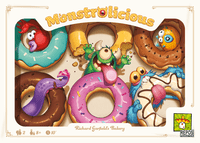
Uh this is a fantastic game. I hope somebody reprints this one. This next one is a small game. It's designed by Richard Garfield, who is one of the most prolific legendary game designers ever. He brought us Magic the Gathering, King of Tokyo, uh, a million games. And this game, I think it was 98 it first came out as Pecking Order was a bird. And they just recently brought it back as Monstrolicious. In fact, I just interviewed Richard Garfield about this reprint and all the things that went into it. If you want to see that interview, you can click that eye up there. Uh, but in this game, in in that interview, he actually mentioned, hey, Strateggo is what pretty much inspired the mechanisms of this game. And that's almost what sparked this whole series because in this game, you're trying to basically have your monsters on your side next to the dessert at the end of the game. Whatever number it's next to at the end, that's how many points you get. If it's one, it's one point. If it's eight, it's eight points. And so, you're basically placing a tile face down. And this is where we said it was the strateg. It could be a big number, it could be a small number, you could be totally bluffing. For instance, you might put a very small number next to a big one just to bluff it because when the other player places a tile there, you have to flip yours up. Uh, and so at that point, you're essentially showing them what it is. Sometimes you're using the smaller numbers to see what's there, knowing what's there, and then you can go in with your face down and say, "I beat this." And you don't even have to flip it over. And so there's a lot of strateges uh mechanisms here where
there's a lot of bluffing. There's a lot of hidden hidden things. There's a lot of flipping things over, revealing things at different times trying to do it. But essentially is a bit of strateging is always just right in front of each other. It's like, hey, I'm going for number eight and I'm going to attack your number eight. Let's see what's there. Uh and so it's very much strateggo. And it's interesting that that Richard Garfield actually said that Strateggo directly uh you know inspired this mechanism of this hidden putting things down and then attacking them and not knowing what's there before you get there. And so very much strategic. That's pecking order and monstericious. Now this next one is uh was the my dice game of the year last year. It is called Kelp Shark versus Octopus. Now in this game you're playing one side or the other, the shark or the octopus. It's an asymmetric game where one of you is essentially playing like a deck building card game while the other one's playing sort of a bag building game. Now the octopus basically has strateggo like blocks. They're set up on the board so only they can see them. One of those blocks is the octopus. Many of the other ones are sort of like food that they're trying to eat and they're going to be basically sneaking around the board moving these blocks uh trying to get close to food to be able to eat them because if they eat for food they win the game and as they eat food they actually get some special abilities as well. Uh, and so they're basically playing cards and managing their hidden and revealed blocks. Uh, and they're channeling the creatures remarkables abilities to camouflage and be deceptive. Now, the shark essentially is patrolling the territory, patrolling the water, and attempting to hunt down the that elusive octopus by rolling dice and
using special abilities to mitigate their luck. Now, they're trying to showcase that creature's natural instincts and predatory behavior. Now, with that deck building and bag building, you know, one of them is trying to hide and seek and and bluffing, and the other one is is manipulating. And so, the shark is winning by successfully attacking the octopus. And by that, they need to figure out where it is, but they can't see the blocks. Different abilities are going to allow them to reveal blocks. As the octopus eats food, they're going to be able to see where that octopus is. But different abilities allow them to hide that octopus, move it around, shuffle it around so you can't see where it is. So, and the octopus is going to be winning by eating four food or by waiting till the shark runs out of energy. So, it is very uh strategike with those blocks because those blocks contain the octopus itself, four different food, some traps. So, if the if the shark goes and tries to attack and thinks they're attacking the the octopus, they could be attacking a a trap that ends up hurting them. Um, and things like that. So, there's all sorts of different things. Everything's randomized at the beginning. Uh, some some of those blocks can actually be upgraded to better versions. uh sometimes you're revealing, hiding them, shuffling back around. So, there's a lot of strateg strateges mechanisms here.
Now, the last one we're going to mention here is Lord of the Rings Confrontation. Now, this uh the most recent version of this came out in 2005. Essentially, this is Lord of the Rings. It's co-designed by Ror Kitia and Eric Lang um are two of the three co-designers and they are, you know, well known. Kenichi is one of the most prolific designers ever. Eric Lang is one of the most modern uh well-known designers in our time and essentially this is a Lord of the Rings strateges game where you have the stands where the characters are facing you one side you know you're playing one of the side the good side of the bad side uh and you're basically moving your pieces that only you could see into areas and when attacked you're basically looking at the special abilities of both sides. You're looking at their numbers and then you have the ability to play cards and those cards might change the attack strength.
They might add to it. They might do different things. They might bring move other things. They might change things. They might alter things. So it's like a strategic game with a tactical card playing aspect with it as well. And and you know the fellowship is basically trying to get Frodo into Mordor. If they do, they win where the Sauron's trying to get three characters into the Shire. Uh and also not only are the characters asymmetrical as to like the numbers and such, but the decks of the card play is also asymmetrical. So they all do different things. And so this essentially is like Strateggo with a theme and an IP of Lord of the Rings, but also with some asymmetry, which is different from Strateggo because Strateggo everything's exactly the same. Here you have different sides trying with different goals and with different cards and abilities and such. So it's almost like Strateggo on steroids. And that is my last example of all these. So that's Lord of the Rings Confrontation. Well, I hope you enjoyed this walk down memory lane and seeing how Strateggo's mechanisms have inspired newer modern board games. If you want to see the rest of the playlist of all of the different uh retro games, classic games I'm talking about, you can click the eye up there in the corner. That's going to be brought you bring you right to the playlist of all the videos of this series. It's been the Game Boy Geek breaking down barriers, growing relationship board games, helping you the next one. You love Game Toppers upgrades every game you play. and they just launched their 4.5 Kickstarter, which will introduce the new Galactic Microoft and Watson game toppers with interchangeable rail inlays, as well as new game mats, miniature gaming terrain packs, leg kit options, dining covers, accessories, and amazing package deals.
Search for Game Toppers on Kickstarter or go to gametopperslc.com.