Reimagined Retro Board Game Classics - Shut the Box
Games in This Video
6 games are featured in this video — they unlock as you watch.


Transcript
Miniature Market has thousands of board games at discounted prices. Click the direct link below to see all those discounted games. Hello my friends, the Game Boy Geek here. Today we are diving back into my re-imagined retro classic board games series where we've talked about old classic board games and then talked about new modern games that still use these mechanisms have turned them into something different. Most recently, we talked about Clue, but we've talked about Monopoly and Bingo and many of these other older games. Today, we're talking about Shut the Box, which is one of my favorite games as a kid, and there's still a lot of games using this the main mechanism of this game in different ways. So, first I'm going to give you a little history on Shut the Box and what it's like, and then we'll talk about some games after that.
Now, shut the box has been around for a long time. There's a lot of sort of variances to how old people think it is. Board Game Geek has it from the year 1750. Uh some unconfirmed histories of the game suggest, you know, a different variety of origins, including, you know, 12th century Normandy, France is where it came from, or as well as mid 20th century Channel Islands. Also, Canada Dry distributed these games of Shut the Box to many pubs as a publicity novelty uh you know some years prior to 1976. Now, Shut the Box is is the basis of you know an American television quiz show as well. So, it was used as the basis of a show called High Rollers which ran from 1974 to 1976 and then 1978 to 1980. I actually remember some of those shows. Uh, and those that was on NBC with Alex Tbeck as the host, the one that's most notably known for the Jeopardy uh, host. U, that show then resurfaced from 1987 to 1988, I think.
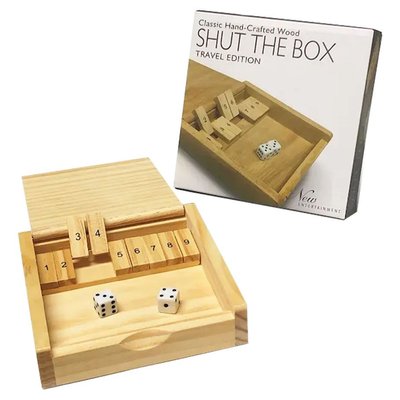
Uh, that's about when I was watching it. Um, and then this time hosted by Wink Martindale, and that's definitely the one that I remembered. Uh, now the game virtually disappeared from English pubs until 2018 when it resurfaced in Liverpool where DJ Duel Coffee and Turntables helped make this the most played pub game in the trendy Baltic Triangle area that year. Uh, and there are many variants of the game. There's many different rules of the game. Much like mass market games like Partezy and other things, they have histories way back into like early centuries of games and they've just been changed and changed and changed. that they've gone on and been marketed. So, you could buy different versions of shut the box and see all sorts of different rules. Uh, but let's talk a little bit about the main rules is you have basically two dice. You're trying to shut the box and get all these numbers, these levers pressed down and you roll two dice and you choose one number which is, you know, which is the uh the combined value of both dice or you choose two's num two numbers whose total adds up to that combined total of each dice. So, you have some some flexibility there. Uh, but you're trying to basically get it so that all the levels shut. If you shut all the levers, you you win. You shut the box and you win. If you don't, you get a score and you just keep going back and forth for rounds until, you know, smallest score wins. And I absolutely loved this as a kid. I actually had a travel version that my mom and I would play on planes and on road trips where like the dice were in like this little contraption where like you just like roll your hand over it and the dice would sort of roll but they would they
would they would spill on the floor. It was really interesting. Uh, I loved it as a kid. So, let's talk about some newer games that use this mechanism of Shut the Box. The one that's most like Shut the Box has just been reprinted. It's a relatively new game that is very new in this reprint called One Too Many Rabbits. This one is uh published by Happy Camper Games. Now, in this you're getting cards 1 through 12. Think of like Shut the Box. You had numbers 1 through 12. Now, you have cards. You also get like a wild card and a plus minus card. We'll talk about those in a minute. Now, just like shut the box, you're trying to get rid of all your cards. First one to do so wins. You're also playing like, you know, a little bit of a game almost simultaneously here where u you're trying to decide to roll one, two, or three dice. So unlike shut the box where you just roll two dice and you get two choices. Here you get to you get three choices right off the bat. How many dice do you want to roll? The probabilities of numbers obviously change depending on that. And then you can use any combination of the dice. So, like if you rolled three dice and you rolled a 1, three, five, it could be used as the one, the three, and the five. And you could remove those three cards from in front of you if they're there. Or you could or you could go one and eight, adding the three and the five for the eight. Or you could go four, adding the one and three and then just using that five. Or six, uh, adding the one and five and then just using the three. Or nine, adding the one, three, and five. So that you have utmost flexibility, as much flexibility as you want. and however many dice you want.
That those permutations add a ton more strategy and a ton more agency over shut the box with with almost feeling exactly like shut the box, but it just gives you more agency. Now, there's wilds that can act as any number. Uh they can even act as a number even greater than 12. You also have a plus minus card that allows you to combine two cards. So if you roll a six and a five, which you know adds up to 11, you could use card number eight with the plus minus card as a plus. So eight plus and then your three card that comes up to 11. So again, you have even more flexibility with the cards comboing them with other cards. Uh and that wild card can actually be used as one of those numbers comboed together with the plus or minus. So you they're just giving you all sorts of flexibility to make the game more interesting. Now, if you can't use any of the dice rolled, you have to draw a card from a pile for one card for each die not used. So, if you rolled three dice, you're only able to use one of them. You got to draw two cards. Now, about a third of the cards are more numbers, which makes it like harder for you to finish because you're trying to get rid of all your cards. But twothirds of the cards are actually helpful. Some of them let you piggy back and and call before another player's turn to use their dice as yours. Some of them are more wilds. Some of them place your rabbits. You're basically placing bets. someone rolls two dice and if the card you bet on uh was there, you get to get rid of it. Stuff like that. So, uh it's it's basically Shut the Box with more agency, more decision space, maybe even a little bit more luck, but it's it's more interesting. It's definitely a much better version of Shut the Box, and it's the game that's most like Shut the
Box on this list. So, if you love Shut the Box and you want to get it, this would be the first one I would recommend. It is still random. the game still because of the randomness, because of your drawing cards. The game can overstay its welcome a little at times where you get down a card, you get down to one card, then you end up with three more, and then you get down to one, and sometimes it can go a little too long, but it does feel most like Shut the Box with that with sort of riding the waves at the end. Now, another one uh that uses this sort of combination dice mechanism is Can't Stop. Now, this was designed by the late great Sid Saxton, the the grandfather of game design, one of my favorite game designers ever. back in 1980 he did can't stop and a predecessor from 1974 the great races exists as a paper and pencil sort of game that used this version. Now the board basically is like a stop sign because it's called can't stop and it has one column for each possible total of two dice two six dice but the numbers in each of the spaces of the column varies depending on the more the probability of the total. So like seven is the most probable total of two dice.
there's the most spaces to get to the top of the seven where like the two and the 12 or the the you know the three and the 11 there there's way less spaces because it's harder to get up them. Now what happens is someone will take a turn they'll roll two dice and you're essentially you're trying to race to win three columns be the first to get the three columns and finish your turn. So sorry you're rolling four dice and but you're specifically making two combinations. So if you rolled like a 1 14 56 that could become a 1 plus 4 and a 5 plus 6 or it could be you know a five and an 11. You know that that's the one and the four and the five and the six. Um you could use the oneplus 5 and the 4 plus 6 uh for six and 10 or you could use the 1 plus 6 and the 4 plus 5 for seven and nine. So you're doing any combination of these two dice but you you're forced to make two combinations from those four dice. So you're a little more limited. But another thing that was on this game is it's a press your luck game. So once you move once you take those those numbers, you move your cone up that numbered slot. So if you took a seven, you move up the seven slot. But you can only move up to three different numbers per turn. And you have to decide, do I want to stop or do I want to keep going? If you can't make any legal moves, meaning move up anything because you've already got three different ones you're moving up and you can't move up any of the three tracks, you bust. And everything that you gain that turn, you lose and you come back down. But what you're trying to do is get to the point where you get three all the way to the top. Not necessarily one turn, but when you get to the top and end your turn, you've won that column.
No one no one else goes up that column. It's now illegal. And you're just trying to get to the to the first one to get to the top of three columns. And it uses that sort of check to the box decision-making and dice rolling to get there. The next one is called Mountain Goats. And I'm putting this after can't stop because I have a feeling that this was inspired by can't stop because it's somewhat similar to can't stop because again there's columns between numbers five and 10 and the lower the number the more probable and so the more steps to that top just like sort of can't stop in a way. Now in this case you're rolling four dice like can't stop but you're making any number of combinations. So if you roll a 2 4 5 six, it might be a five for the five and 12. 6 + 4 plus two or a five and six and six. So sometimes you're going up the six track twice and the five track once uh by just adding two and four. Now if the player rolled more than one number one since it's not a very good number, you can actually turn all but one of those ones to anything you want. So like it luck mitigation. You have a bad roll, it's not that bad. I like that aspect of this game. Now, when you get to the top on my can't stop, you take a scoring token.
And a scoring token equals like if the five, you get five points for getting on the top of the five at first. Now, you're on top of this mountain. Every time after that that you get a five, you're just taking tokens, but you're not going somewhere else somewhere else. And if someone else goes on top of the the five, they knock your mountain goat down to the bottom. So, like you're you're you're watching players get to the top. You're watching them milk the tokens up there. there's only a certain amount of each one and you're trying to get there to overtake them so they stop doing it and that you could do it. And another thing is is that you're also trying to get um a bonus. So if you get one of all the six different columns, you get a bonus. Sometimes you can do it more than once. And the the better the bonuses, the quicker you do it. So the people that are going to to the five and just milking the five five5, they're not working on other things. They might not get the bonus. You might not get the five. You might get a six here, a 12 there, a three here, sorry, a seven here. you might be getting bounced but you might end up getting the bonus the top bonus I think is 15 points. So very interesting similar can't stop but still using that uh you know roll the roll the dice shut the box mechanism with some more agency. The next one is quicks.
This is a roll and right game. It was very popular. It is still very popular. And in this game you're scoring by having the most X's of a specific color. Every X you get is more and more points for one color. So you kind of want to focus on getting certain X's on one or two colors. So you want to sort of focus in this game. One player rolls two white dice and then one die of all the other four colors. So six total dice. Now all players can use the sum of that of of those two white dice and you could put them in any row meaning any color. Now as you're doing this when you mark off a number in any row, you can never go backwards. Meaning you have to go left to right. Uh and so you cannot go to the left if you've made an X. And that means you can't just jump a far ahead and jump back. you have to work your way left to right on each of these columns. So you're trying to decide which one. Now two of the columns start at 12 and work their way down. And two, sorry, two of the rows work their way up. Uh, and the other two columns go in the opposite order. So like two of the columns, two is the like the first number you'd want.
And the other two rows, two is the 12 is the 12 is the one you'd want first. And so as you're working through these, you're going left to right. Now, the ruler themselves can also take one color dye and add it to one one white dye. And so there's a lot of combinations there. There's four colors and then there's two of the white dice. So that's eight combination possibilities. So each color has two possibilities that they have. And that's in addition to possibly writing the number for the two white dice. So that's just the person that rolls it. So you have quite a bit of agency here. And you're making combinations. Now granted, when it's not your turn, you're just taking the sum of the white dice or not. But when it is your turn, not only doing that, but you have this combination, eight different combinations. And when you mark things off again, you can't go back to to the left. Also, another part that's like shut the box is it's kind of a race a little bit because if you think you're in the lead once you have five X's in a color and you roll the last number, which again on two of the colors is 12.
On the other two colors, it's two, which is the the hardest thing to roll essentially. Uh you can close out that color. And when you close out the color, you remove that color die. And once two colors are closed, that's one way the game ends. So you can sort of like take a color away from someone that is also doing good in it. if you get there first and it also is ending the game. And so that's a bit of a little bit of a race to kind of like uh shut the boxes. So again, some more ways of using the shut the box mechanism. Now I've saved the heaviest game here for last. Um it's called Space Base. Now in this game, I'm going to just give you a one minute overview of how this works. Space Base is an engine building dice rolling game for two to five players where you're trying to get the most points and get all the way to 41st. On your turn, you'll be rolling dice and taking the sum and taking what's there, maybe money. Or you can split them up and use them individually and get things like points and some special abilities. Then you can spend that money at the end of your turn on getting different cards to upgrade your engine, level one, twos, and threes. And they get more expensive and more powerful as you go on. And as you buy cards, cards that get replaced go underneath and get tucked. And you get the ability on the red side. So on other people's turns, when they roll things, you get to activate those as well and continue doing things on other players turns. You can also buy powerful colony cards for a lot of credits, but they give you a lot of points. But also, they can never be replaced and they clog up your board for future turns. So, you're trying to manage your credits, your points, and getting special abilities, some of which that give you a lot of points or even able to win the game immediately if you're able to do
those powerful things. Yeah. And as you can see here, the big thing, the real tie here to shut the box is you're going to be, you know, you're you're adding the dice or you're you're essentially splitting them up. And so this is really interesting because again it's it's just like shut the box. You've got two dice here and in shut the box you roll the two dice, you add them up and then you can combo which levers you're you're closing. Here you're rolling two dice and then you're either summing them or splitting them. And that really changes the probabilities. It doesn't sound like a big change, but like with two dice if you're just adding them up, obviously seven is the most likely, right? And 12 and two are the least likely. But with here, because you can either add them up and sevens are the best, then six and eights are the next best. The thing is is that if you choose to split the dice up and use them as two six-sided individual dice, the number six slot in your your your tableau there actually is the best chance because a it's the second best chance when you're rolling two dice, but you also have one in six chance of getting it when you roll just one dice. So like six is the best. Five is pretty good, too. like and so you're trying to decide as you're going through and you're buying cards and you're trying to figure out where to slot them, where are you going to slot them? Do you want to slot, you know, there's different strategies of that and I love that. Um, now I I love that the, you know, you're adding to that shut the box combo mechanism. all of these different even though the decision seem simple add the dice or split them up it really lends itself to many strategies and
depending on which cards you're getting and buying uh deciding where to slot them um there's also hey are you going to be going which cards do you buy are you going for moneyheavy strategy or you going for points points wins the game but you need money to get more cards to get you better cards get you points usually you're going for money early and then at some point transitioning to points but then once you start to buy the point cards like in some of the deck builder games that are popular. You buy these high high point cards and you're trying to figure out where to put them. And again, where am I going to put them? Which slot am I going to put these to? I'm going to put it in a slot that's more probable. Am I going to put it next to a card, a slot where I have a card that says, "Hey, use the slot to the left." So now I have more probabilities. And you're constantly doing this arithmetic to figure out which which way to put it. And also those those huge high point cards, they essentially cover everything there. So you're no longer getting any abilities from that. Another interesting decision space. Uh, and also, you know, that the the cards themselves, you also get things from them, um, you know, when it's someone else's turn. And that's interesting, too, is that like everyone and that's another mechanism that's used by a lot of games now, too. But it's also still a race just like shut the box. It's a race to 40 points. So, it it's a game that has a shut the box mechanism and dice rolling and combo, how you split and use those. The decision space based on that is huge. and it's still just a race just like Shut the Box. So there's there's a lot here that I feel like was inspired by Shut the Box, but then a lot of very interesting decisions were made in the design of this game from John Declair.
This is one of my favorite games of his and that is Space Base. Well, I hope this helped you bring some games back to your nostalgic feeling for maybe Shut the Box. Maybe you have an old copy and you dust it off and play it tonight. And then after you're done, maybe you look up some of these games and play some of these. Uh I hope you like this series. Let me know which games in this series you'd like me to cover from the classic retro games. This has been the game with Game Boy Geek, breaking down barriers, growing relations with bargains, helping you find that one you love. Game Toppers upgrades every game you play. And they just launched their 4.5 Kickstarter, which will introduce the new Galactic Microoft and Watson game toppers with interchangeable rail inlays as well as new game mats, miniature gaming terrain packs, leg kit options, dining covers, accessories, and amazing package deals. Search for Game Toppers on Kickstarter or go to gametopperslc.com.