I finally ranked the Splotter games
Games in This Video
7 games are featured in this video — they unlock as you watch.





Transcript
The time has come. It's time to rank the Splotter games. My journey into Splotter games started a while ago when I heard of games like Bus and Food Chain Magnate being praised on BoardGameGeek. I played them, thought they were interesting, but it wasn't until recently that I played Roads and Boats on Tabletop Simulator, and then Bus again and Indonesia on the physical table. I realized that the design philosophy of these games was something I really enjoyed where every turn counts, player turn order is a big aspect of each game. And with a relatively low amount of rules overhead, players can tinker around with the game offerings and mostly play against the actions and agency of other players rather than playing against the challenges set forth by the game. Being able to play some of these games more online on onlineboardgamers.com has been such a great way to experience these games. And after some plays and thought, I'm ready to give you my rankings of these games.
To start, I am ranking seven games. There are others, of course, but I feel like these are the highest ranked and heaviest ones with the kind of complexity that I'm looking for. I suppose if I had a chance to play some more games to add to this list, I would try Greed Incorporated and Ur 1830 BC, but let me know if these are worth trying to potentially add to this list. But for this video, I'll give you my ranking and why I think they are where they are. So, in the seventh spot is Horseless Carriage at a rating of 6.8. A game that has to be in the last spot, and unfortunately, it's Horseless Carriage for me. This is the latest game in the heavy line of Splotter games aside from Bailiff of Bosk coming out later this year. And interestingly, it is the lowest ranked game out of the seven on BoardGameGeek.
This game has you producing automobiles in the early 1900s following the trends of the market and utilizing spatial puzzle mechanisms on your tableau to realize your goals. This to me is a complex game and from my experience as well as others, this game does not seem to have the same replayability aspect as other games, meaning that it doesn't feel as varied from game to game and strategies seems to be pretty similar from game to game as well, on especially how to build out your tableau. The juice doesn't feel like it's worth the squeeze in learning how to play the game since the game rules overhead is quite high. Interaction, which is a hallmark of Splotter games, seems to be on the lighter side here, too, where most of the challenge is deciding how to build your tableau and I suppose there is a race element for player turn order to sell cars to market first and using coordinated research tracks to build the cars that you need, but when compared to the elegance and intensity of interaction in the other games on this list, in my opinion, interactivity falls a little short in Horseless Carriage.
Others disagree and let me know if I've got something wrong here, but still, I haven't been super impressed with what I'm am doing in this game and I suppose that just hasn't clicked for me yet. But I do hope with future plays that opinion will change. Number six for me is The Great Zimbabwe at a rating of 8.0. This might be a shocker, but I still have The Great Zimbabwe at a high score and I will say that this has the most potential to rise in my estimates. In this game, you're building monuments in ancient Africa, which is a a very unique in and of itself, but the mechanisms of this game are very unique as well with a bidding system for player turn order to acquire special powers as well throughout the game, which increase the victory point threshold for you personally to trigger the end game and to win, hopefully.
All of these possibilities are present in every game with the only randomization based off of a modular setup of the main board. This game plays in a very manageable time frame as well, which is probably the best out of all of these games besides maybe Bus, but similar to Horseless Carriage, I haven't found the puzzle of this game to be quite engaging yet. I admit I think I have the least amount of time with this game compared to the others. And on paper, I think I should like this game more than I do now, but future and further plays are necessary and like I said, I think my estimation for this game will probably grow. Number five is Bus at a ranking of 8.4. I've had more time with Bus and so I feel more confident with this rating as it is such a quick and easy to learn game that is also hard to master.
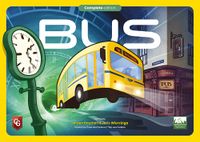
As one of the first games to use the concept of worker placement, you are transporting people from work to the pub and then to home and around again while using actions to build out new locations, lay down lines, and even to stop time keeping folks in their places for the next round. This is a super tight game points-wise. And of course, with the worker placement, you only have 20 workers to use throughout the game and so you must allocate them wisely. The map that you build on is always the same, but once again, hearkening back to player agency as a core principle, players place out their starting locations and lines creating a different puzzle based off of what other players do rather than the game itself presenting a different puzzle each time. This is a game that I think is deeply strategic in opposition to its weight complexity rating on BoardGameGeek.
And I think everyone should try once to have a small taste of this game to see what Splotter games are like. Number four is Indonesia at a rating of 8.6. Indonesia is a tough and long economic game and I've covered my thoughts in more depth in a separate video on the channel. I still stand by my rating of this game and since then I've played it again online and I appreciate a little more the simple yet elegant way this game can feel variable from game to game despite not having a lot of features to tinker around with. Once again, it does come down to player agency to place the certain industries which are, you know, somewhat random and and give you a little bit of wiggle room to set up based off of the board state from game to game.
Uh but a lot of the variability comes down to when you merge companies and at what price to merge them as well with the bidding war that you have for players interested in acquiring them. It is a hard game to conceptualize strategically if doing a lot of money calculations and speculation isn't your strong suit like it is for me. And it does feel like uh you know, a little long for its playtime as well, especially if you play at lower player counts, but I really do like this game and I suppose it's teaching me some mechanisms and skills that I normally wouldn't get from classic Euro games, so I do appreciate that. Number three for me is Food Chain Magnate at 9.2. My original rating for this game was around 7.5 when I played it years ago.
Boy, have I turned around on this game. You run a restaurant chain hiring workers from a tech tree type of configuration reaching milestones before others to acquire bonuses and asymmetric powers during the game and then finally really using player turn order to its fullest to be the first to deliver your food and drinks to hungry neighbors before others hoping to have the most money at the end of the game. I really do see why this is the most popular Splotter game as it has pretty much every design feature and principle that is seen in the other Splotter games. I wouldn't be surprised if most people agree that this is their magnum opus. Uh for small reasons I do like the other two ahead of this one, but I'm so glad I am starting to see the brilliance behind Food Chain Magnate and would love have play this more.
Finally, my number two is Antiquity at a rating of 9.4. So, more on Roads and Boats later. Antiquity for me is like if the concept of Agricola met Splotter. Antiquity has you in charge of a medieval city-state expanding across the land to acquire resources, building out your city with polyomino spatial puzzling, and battling the rages of pollution and dying population to hopefully fulfill the requirement set out by your patron before others win the game. On paper, this game looks fiddly, long, not fun to look at, and not super variable in setup and play. But to me, this game has the setting and feeling that comes with a very tight struggle type of experience that I really enjoy in games like Agricola.
And in comparison with The Great Zimbabwe, which also has the concept of choosing a patron or a god to worship, which essentially means trying to meet a certain type of objective during the game, I find that the requirements in this game offer two situations where you can challenge yourself to win the game with a certain patron or as more of a personal like as a personal sandbox challenge, or it could be a super competitive uh you know, experience based off of the starting map and situation. Therefore, because of how the map is randomized, you might think this particular saint would be the best way to approach this game. While The Great Zimbabwe is quick, Antiquity is long and epic. And the first couple of games I played were very rough.
But overcoming little challenges such as trying to just build the first city uh or the second new city, you know, not starving out, uh not running out of wood or uh you know, tinkering out with uh new buildings to create combos that were pretty interesting, this journey I've enjoyed like kind of learning the game and taking step-by-step to uh understand what each building does and you know, how to approach the game for me has been a very enjoyable experience. To me, Antiquity has the same strategic appeal as Food Chain Magnate and the right amount of variability as uh The Great Zimbabwe and Indonesia, which is minimal but appropriate. And so, combined into a setting and gameplay that I just love, I really enjoy Antiquity.
So, that of course leaves number one, Roads and Boats, barely eking out Antiquity with a rating of 9.6. So, it's It might not be a surprise to me that Roads and Boats is still on top after my first impression of it years ago, which there is a video of. Having the opportunity to play it again online, which has been a new development recently, I've realized a few things about this game. First, this game is definitely a logistics puzzle of creating infrastructure to produce and transfer goods across a map, contributing to the wonder all the while being open to competitive stealing and blocking of opponents' resources in this in the sense that you can, you know, walk over, put them on your own donkeys, and take them back, or even build walls around your opponents' stuff to make it so they can't access them.
And all this while utilizing a dynamic player turn order mechanism to make sure you can get somewhere first and kind of cash in the opportunity to take the first move if needed. This game offers a wide variety of maps and configurations of the hexes that you use to build the maps, which make each challenge feel a little new and create the kind of variability that I love in the sense of, "Hey, here is a new map, a new puzzle." Very similar to how the variability of games like Age of Steam make itself very interesting to kind of approach the game in a different way. This game is also the only game officially with a solo mode from Splotter. This is a challenging and fun experience and I love that about this game. I've realized that this game is super hard just like Antiquity. But whereas in Antiquity, it's mostly a challenge against the game as well as the players, Roads & Boats is such an efficiency puzzle that if you fall behind, you can literally get blocked off from using your pieces by your opponent and just continue to fall behind. Honestly, I've had some quite negative experiences with that recently where I have been blocked off completely from being able to do what I wanted to do.
But like with Antiquity, Agricola, and some of my other favorite games, the steep difficulty curve kind of calls me back every time and I try to do better every time and and and learn. And this game is very long and it has certain arcs to it, too, just like Agricola where the first part of the game feels different to the middle and the end. Uh so, it's definitely a long epic game as well and I'm determined to get better at this game and slowly understand the nuances of proper road placement, building combos, and the correct way to situate yourself on the map and interact with other players based off of how that random map is set up. So, right now, this is definitely my preferred Splotter game to play and think about. It's just the one that I'm having the most fun, I guess, exploring right now. Thank goodness it once again that it's online to be able to play this since it is so long. Uh it's it's been nice to understand this game at a faster pace because of its availability online. So, there you have it. I'll I'll put the Board Game Geek ranking here for these seven particular games in comparison to my own personal list and you'll see where they lie, but let me know what you think about these games. If you were to rank them, how would you rank them?
What What did I get right? What did I get wrong? Uh I'm curious to hear your perspective on this topic. Thank you for watching this video and I hope you have a great one. Take care.