6 new drafting games worth checking out | Ep 163
Games in This Video
4 games are featured in this video — they unlock as you watch.



Transcript
Hey everybody, welcome to Going Analog, a podcast in which gamers come and talk about board games. So, I'm your host Christina and with me is Shu, my partner and board game confederate in all things. So, we have one of our quick hits this week. Uh, we have I don't know, it's just one of those things where you like accumulate so many things, you reach this threshold. We've been accumulating drafting games. So,
this year there's been a lot of drafting games. So, uh and some of them are doing things a little differently than we're used to. So, we thought it'd be fun to talk about them today.
Yes. Who doesn't love a good draft? You know, some breeze. Okay. But before we get started, we wanted to highlight a game that uh we wanted to talk about.
What game is that today, Shu?
Yeah, our game pick is Yomi 2. And uh by the time you listen to this, it should be coming out uh any day now. Um
holding it upside down.
Y me too.
He's he's really good at this game. So
yeah. Uh I can't see on his screen which side's up. This is Yomi 2. This is a sort of a starter box with two characters. Uh the starter said this is uh Bashane versus Finesse. Um what's funny is I'm about to show you the big box. Hold on to this. Uh this thing is humongous. This is the big uh awesome set. Uh so this is the Road to Morning Star. This is the full set and it has uh multiple character decks. It has the more deluxe components. It has a player mat. Uh that's a star set. If you don't want to get the full thing and you just want to play with a couple characters, but those two characters are not in here. Funny thing. So if you wanted all the characters, you actually have to buy both boxes. But this is there's more enough content in this thing. So, and the reason why it's so big is because it shows you, let me show you here. The playmat uh comes inside the box, but fully uh unrolled, right? There's two playmats. This is a head-to-head game.
So, the playmat just sits flat in here, which is really nice because a lot of times like we have games where they try to fit the playmat in there, but you have to roll it really tight. You have to have a little spot for it and then you have to unroll it and kind of try to smooth it out
like you know rolled up and stuff.
So I haven't seen many games where the the playmat just comes like this where it's just flat. There's enough room for it but it does make the box really big.
But what is this game about shoe? [snorts]
So uh Yomi 2 is a fighting game. If you ever played games like Street Fighter uh the video game, this is basically that in card form uh but it's its own universe the Fantasy Strike universe. So, Sirlland Games, which is the publisher here, they've made a Fantasy Strike game, they made a Puzzle Strike, they made a previous Yomi. Uh, they're all the same characters from this universe, but they're in a fighting game tournament, and Yomi 2 is a sequel to Yomi 1, of course. Uh, but basically, you have a deck of cards. So, my deck is my character, your deck is your character. It's a head-to-head game, and then you're just trying to whittle the other character down, your opponent down to zero health. Now, how this works is uh it's a very it's all card driven, right? And then it's very tactical and very strategic. So there are a lot of different fighting game card games, you know, like ex the exceed system, Battle system. Uh uh but Yomi 2 kind of does its own thing. Uh the creator, David Serland, who of Serland games actually worked at Capcom, which is the publisher for Street Fighter, and he developed some of the Street Fighter games. Uh so he kind of knows his stuff. Uh and he could feel it. This is like a game where I actually didn't even really want to play with play with me.
I was like, I think it's better for people to know fighting games. And Christine is like, I know fighting games. And I I'm like, okay, what does chip damage mean? And what did you say?
Uh, it's what I do to nachos.
So, but these concepts I played with my friend Nam who does like we previous play the street game and stuff. So, he and I uh I could talk this language him, right? It's like, okay, for example, if I try to attack you and then uh but you block or you dodge the attack, then I'll miss. But if you try to dodge and miss or or try to dodge or uh block an attack and I try to throw you, I will actually win. So, there's this rock paper scissors relationship between the moves. But also, there's high block for high attacks, low block for low attacks and things like that. And so it is very fighting game oriented and a lot of it's like in a real video game fighting game. Uh it's not just like throwing out attacks, spamming attacks, and trying to do as much damage as you can because you have to be okay, what is my opponent going to do in this situation. Is he going to jump in the air and do this or is he going to throw a fireball and I could counter with this? And that's what this game really represents.
And it's better for people who get older because then you don't need the hand eye coordination reflexes.
Yeah, true, true. Uh yeah, so this game catch a lot of it. It's like, okay, do I want to block now or do I think you're going to try to throw me so then I'll attack you instead? And all those kind of mind games kind of play into this. And a lot of this game, uh, in terms of the board game terms, it's very, uh, deck in hand management, right? So, there's a lot of times where like, I'm going to put these cards in my discard pile, then I'm going to do something else to draw these cards out of my discard pile to play them at the right time. And you could string along combos because there's certain moves that are like you'll see symbols on the cards that link like this card will link to these types of cards will link to these kind of cards. Your character determines the max size combo you can have. Uh so you can't just go unlimited and play 20 cards and then finish off the opponent. Uh so you have to go within your limit, but you can link these cards and it's really satisfying when you get all done. You're like, "Okay, I'm going to link I hit you. My landed a hit. Therefore, I can link the second hit of this combo then this third hit." And then you can pump up this card for damage. There's a lot of insane combos. Uh, but I do very much feel like this is a game for fighting game fans. Like I would not break this out as a casual game. Uh, just to play with someone who's just like, "Oh, we're let's just play a quick two-player game." Unless they knew fighting games.
I don't know if I would break this out for them.
How is it different from Yomi 1?
So, in in Yomi 1, it's been a while since I played Yomi 1, like a long time. So, uh, in Yomi 1, they used a like a uh a deck of cards sort of format, right? So your deck is also like a playing card deck. So you had like a king, a queen, and then that will help kind of determine some of its priority. They removed all of that just to kind of make it like, okay, we're our own thing, right? Instead of following that format. Uh so now initiative, they'll have initiative numbers based on how fast the attack is and things like that. So they did take a lot of that out. And from what I remember of Yomi 2, I felt like this was easier to grasp in terms of like, okay, these cards link here, these cards are these type of cards. It's just a little cleaner, I'd say. Uh, and also a little bit smoother. And then they did spend some time like just sort of polishing up the system and balancing everything uh and making a little bit more intuitive. But yeah, but this is a a a pretty core hardcore game, I think.
And who won? You or N?
Don't worry about that. Uh but yeah, it's uh it's like people who just want to be very strategic and then they get really rewarded like, "Oh, if I do this at this time, if I could if I could make the opponent whiff and I could just do all this stuff, it's like really rewarding where you could land all those combos and moves and get all the things right." It also has like the fighting game concept with super meters, right? You can build up your super meter and launch these super awesome attacks and things.
I know that.
Yeah. So, that is uh Yomi Road to Morning Star. Again, there's two different sets. Uh and we should say we forgot to mention this at the top of the show. Uh I think all the games we're covering today were supplied by publishers, right? Yes. Yes. So uh yeah, just so for full disclosure so everyone knows these are publisher provided games.
So let's move on to the draft.
The drafting games.
So I get to go first cuz I decided that. And I would like to talk first about uh Citizens of the Spark, which was published by Thunderworks Games and uh designed by Philip Dubberry. Really, really cool art. First of all, I think we were wandering around Gen Con when our uh graphic designer friend uh Matt Pquette was saying like you never see this sort of inverted color scheme um often uh in a lot of illustrations and stuff. So, he's like it's really striking and the game is illustrated really beautifully. But this is a really cool drafting game that has a fun tweak to it. So when you are uh collecting citizens, uh you are trying to uh collect enough citizens to get the most points which are spark in this game. And there's these little like spark tokens.
So the fun part is you're building out tableau and you have different sets of up to like around 10 different types of citizens in every game and they combine in really really fun different ways as you're playing. So, you have might have like a whole um complete deck full of like scientists and scouts and um assassins and all of these different types of characters. When I collect them, they actually stack on top in a tableau in my in my town essentially in my civilization. So, when I'm drafting, I'm taking a whole row of three to four cards, I forget, depending on the player count, but you're grabbing a whole row of cards. the rows that you uh skipped over get an extra spark to make them, you know, tastier for the next person to those will be points at the end.
And those will be points at the end of the game. And then you've collected your citizens, you stack them on top of each other, then you can activate an entire faction of of characters essentially. And they have some sort of power. So if I pick a scout, the more scouts I have in the stack, the more powerful its action will be, which is to grab random cards off the top of the deck. Um, so if I have a stack of three uh scouts on top and I activate, then I get to grab like a lot of cards, which is fantastic because the more cards usually the better your city. There are some exceptions that I'll talk about, too. Um, and that's like super cool. Like I just got a lot of extra cards and I stack them up. However, other players also get to follow your action if they have that citizen in their town. So even on off turns, you can participate and say like, "Well, I'm just going to follow that too. I've got a stack of two, so I'm going to get at least some characters here and you're getting more actions than you would if you only activated on your turn, which is really interesting. Um, so there's a lot of different ways to play this because as I mentioned, most citizens have cool things. Some of them might be negative points and you need to get rid of them by the end of the game hopefully. And they have really interesting preset combinations um of these different factions where you could go like high interaction, low interaction, um very aggressive play or more like multiplayer solo play or something. And they have different themes. So every time I've played it with a different combination, the game has been really different. Um and it's really really streamlined, fun,
and quick. Like it's doesn't overstay as welcome. It's like what 20 30 minutes per game depending on number of players. Yeah. Yeah. I I think my longest game was maybe a half hour or so.
And when you can line things up to get huge spark combos, it's really satisfying because some of them are going to be like, "Oh, I will find um I get to score a certain multiplier off of these sorts of symbols um on the town that has the most of those symbols." So, I can even use shoes and say like, "Oo, he's got the most of that. I'm going to take advantage of it and score like 50 points off of it." So, um, really quick game, very striking, and I've just really enjoyed delving into the different combinations of cards. I played it for the first time with a group of friends, and then we have a, um, a designer friend, Steve Cole, who was saying like, well, what happens if we pick like the most aggressive possible situation? And so,
like the set of cards,
the set of cards. So, like it wasn't a preset situation, but like, well, he didn't actually want to do aggressive, he just wanted to do all new cards. So, we were using the the um the randomizer and just like pulling out the the card types that we'd already played with. He picked brand new ones. And so, we had a new set of cards nobody had ever played with except it did turn out to be like the most aggressive setup ever. And we were just like constantly killing each other's cards and stuff. So, it was hugely different from the first time I played. Uh have been finding it really really interesting. And even if you're doing horribly, it's a quick game and then you come back and you have a brand new game and maybe you do really well the second time. So
yeah, and it has an interesting balance because when you activate one of those characters, you actually have to discard the card.
Not to mention, that's huge. So you have to
you can't just stack it over and over.
Yeah. It's not just this power crit that goes out of control because you have to make a decision. Well, I have two scouts. Do I play this one of them and leave myself with one or do I wait till I draft another scout to make it more powerful? So you have to make these decisions because it's always kind of balancing itself and you know, no one gets ever too powerful.
Yeah. But it's same thing. I I play games without you and then I've also had very different experiences where it's like wow this plays completely different from another because they give you so many and you just take 10 of the different classes to combine it. I forget how many come in the box but uh and this feels like it's the kind of thing if it does well I'm sure they'll do expansions and create more cards
30 unique citizens this base game.
So 10 different sets of these per game. I again I think it matters by player count, but you can imagine how many different combinations there are within the 30 that come with the game. That's quite a bit. But the drafting is a lot of fun, too. Like that's what we're talking about here today is the drafting games where you're drafting not just one card at a time. You're like, here's a row of cards. So I think when it was two players, we drafted three cards. When I was playing four players, I think it's two cards. Uh so you have to you're not just looking for what card is most attractive, but what pair or trio of cards looks most attractive. But also as in any drafting game, what are you leaving for your opponents, right?
It's like I can't give Shu this aggressive one. He's gonna murder my people. So,
so I like the idea of like drafting a group of cards at the same time.
So, that was a surprise to me that I saw at Gen Con we got to play later and I was like, "Oh, I really like this."
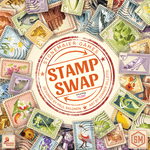
Cool. Okay. So, uh our next drafting game is Stamp Swap by Stone Meer Games. Uh, so if you're looking at the our YouTube video or our Facebook video right now, you can just see it's a game about stamp collecting and just a bunch of stamps everywhere. Uh, so this has an interesting setup too in terms of draft because you will draw uh these setup cards that show all these different stamp sizes and then you'll draw however many cards there are as there are players. So at a four-player game, there's four of these cards. Each one will have something like play one big square or draft one big square card, one two rectangular cards. Some will be face up, someone face down. So you're all together between each of the three rounds, you're creating this big pile of stamps, a bunch face up, bunch face down. Uh and then also some cards that provide special powers, some cards that provide in between round scoring. The first player marker goes into this draft pool as well.
Everything's for draft.
Everything is for draft. So, it's it's like you're looking when you get to go first, you're like, I'm looking at 20 different things here. And it's just kind of like awesome because you're like, I do you want to collect animal stamps? Do you want to collect blue stamps? There's all these different things that might score uh based on common objectives as well as your own uh your exhibitor cards, which would might be rewarding my only me with uh space themed stamps, for example. But we're at a gaming or a stamp, not gaming convention, a stamp convention. And then we're we're gathering all these stamps, but you have to swap them because after you draft six items, first thing you do, this is also really cool. You get to reserve one.
So this is like I'm not going to give anyone this. This is mine. But the other rest of the stuff you just drafted now, it becomes a second phase. I split, you choose. I love
I really like this mechanic. Uh, and this is basically now let's say I have five items left. Um, I'm going to make two piles. I could make a pile of one and four, two and three, but I'm going to put these out in front of my board and then we're going to in turn order pick one of those piles that you see in front of an opponent. So, if I pick Christina's left pile, I get that pile to put into my collection, but her remaining pile gets she gets to keep. When someone picks one of my two piles, the other pile of mine returned to me. So, you have to make this decision if you haven't heard of this mechanic before of like I have to make pretty equally appealing piles because if I make one really awesome, one kind of crappy, no one picks a crappy one. I'll be stuck with a crappy one.
But because some of them are face down, I get to know what my face down ones, I can make a pile look really juicy, but I've got like maybe fewer face down ones on the other pile, hoping that they'll leave that for me. Right.
Yeah. So the first time I played it, so that this draft is really cool because it immediately
it was also weird. The first time I played it, I'm like, I don't know if I like this because you're drafting, but you don't get to keep everything you draft. But then you're like,
oh, okay, I'm going to draft things that other people want because I want need to make another pile of the things I want. I'm hoping the people take that. So it changes a lot of things about how you used to playing these kind of games and drafting and stuff. And then once you are done with the iclit, you choose portion of the game. Now you build out your collection. You have a little book and you're laying out the stamps. And again, the game will reward you for things like having rectangular shapes inside your collection in groups or having sets of different themes or certain colors and things like that. So that part's a little bit more standard, but it's like everything that builds up to which stamps you could take uh is really cool.
I will say I really dislike this rule book though. Uh the first game I played and taught, it was a lot of referring back to the rule book, a few questions I had to look back at again and a few moments of like, oh, oops. Uh this was supposed to be done this way or we weren't supposed to do this way or just so you know. Uh so there the first game I had multiple people say it's okay. It's a learning game cuz they they knew I felt bad that I wasn't teaching this very smoothly. Second game went very smoothly because I really really liked it cuz I was on the second game.
You didn't have to deal with my first initial teach. Peach was great. My pet peeve about it is it you sometimes have things about scoring for rectangles or squares and squares are rectangles people
but they are differently considered in this game.
The rule book is like the rectangles are this shape and not squares. I we had the same discussion at the previous game too. Uh but yeah it's a it's a cute quaint game. Everyone played is like oh this is a very cute game because yeah it's just like collecting those stamps even if you were never a stamp collector. is just like collecting these things. Uh, a couple of different people, including myself, have kind of compared it to the game Fit for Print, uh, which we were drafting, uh, uh, different articles and advertisers to lay out a newspaper, uh, page. Stamp Swamp is a better game. Uh, if you like that, definitely check out Stamp Swamp because this one,
you keep calling it Stamp Swamp.
Stamp Swamp.
Uh, [gasps] I I do think this is a better game and it's cute. And again, you just have to get through the rules. I would watch a video online. Uh there's a how to play video, but then uh that will help you kind of get through this rule book, which surprisingly
for a short game,
for a short simple game, there's just it didn't explain things uh very well, I think. So,
but it is a short game and I really enjoyed uh the the drafting part where you literally just draft one thing at a time. Um but then different scoring objectives every time. So, I can see a lot of variety there.
Yeah.
Yeah. Stamp swap. Next game. What do I want to talk about? Let's talk about Fountains. So pretty. Ooh. Ah. So, Fountains has been was published by the OP and it's a super super beautiful game designed by um Kendrick Winks. And so, this game has this really nice sort of I don't know what what what era is this of art.
Maybe it says on the back of the box that that you can't lift out. Here, give me that.
Yeah, sure. Um I don't know. I don't know my art eras very well. Sorry. not a not a not an expert at that, but it's beautifully done. Um, really striking and it's a really quick drafting game that's so so so pretty. So, we are playing fountainers.
Fountainers in an elegant city of Flora,
which is made up, I think. Um, but fountainers is a real word. So, we are fountain engineers basically. And the we are using this um common fountain t uh what is I don't know tableau.
It's like a it's like a central wall that you're drafting
that you're drafting different shapes from. So, the shapes are lined up by by type around here. And we take our little we don't have a personal player token, but there will be set a blue token, a white token, and a green token that we will move around in a rondelle type fashion. Where it lands, we can move like one, two, or three spaces, I believe. Where it lands, you're going to dra take the top tile from that stack. So, it's sort of like a draft with a little bit more constraints, but you're drafting these tiles by moving these tokens around and building out your fountain, which sounds great. You can even build sideways, uh, make them really wide and beautiful, you can build up, too. So, like some of these other games where you can build higher up like Acropolis and stuff, the higher up your fountain goes, the scoring elements on the higher levels will give you more points. Um, it's a little challenging to build up, but it's uh really, really rewarding. And the to the pieces are all this really nice foam core. So really satisfying to play around with. You're building out like a nice physical beautiful fountain. Has great table presence. Um but the fun thing about it is like there's just like a good light amount of strategy which I really appreciate. So as I mentioned, you're moving these tokens around to draft stuff, but the color also is going to match set types of scoring requirements.
So when if I go and draft something and I put the green token back on the green scoring um space, this means all the lily pads are going to score. So it is up to the players when we score these features. So a lily pad's going to score for the biggest contiguous group of lily pads. Um if they're on the second level, the lily pad will be worth two points. If they're on the third level, three points. Um if you score on the blue, that's going to be who has the biggest uh continuous fountain tiles. So, you would count out who has like the biggest range of of tiles and you get scored like first, second, third, which is huge, too. Um, when you score the fishies, then the fishies are going to score for whoever gets to pick the scoring will pick what color fish they want and then you get a score. Everybody scores for that color fish. So, there's a lot of control if you are the one to push this to the scoring place. So, like a fun little decision there. Um,
and sometimes you don't want to score something that will score you points but will actually score another player more points. You're like, I might actually want to block that so that they can't score that,
which I've done out of before, too. So,
um, so there's fun little strategy there. It's not overwhelming, but it's like nice and crunchy and really pretty. One thing you have to consider though as a good fountain, make sure your fountain has water, right? And so there are ways though that you can be building on top of your fountain that end up cutting off parts of your fountain from the flowing water. So they added that aspect to it. So you have to watch and check that water still flowing to every part otherwise it gets scummy and does not score at all. So um a fun little consideration there. And if you want to add more strategy, they have an advanced mode where there's extra scoring mechanisms um that everybody will share at the end of
scoring objectives to each scoring objectives rather than just the base scoring.
Yeah. And Christina in a video here is only showing the round pieces, but there's a bunch of different shapes like a crescent shape and some uh more cross shaped things. And so when you're building out, they they have connection points to show how they fit on top of each other. But it's your fountains will all look different from each other. And because the pieces are so thick, it's just like it looks really pretty. And then they colored the edges of the pieces. So it looks like uh what is that material? It's like a terracotta almost.
Sure.
Sure. But it looks like clay pieces. The first time I actually saw this game, I was like, "Wait, are these real pieces?" I thought I thought maybe this is a prototype or something. They're like, "No, that's actually what it looks like in a retail copy." And so I'm like, "Wow, this looks this is a really cute look, good looking game."
Lovely, beautiful, fun times, enough strategy, and doesn't and is like a nice quick game, too. So really enjoying
I think the drafting part is the best part. It could have been a more standard straightforward game of just building that we've seen, but the way they do the drafting, like Christina said, uh you only could move a piece to an open space and then everyone's sharing those pieces. So, I think that makes it a lot more uh decision focused about which how do you draft and win
and so striking. We've had people request to play this just because they saw the cover and they didn't know anything else about it. So, yeah.
Well, okay. Uh our next game we're going to talk about, uh we just played this right before the show. We played this before, uh but we played another round before the we recorded this. It's called Strange World Above the Clouds. Uh it is a tiny box. If you look at this, it's
Yeah, it's a tiny box, but it's a it's a thicker box cuz there a lot of cards in there. U but it's just the size. It's the height and width of the cards themselves. Um and it has this really great fantastical kind of whimsical otherworldly
art. Weird art, too.
Yeah.
Not too creepy, but like strange in a fun way.
Yeah. And the cards are all mainly showing these different lands of like like mountains and forests and waterfalls and volcanoes and things like that. Uh, but the draft the draft part of this is a little bit more straightforward. So, for example, in a two-player game, I have three cards. Christine has three cards. Keep one, pass two, keep one more, pass the last one, and then you end up with three cards that you're going to lay out in a 4x4 tableau. And then, so then there's all these rules. Here's another game whose rule book I hated. Uh, it didn't explain things that great. And those tiniest print I've ever seen. Tiny pictures that you had to pull examples from. And you had to
You need a magnifying glass.
Yeah. You need you need uh some of these examples to really clarify what the rules meant by this. So I had the first time I read these rules, I had a lot of trouble. And then my first game was similar to what I just described for stamp swap, which was a lot of like let me check the rules again and then let me like put these rule these this rule book uh this page right up to my face. I'm like looking at these tiny tiny print uh examples and then we eventually figured out it's like okay once you get over that hump it's a pretty smooth game. Uh and then the reference cards make sense after that. But basically there are a lot of rules like so these if you see this character here on the side of this box uh or if you're just listening go uh look this up online. There's these world eaters. They just look like giant black blobs that are just eating
the world
the world right. So you have to be careful not to summon them. So, for example, if you put two uh water cards next to each other, adjacent to each other, then uh they're thirsty. The world leaders are thirsty, then what? They'll come in and you have to flip one of the cards to it's world leader side, which doesn't score you anything. And there's other rules like uh was it grain was the um
marsh or something? There's one of the land tiles. You can only have one per row. If you have a second one, they get angry and come in and then you have to flip one of the cards. But there's also cards that are like volcanoes which will destroy a land next to you. But if you get a couple of those destroyed lands together, it could create a new dark city which will score as well. So even if bad things happen to you, you can mitigate it hopefully to turn it into a good thing and possibly get rewarded more. Uh and there's these cards where if you connect certain symbols, they create a portal that a traveler comes in and gives you extra scoring opportunities. pretty simple game, but uh like not as simple as like a sushi go or something like that. There's more a lot of strategy of you have to think about it and you're like bad things are going to happen. You're going to get stuck with cards you don't want to get stuck with. Uh you you definitely will and in fact it's part of the uh pitch for this game. I think uh we heard from the marketing person like a lot of this time you're just going to be stuck and you're going to be angry about like I gotta put this thing that's gonna do one of these bad things. So it's about uh managing around that. So that's the kind of game you're getting. It's not a simple, oh, okay, I laid these out.
Let's see what my scoring combos are. It's like, how do I mitigate the bad things and hopefully turn them into good things. Uh, but it's like inevitable you'll get something bad. And that's that's the game.
We played it what, three players once or four players and then I think it was four players and then this time we played it two players. So, I found the smaller player count actually a lot easier to mitigate bad cards. I don't think you did that as much as I did this time. But since you have three, you're going to keep one. And you know, one of the other two is coming back, so you should accounted for that.
Well, I I made I arranged my volcanoes in a way that is like they were all positive, but Christina just had more scoring than I did overall.
No, I just knew like, well, there are times where I was like, oh, I bet a volcano is going to come back because I see that in my hand, and so I can account for that, too. So, there's more control with, I'd say, fewer players. with more players. It's a little bit crazier and more chaotic, but you see a lot more cards, too. So, uh, so that's the interesting part of Strange World: Above the Clouds. Uh, I really, really like the vibe of it. It's so weird and quirky and the way that you build out the tableau is works a different side of your brain than some other tableau builders, I think.
Yeah, it's a good game. Like we had several people like this after they played it, they're like, "I want to play it again." Because they just they they start thinking about it and they like, "Oh, I could have done this better." And they just want to see other ways the cards will come to them and they can build out their tableau.
But you're only building a 4x4 grid. So it's like a quick 15 20 minute game really. So
really easy game.
And my final game I have Oh, so heavy is uh Twinkle.
So this is heavy because we have the expansion and a mini expansion and a 3D printed insert. Oh yeah, that's why
inside here. So
it's very dense basically. Uh so this was put out by allplay. We got a copy back at Gen Con, an early copy uh designed by Ammon Anderson. And it is uh definitely on some level in the beginning very seemingly straightforward drafting, right? So you have um a bunch of tiles. Then when you select a tile, you will move your um mele person. I think it's a space cat. I think it's a space cat.
They're like space They're little astronauts.
They're little astronaut cats. And you're going to go claim one of these tiles. The cool thing about these tiles is that they are transparent and acrylic. So, they're really really um you have to dig through the Oh, we have a lot of stuff in here.
The insert to get to them.
Yeah. So, you'll get these to tiles that look like this that are really neat. I don't know if you can see it on our um video, but you are going to build out your night sky um in different ways to score. So, They're completely clear. So, in case you're you're not sure what we're talking about, they're little squares,
completely clear acrylic with some white markings on it. So, you could actually flip it backwards and then lay it completely on the other side. It'll still work and the symbols will just be mirrored.
Mhm. That was the really cool part that I like about this, too. So, you know, in some ways it's pretty straightforward. You take your tile, you build things out. You're trying to make maybe like constellations of stars. So big constellations score one way or um if you have many constellations, they'll score another way. Um then you might have asteroids and black holes that sort of limit your scoring. So the placement of them really matters. But where you go and select your tile, let's say I go really far up, then this means that I will get to go um earlier in the next round for my picking. Also, um, the really valuable ones that might have a lot of stars and stuff like that, they have a symbol on them that forces them to the back of the draft row. So, if I take this really juicy tile, I will likely I will have to go last in the next round for picking. So, that draft order really matters.
Yeah. If you play King Domino, it's a very it's the same kind of drafting effect of like your decision isn't just which tile you're going to pick, but uh you might have to go later in the following draft and then you just and you get a preview of what's coming up. So you might say, "Okay, I'm
not worth it for me." Or it is.
Yeah. Yeah. You might say, "I'm purposely I'm going to take this great tile and then and then not do well in the next draft or vice versa." Right. So uh I like that mechanic. Again, it's not original. King Domino did it. Um
but what I like about this game is so even in the base set there are uh I think five or was it six different tiles,
but uh the little reference card for them each could be flipped over to a variant. So you could have all these different combinations of like here's here's all the basic tiles or let's flip over half of them and do a more advanced version of these so that comet score slightly different score slightly different and things like that
which wasn't I played this on board game arena several times two-player with our friend Eric Euro and so we played the base game several times and then uh all of a sudden he switches it to a new scoring and I was like what the heck I was setting up my black hole like normal and I was like wait a minute. This is not the same anymore. So,
that's on you for not checking the which ones to pick.
Um, yeah. So, that's a lot of the fun. Like, I think if you just took the base game and you didn't have any of these variances, I would like okay, it's a fine game. It's like nothing special. It's cute. Uh, the novelty will wear out, but it's like, okay, you're building connections of stars. You're sprinkling some planets into this, and then eventually you'll build out a tableau of uh your night sky that you're looking at, right? Uh, but uh, where I think this game shines, and I hate to be one to tell people like you need to get the expansion or the expansion makes the game good, but in this case, I'm like where I found Twinkle really appealing is when I we combine the expansion that has a bunch more tiles each with a variant on the back and then the UFO expansion, mini expansion, which is another tile set. Uh, then when you have all of these together, it's like in one set and it does fit into one box. It's like, okay, now you have a million different combinations of ways to play this game. And then that to me is where the fun is.
I think the base game has a lot of variety though, just because of the different combinations of how you score each of the features. Um, and then when I I played it several times uh online, and it was pretty different depending on how the tiles came out and stuff, too. So, I think there's a lot of game in the base game. Um, and then, oh, I forgot to mention that the flipping of the clear acrylic tiles is really great because in a lot of other games because it's cardboard, you're like, gh, I can only turn it around and I can't flip it the other way. If only it would go this other way. And now it can. So, that's sort of satisfying.
Yeah, because the constellations, they're they're mapped out as stars that have connection points. It's like as if you've drawn out the constellation. So, sometimes you need these lines to go off your tile a certain way to make other connection points. So, that's really a nice thing part of this game. Uh, it is, I think, um, an organizational nightmare this game. Uh, because, uh, they're all clear tiles. So, from a distance,
all the tiles look alike. Uh, so even if you're trying to sort them and bag them and you probably want separate bags for each type rather than having to like where all my planet tiles, where all my comet tiles, and then arranging a game that way, you're going to want to figure out a way to organize these yourself. Like I said, I
only if you're anal retentive like you.
You never had to organize. You've been playing.
I'm not saying I would, but some people just dump their crap in the middle of their box.
Can you imagine like 30 40 tiles and it never they're all similar looking and you have to sort through them.
That would be their problem if they don't organize. But yeah, I get it. I get it.
It's like you're going to want because because especially for us, we have the expansions in here as well. It's like, okay, I want the the asteroid tiles. And then so I 3D printed an organizer that I thought was really mandatory for this kind of game. Uh but that is a consideration. It's like you're just going to have a million tiles that all look fairly similar at a distance and so you're going to want to be able to categorize them and group them more easily.
And that is Twinkle. And your last game shoe.
Okay. So our last game is solar gardens. Uh this is a drafting game as well. Uh this is about building a rooftop uh garden, a eco-friendly garden of like the things that have like uh like wind power, solar power, uh and different features that are very ecologically friendly. And that's the kind of message of the game is like about being more ecological ecologically friendly. So, you're drafting these tiles, but the way the uh drafting works, I really like this part of the game is uh you so each round, let's say there's going to be, I think, one more than the number of players, right? So, four players, you're if I'm first player, I have a stack of five tiles. I don't get to look at all of them. No one gets to look at all them. I only get to look at the top one and then I have to make a decision. Do I keep this tile or do I pass it to the next player and have them decide? And then I get to draw the next one. So, I could have potentially better tiles in that pile or it could be worse. And then you you turn off. So, every time you pick up a tile, you have to make this decision of like, oo, do I try for what's behind door number two? It might be better. Um, or do I give this tile and maybe this is a tile another player really wants, right? Um, and then so then when I pass to Christina, Christina has to decide. She's like, she knows there's more tiles coming her way because most of these out of the five, four will get drafted. So, she has to decide, do I wait to see what else she passes me? Uh, or do I take this one tile and then it skips her? Then the next player will get the remaining tiles
and such. So, it might get all the way down where I'm like, "Okay, I'll pick the very last tile." Then you're stuck with that one if you get make it all the way to the bottom. But in the meantime, I passed around four other tiles that other people are now deciding between.
That's the coolest thing. I I really like this strat because every decision is like, "Ooh, this one or should I wait?" because you don't know what you might be getting, right? Um, I really like that system. Then you're placing these tiles. I sort of like a lot of different tile lane games of like, okay, I want to make this uh group uh this kind of farm uh land that's all grouped together or I need to collect certain sets of things or I want to a lot of wind turbines in this row or this column or a lot of solar panels in this column. Um, and then and then a lot of the scoring is based on that. But I think the drafting part is the coolest part of this game.
Mhm. um you're balancing a lot of different scoring options. So, you know, that's what you're risking. Like, ah, I really need that like fourth animal type because I've got three of them right now. So, do I risk it? Will I wait for another uh another turn or something like that? Um so, it's like just a really quick nice drafting game. You end up with this very uh cool looking rooftop garden situation and then uh that should be very eco-friendly is the goal. Oh,
yeah. I I will say I I don't think the art is the most striking. I I think it's a little dry looking. Like there's like there
it's too clean.
Yeah. I I just kind of almost kind of clinical. I will say the art it's okay. It's fine. It's serviceable, but it's also like this is a big box for the kind of game you're getting. And it's also I don't think there's enough tiles in this game. I think there needs to be more uh uh like an maybe it's an expansion or something like that, but once you see all the tiles in one game, you've seen all the possibilities that this game can offer. So, I do wish it came with more variety of tiles,
but it's a fun drafting game. Um and it's Yeah, I had a good time with it. Mhm. Nice and quick. So, thanks for joining us for drafting day. Uh hope you found something to draft for your shelf right there. Yeah. Is that corny?
Yeah. You're so cheesy. Anyway, thanks for joining us. Thanks to Mike Zipkin, our fantastic editor, for making us sound great. And uh we hope we will see you at BGGcon. When this comes out, we will be at BGcon. Oh my gosh. Yeah. So, we are having a live event for uh Board Game Trivia. Come and form a team or find a team and join one and see how you do.
Yeah. Look for the board game quiz show under the events calendar over there and sign up.
All right. Hope you have a great day and now you can stop listening and go play game.
Bye
bye.