Everdell The Edge Of The Map Buyer's Guide: Farshore vs. Silverfrost vs. Emerland



Transcript
Hello everyone. I'm Tally, this is Farrell, and welcome to our buyers guide for the Everdell Edge of the Map series. Everdell is a very popular series of games, not only due to its very neat gameplay, but also due to the cute anthropomorphic animals, city-building vibe, and eye-catching components. Now, what we mean by the Edge of the Map series is the latest wave of standalone Everdell games in the series, which are Everdell: Silverfrost, Everdell: Farshore, and Everdell: Emerald.
So, I'm sure you're wondering what are all these games? How are they different? Why are there so many? What does the original Everdell have to do with any of this? But, luckily for you, we're here to answer that. So, in this video, as I said, we're going to focus on the three games in front of us, but not exclusively. And the first thing we're going to do is take you through a bit of Everdell history, and then we're going to kind of briefly show how to play the general concepts, cuz each game does differ. Then, we're going to go through each game in turn and talk about them and what they're bringing to the table. And then, finally, we're going to talk about what we think about each one of these games, and kind of link it back to the original Everdell. Now, all of this is going to be time-stamped, so feel free to jump to the relevant points for you. Say, if you have one game and not the others, and you want to know about them.
And please consider subscribing, because we put a lot of effort into these. It takes a lot of work. We have to play a lot of games over and over and over that are very similar. Uh and also, if you would consider supporting us through our YouTube membership, you get some perks there. That would also help us out and make more of these. And the last thing to know is that these three games were review copies uh given to us by the publisher.
Everdell is a tableau-building worker placement game, which first came onto the scene in 2018. It was wildly popular once released, and it's currently ranked the 43rd best board game of all time on BoardGameGeek. Now, what you do in Everdell is you build a vibrant city full of critters and constructions represented by cards, and you'll also send little workers out to get resources to play those cards. Now, due to the popularity, there was a number of expansions, namely Pearlbrook, Spirecrest, Bellfaire, Newleaf, and Mistwood. In 2023, what could be called the second wave of Everdell products started to appear. And these were standalone games in the wider Everdell universe that explored new ideas and also incorporated some elements of previous Everdell expansions.
They were known as the Edge of the Map series, and to date, there are three games in it: Farshore, Silverfrost, and Atherland. And these are all for one to four players, as was the original Everdell game. However, the original Everdell game can go up to six with expansions. Lastly, there is Everdell Duo, released in 2025, and this is a two-player implementation of the original Everdell game. So, the same cards along with some of the cards from the Newleaf expansion. However, it does have different mechanics suited to players. Duo also includes a cooperative campaign for two players.
Everdell is always played over four seasons, i.e., rounds, and on your turn, you'll take one of three possible actions: place a worker, play a card, or prepare for season. For the most part, you're going to be placing workers in order to get resources, and then spending those resources in order to play a card.
The cards are divided into critters, who are the citizens of your city, and constructions, which are the buildings in your city. And you'll go through the game playing these cards till you have a vibrant city in front of you. Now, the cards have different suits, and each suit has a different way of working. So, one suit will activate when it's played and then never again. Another suit will activate when played and then at the beginning of certain seasons. Another will give you a personalized worker placement space on that card. Then another one will kind of activate ongoingly. So, you'll have an ongoing power and whenever you meet the trigger of that power, you get it. And finally, the last suit will give you end game scoring in terms of how well you meet the condition on that card.
And at its core, what Everdell is is finding way to play these cards through your worker placement spaces and the resources they give you. Then using what you get from those cards to maybe gain more resources to play more cards to get more and kind of spinning this out until you have this full city and a lot of points in front of you.
Now, eventually, each round you'll run out of workers and resources, and that's when you'll need to prepare for season. You'll take all of your workers back, probably get a new one, and then some different things can happen according to which game you're playing. Note that on your next turn, you're then free to again place a worker or play a card, and different players can be in different seasons to you. At the end of the fourth season, you'll score everything up. Generally, you'll need to score up any points tokens that you've gained throughout the game. There's points on the cards in your city. There are certain scoring suit end game scoring cards. There'll be objectives that the players have competed for. You'll score them up. And then there's some unique scoring elements which are different game to game. And then guess what? Whoever has the most points will win the game.
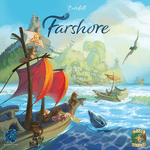
Farshore is in a sense a reworking and reimagining of the original Everdell game. It is the first in the Edge of the Map series and it sees Everdell taken to the seaside. There's a nautical theme with the constructions and critters and resources and board all having this nautical theme and leaning into it. And much in the way that you have Dune Uprising and Dune Imperium, if you're familiar with that series, that's very much the relationship of Farshore to original Everdell. Kind of rebalancing, re-baselining of the game series. The bulk of Farshore is the same as Everdell in general gameplay terms, e.g. you can place a worker, play cards, or prepare for the season. It's just that now you have all new resource types, cards, and mechanisms.
The biggest gameplay change is probably the inclusion of a boat. In Farshore, you're only going to have five workers throughout the game rather than the six of classic Everdell. And this is because one worker is going to sit in your boat and they go for a jolly around the map. Because each season there'll be two conditions to meet. They'll be related to what type of card you play, critter or construction, unique, common, suit. And when you match one or both these conditions, you can move the boat accordingly. The boat can also be moved through the playing of certain cards. But you're doing this because the boat track gives you points based upon how far you move and you'll also get treasure as you move, which acts as either a single wild resource or if you don't spend them, each one is worth two points at the end of the game. While boats can get you big points if you lean into them, you can also get big points from the map tiles, another new form of scoring.
So, there's a worker placement space you can go and you can claim a map tile. The map tiles will ask you to have certain numbers of certain suits of cards in your city, like three prosperity cards, much like the basic events from original Everdell. And map tiles will score, let's say, two points per map tile you have. So, the more map tiles you have, there's a little bit of exponential scoring there. So, you want to get a lot of them if you start leaning into this. But, the trick is is that they are worth less points the later you get them in terms of the first player to get have three prosperity cards, that'll be worth two points per map tile. The next one is worth one point, and eventually, in a full game of four players, the last one will be worth zero points per map tile. So, [snorts] it's a little bit of a race and a little bit of player interaction there in the scoring mechanism. Lastly, there are some new quality of life improvements, which are much welcomed.
So, new rules, which mean that multiple copies of the same card in the central marketplace will be stacked on top of each other, allowing for more variety. And now you don't need to have such specific critters to play them for free. Because in the original Everdell, each building had a matching critter, and you could only play a critter for free if you had the right building. Now, you get three anchors at the start of the game, and you can play one on a building any turn you want. And the anchor will let you play a critter for free that matches the suit of that building. So, if you have a prosperity building, you get to play any prosperity critter for free. Much simpler, much easier. In summary, Farshore is the perfect game to get if you have no experience with the Everdell series, or at least you don't own any content from it, and you're looking to own some, get into it, whatever.
Because this is a very strong redesign of the original Everdell game, smooths out a lot of the rough edges people complained about, and it's very welcoming to new players. But, the fact is that it doesn't have any expansions, so it is best, you know, if you're getting into Everdell, if you also don't really care about getting a lot of expansions, because that is the one thing the original Everdell has over it.
Silverfrost is the second standalone game in the Edge of the Map series, and it's for one to four players. This takes some general ideas from the Spirecrest expansion of the original Everdell, and twist them into a meaner experience, which is ideal for more experienced Everdell players. If you remember, Spirecrest was a mountainous-themed, and this also holds true here, as Silverfrost has a snowy mountainous vibe. The core change in Silverfrost is the concept of snow and fire. At the end of each season, snow accumulates in both your city and on the main board. Snow in a space or on a card will prevent that card from activating, or you being able to take that action, unless you clear the snow by spending fire, a new resource. On top of that, some worker placement spaces will require you to pay fire to activate that space.
This includes the beacon spaces, which are spaces on the mountain that allow you to call for the help of big critters, which were previously seen in the Spirecrest expansion for the original Everdell. Here, they're represented by cards, and they sit on the mountain, and when you go to a beacon, you can take one of your choice, and each big critter has a unique action. Also, if you're lucky, you'll get a few points for taking a big critter card, because depending on their position on the mountain, they will give you some points.
Playing critters for free has been adapted, as you'll now occasionally receive a chimney when preparing for season, which can be used to play a critter for free by placing that chimney on the construction and paying a fire. However, what critters can be played with the constructions is somewhat randomized. EG, there is no suit matching between the construction and the critter. In terms of scoring, journey scoring returns from original Everdell where in the final season you can discard cards for points. New elements of scoring include scoring based upon snow removal, IE scoring for each snow removed, and bonus points for whoever removed the most, and quests. The quests are reminiscent of events in original Everdell, but in this case you'll have lowland quests which are private and highland quests which are available to everyone. To complete a quest, you have to meet the conditions on that card and go to the guild space to claim it.
In summary, Silverfrost is a harder, harsher, more challenging version of Everdell. That is certainly the most different out of any standalone Everdell game that exists currently. So, this is one that if you're an experienced Everdell player, it'll make you rethink how you play because it throws so many roadblocks in your path. So, certainly one to try for the people who really want to fight against the game as much as their opponents.
This is the third game in the Edge of the Map series. It's a one to four players and is again standalone. Everdell takes Everdell to a more ancient ruined jungle setting and introduces numerous new mechanisms when compared with the previous games in the series.
First up, you have a new type of card, the artisan suit. These you'll play into your city like any other card, and on your turn, as your turn action, you can discard a card from your hand beneath the art sign card to activate its power. However, these are limited to a certain number of activations per game. Next, in terms of the changes, you now have double-sided cards. So, all the cards are the same you've come to know and love, but you know, coded to Everland. But now they're double-sided and the back side of those cards will have an upgraded version of the front side, so it will give you more resources or it will perhaps give you a better action. Now, there are certain spaces on the board and you could where you can upgrade them and you can also do this through card play.
And when you upgrade them, depending on the suit that you're upgrading, a lot of them will trigger, uh so you get a bonus as you upgrade them. For example, a green production card will produce on the upgrade side when you flip it.
There's a new type of sub worker called helpers. Players will get a certain number of helpers alongside their main workers and these are represented by distinct insect meeples. There are some helper specific worker placement spaces on the main board, but more importantly, if you send a helper along with your normal worker, you can double the resources gained from a normal worker placement space or if you send a helper with your worker, you can also go to a space where another player has also been.
Leaning into the theme, in this game, you can explore ancient ruins. So, on your turn, you can discard cards and spend resources to explore the ruins, which in principle is moving your explorer figure along a track in the ruins. Now, this will let you draw artifacts out of a bag and these artifacts have a variable number of points and bonuses uh that you'll get immediately. And so, it's kind of a secondary mechanism to get points. And the more cards you spend, the more you can draw before you decide what one to keep. You can also gain points from the ruins themselves because certain spaces will give you points depending on how early you get there because there'll be less and less available the more people go there before you.
Lastly, your tableau is limited to 12 cards unlike the 15 in the previous games, but you can increase this by one for each domain card you obtain. These are scoring cards that you can get by a specific action space or card play and they give you points each time you meet a specific condition.
Turning to what we think, let's start with Everdell Farshore. So, to me this came across as a remastering of the original Everdell. It's very similar and very straightforward in its gameplay. It does have a few new elements which I enjoyed, but it it feels the same and just that it's been tweaked to get rid of the rough edges and smooth the entire experience to make it just more user-friendly, basically. Uh if you didn't have anything Everdell, I would probably recommend this one as the place to start if you didn't have familiarity particularly with Everdell. Uh I just think it's a very nice uh kind of moderate clean package.
Yeah.
I don't know what you think about Farshore.
Yeah, nothing more to add really. Just agree with you. It's a good solid game with some nice little tweaks. Good components as all of the Everdell games and I like the kind of nautical theme
Exactly. I was going to say that. If you if you didn't it's a good it's a good little theme. You get to push a little boat around which is always good fun.
Then, turning to the next game is Silverbrook and I think here our opinions differ a little bit.
Yeah.
So, I didn't like it so much. Uh to me what it does is it kind of incorporates some ideas and elements from one of the original, uh, the OG Everdell expansions, uh, Spirecrest. In terms of big critters and snow and all and making the game just a little bit more difficult. So, on on the bottom level, this is kind of a game for people who are familiar with Everdell. So, let's say you've played the original Everdell, maybe you have it, and you're kind of looking to get one of these, this might be the one to get because it asks more of you. It puts more of restrictions in your way, it's more challenging. Uh, but what I found is that that to me took away some of the fun of Everdell. I didn't like what it added. I found it quite restrictive, and I think this is something that I've seen both sides of where some people enjoy that challenge and other people don't enjoy things being arbitrarily put in their path all the time.
Yeah, no, and I'm in the camp of enjoying it actually. So, I think I think this would be my favorite of them. Really? Yes. Again, I like the kind of frosty theme, but aside from that, I really enjoyed the challenge of it being a little bit more difficult. I get what you mean about it cuz I know you're the fun that you like to have with Everdell is building things out and and sprawling and making the combos, which yeah, I understand that's a bit more restricted here, but for me it was a nice move on to have it be more brutal and be more challenging. So, yeah, I I really enjoyed it. I liked the puzzle of trying to navigate like the the weather and the fact that you have to like spend the fire, I I like trying to navigate that on top of building the city out personally. So, yeah, I got some kind of satisfaction from puzzling everything out in that way and that it being more challenging rather than everything just being open and being able to spiral out.
Yeah. So, I think the end result is uh is the one to get if you have essentially played Everdell before.
Yeah.
Excuse me. And it's you don't want to go straight into it. You don't want it to be the first experience of Everdell cuz it's very tough.
Yeah.
And it expects you to really know the systems. So, going to the third and the newest game, Pearlbrook. This was one that pleasantly surprised me because for me, and I'm sure a lot of people have wondered, you know, you have the original Everdell, you have the expansions, you have Farshore, you have uh Silverbrook, and now there's another one coming out, and it's like, what is the point? Is it just money? Is it going to add anything? Is it, you know, what's its kind of value of existence? So, I went in not really knowing anything about it except I was the new version, and yeah, as I said, it was very impressive because this one probably develops the core of Everdell the most out of any of the expansions or the other games.
Yeah.
It really changes thing up changes things up. So, as we mentioned earlier in the video, you have these double-sided cards, though you can upgrade the cards, and then they have triggered effects. You have a new type of cards, you have a new type of worker, and I think it it also new mechanisms with the artifacts and looking for treasure in the old ruins. I think it all came together to add something I really enjoyed playing, and it really surprised me how much it freshened up the experience and how much I enjoyed playing around with the new mechanisms and the space that added to Everdell.
Yeah, I agree with you. I really enjoyed playing it. I think it's a really nice the the new type of card where you can upgrade them and managing your emeralds in a way that you can upgrade the cards or go about it in certain different routes. It doesn't stick out in my mind personally as much as Silverfrost. Um but that's obviously just telling to the fact that yeah, I preferred the challenge of it being more brutal. Like this for me in ways because you have the way that you can use the workers and now go to spaces where other people are. I'm not going to say I found it too easy. That's going too far, but for me I missed the navigation of the puzzle because it was easier just to go to like spaces where you were now. Yeah, I know that you have to spend the extra worker the
Yeah, see I never found it to be
[clears throat]
thought at all. I was too busy having fun with the new cards.
Yeah.
And the flipping them over and the new mechanisms.
yeah, I get that. And it is Don't get me wrong. I think it's really really fun. It's just the the challenge is I guess spinning things out and like you said flipping the cards in front of you. But then you're limited, right? It was like 12
Yeah.
buildings in front of you. You have to be doing pretty good to get that many, I think.
Yeah. I guess it's just a different type of challenge. It's like working within a constraint versus working with a less constraint, but optimizing it.
Yeah.
That's Everdell. I think I just preferred the challenge of working within the constraint. But I really really like Everdell. Don't get me wrong.
Yeah. So, for me this would be the one that if you're looking at getting one of these three, you don't own any of them, you maybe have a little bit of experience with with Everdell. I would recommend this because it if you've played it before somewhere, then it is more fresh to me. It has more interesting ideas than the other two. Uh it's less what you've seen before.
Yeah.
kind of recommend it on that side of things. But then if we take it back to the original Everdell, I think it comes down to what you want, you know, if you want Everdell, but the most polished version and the most classic version, Farshore would be the one.
Yeah.
If you want Everdell and you want it classic, but you want the option for expandability, then get the original Everdell because there's nothing wrong with it and it has something like five or six expansions. Uh so, there's a lot of content you can use to play with that system, whereas these are all standalone and don't interact with each other and their mechanisms and no expansions for them. As of yet. So, this is kind of all you're getting. So, that's the benefit there and it depends, you know, are you an expansion type person or do you just want the game and to play it and that would be kind of Farshore versus the original Everdell.
Yeah.
And then again, it comes down to if you've gone for one of these and you really enjoyed it, then maybe you'd go for one of the other ones. You know, for example, if you're experienced, you might go for Silverbrook, if you want a challenge, or if you want something fairly different in in relative terms, you might go for Pearlbrook. I think that's how they sit basically.
Yeah.
Yeah, do you have anything to add?
No.
No?
Uh my favorite components across all of them, I think, are the little monstera leaves in here.
So, see, so it's the best one.
I do like the components.
Yeah. Yeah, so that is our overview of all things Edge of the Map and also a little bit original Everdell. We have a kind of full buyers guide for the original Everdell and all of his expansions if you want to know about those. We have a buyers guide for uh Farshore, Silverfrost, the original Everdell, and Everdell Duo. Uh so you can check that out as well. This is a semi This is a semi-updated version of that, but focusing just on these three games. So you can check those out and if you still have questions, please just ask us cuz at this point we've played everything Everdell. It's been very tiring. So we will leave you there. Again, thanks for watching. Please consider subscribing and we would like to see you next time on our next buyers guide. See you.
Bye.