Top 10 30 Minutes or Less Games
Games in This Video
8 games are featured in this video — they unlock as you watch.


Transcript
We're running out of time, Mike. We talked about two hour games, 90-minute games, one hour games, 30-minute games or less. We're running out of time.
What's up everybody? I'm Mike. I'm Nick. We are the Brothers Murf and yes, we're going to be talking about games you can play in 30 minutes or less. These are kind of your lunch break games. You don't have all day, but I want to play something. I want to feel something. Uh and and you know, a board game is a good way to feel feel some good stuff. You feel good emotions. Yeah. You know, hopefully. Yeah. But these these are games are that are 90 minutes or no not even 30 minutes or less. So that kind of this is going to be the last one of these because it hard to get any lower than this. There are quicker games than 30 minutes or less, but 30 minutes or less is effectively a nice quick game. And there's a ton of games in this category. There's so many of these good quick games and games that are going to give you some crunchier experiences. Not just party games, which of course there's many as well. Course. Yeah. But nonetheless, let's go ahead and talk about them.
Our number 10 is going to be cribage. This is a um game. You play the standard deck of cards. As you've seen in our various sets, we have cribage boards everywhere. There's multiple right over here. There's like one right here. here. There's like a pineapple one back there. We love cribage. We've talked about it a couple times. We absolutely adore cribage. We were taught cribage by our grandparents. I feel like many people were taught by their grandparents. And guess what? Someday I cannot wait to teach Mike's daughter. I hope she then passes it on to her kids if she has kids or whatever. On and on and on. Cribage is one of those games that gets passed down through generations and we absolutely adore it. Love it. Love it. Love it. Cribage is a um game you play with a standard deck of cards. You are trying to score a certain amount of points. I think it's like 142, I think. I can't quite remember exactly what it is, but it's somewhere in there. Um, and you do that by playing cards. And so you're given a hand of cards, a hand of six cards, and you will keep four of them. You will choose two two of them to go to the crib. Whoever dealt the cards will have a crib, and each player will choose two cards in the crib. So, they will have a four card crib. Then you play cards out one by one, and you're basically trying to score points. You score points in the card playing phase by getting pairs, three of the kinds, things like that. by getting runs and then also but mostly by getting 15s and 31. So if I put down a 10, Mike put downs a five, he will say 15 for two because that will score him two points.
If you get to 31, so I have 27 and then Mike has puts it down to 27. I then put down a four that gets us to 31. I will get two points. That's how you're pegging. You're getting points in the first phase. And then you will actually put out your hand in a little tableau and then score that. And again, you're scoring your runs. So if you have like 567 that is a run of three that's three points. If you have 5678 that's a run of four. If you have five five six seven8 that's a double run because it's 5678 the other five six seven eight because there is a face up cut card that both players get to use. So you technically have a five card hand but one of the cards you didn't get to choose. You also get points in your hand for like 15s pairs three of a kinds flushes all different kinds of stuff. And you're basically trying to score the most points. And then whoever dealt the cards, they have a crib. So after they score their own cards, they will then bring out the four cards in their crib and score that normally. Now again, they only chose two cards for their crib. The other person chose two cards. But if you're the dealer, you get to get some extra points. But the other player, the non-deer scores first. And the game ends right when someone gets the scoring threshold. So it's one of those things at the very end of the game. It always gets this weird thing. You're like, "Oo, I'm the dealer, so I have a crib, so I'll probably score more points right now, but I'm not scoring first. And can the other person get to the scoring threshold before I even get to score my hand? It's a classic card game for a reason. We love it. Love it. Love it.
Love cribage. Never ever get tired of it. It's one of the best. All right, next up we have Scout. This is a uh one of many uh smallbox card games, which this kind of list in 30 minutes or less. Small box card games can be everything, of course. Uh, but Scout is a card shedding game. This is a game where you have a hand of cards and your goal is to get rid of all those cards. You don't want cards. They are not going to be useful for you. They're going to hurt you if you hang on to them. So, you're trying to get rid of your hand of cards. Now, the trick is is that when you get dealt your hand of cards, you kind of, you know, spllay them out uh in front of you. You cannot rearrange the cards in your hand.
Whatever order they come in, that's the order they have to stay in. You can, however, flip your entire hand over because the tops and bottom halves of the cards are different numbers. So, you can try to figure out maybe this is a more synergistic hand and then when you're going to actually play, you need to always play something to the table that is stronger than what was previously played. Now, what that can mean is playing simply a high value card. That might be hard to beat. If I have a bunch of low numbers, I can't beat that. However, you can play more than one card at a time. So if you play two or three or four cards, uh you can either play runs of cards, so two, three, four, five, or all the same number. But the trick is that in your hand, those cards, if you're playing multiple cards, all have to be adjacent to each other. So I have to have 2 3 4 5 or 54 32 all next to each other in my hand to be able to play them out. If they are separated by other cards, I cannot just pull them and then connect them together and then play them. So, this is where it gets a little bit tricky with the order of stuff in your hand. So, I need to maybe play those weaker uh single cards so that I can bring those two cards now together to make this run or this set of the same number. And if you can't beat what is in the middle of the table, or you simply don't want to, you can scout. This is you taking a look at these circus performers uh and taking one of the cards that is on the in the center of the table and actually putting it into your hand. And this gives you an opportunity because you can put this card anywhere in your hand and you can put either end facing up. So you have
choices of what goes where. So maybe if I have one single two, I can put now a second two next to it. So I at least can play a pair of something which is going to be a little bit easier. And you're trying to play powerful hands that people cannot beat because every time someone scouts something you've played, they give you a dollar to do so, which are your points. So this is one uh you know game. There are so many of these types of games that are just really really fun. And Scout just brings I don't know just a a a level of joy with just about everybody we've encountered uh playing this game or playing this game with. It's just one that goes over really really well. It's a unique interesting puzzle and the idea that I have this hand of cards and I really wish I could just rearrange a couple things, but of course you cannot do that.
Number eight is Hey, that's my fish. They actually Next Move came out with a recent uh a new up kind of updated version of this game which is easier to play I will say because one thing I will say about that's my fish is it's kind of it's got a lot of setup for being such a short game. But this is a game where you're going to put out all these tiles and these tiles will have either one, two or three fish on them and then you have these cute little penguin meles. One of which is like a It's great cuz they're like that was my fish. They're these very angry penguins. It's adorable. But Ellis, you have your penguins out on the board. And basically what's going to happen is you are going to move your penguins in a straight line to a different tile. And whatever tile you left, you will get to gain that tile. And you want the most fish. That's pretty much the entire game. You are basically just moving around picking up the tile you left. So you're trying to essentially land on high fish tiles so that when you leave that tile, you then can keep that you can then get more fish and get more points that way. But you're also basically trying to like cut off each other and like put people on islands or if you get on an island, it's kind of nice because you will then get every single tile on that island, you can get to the point where you're stuck where you can't move anymore. It's you're basically it's just really kind of like in your face where you're like coming in stealing people's stuff and and trying to cut them off and get in their way. It's just really really fun.
The new version is just a lot easier to set up. It's a lot bigger of a game, but it's still it's still the same game, so it's still very very good. But it is a lot easier to set up because that's one thing about the game is tough. You have to set up all these little hex tiles everywhere. It's a bit of a setup, but nonetheless, it's a really, really fun game. It's just a super simple kind of in-your-face game where you're running around trying to catch this fish. It's just
great. Number seven is Seven Wonders Duel, or Seven Wonders for that matter. Both play pretty darn quick. Seven Wonders Duel, though, uh, really always kind of gets in in that 30 minute time frame. Uh this is a two-player version of Seven Wonders, which is kind of a classic card drafting game, a civilization building game as you move through three eras uh kind of forward in time. And Seven Wonders Duel uh turns this into a twoplayer kind of heads up experience. And rather than drafting cards, you know, via having a hand of cards that then pass back and forth, you actually have this card pyramid in the center of the table. And any face up and fully uncovered card is a card you can take. Uh oftentimes this will give access to cards that are higher up in the pyramid because now they are uncovered which of course your opponent is going to have the first opportunity to take because it's now their turn.
There's also certain cards that are face down and as they get uncovered they flip face up. So you don't have a perfect information as you're going. Uh and it's a game where in the earlier uh eras, the first era in particular, you're mostly going to be getting the ability to produce resources. You're getting the ability to produce bricks and stone and and and wood uh because we're in the age of antiquity. And then many of the cards that come later in the game are going to require that you have certain levels of production of bricks and stones and those things that I mentioned before and then kind of high-end goods like uh papyrus and glass. Uh and if you can't produce those, you're going to have to pay money to kind of cover that, you know, uh what for what you can't build. So you're really trying to kind of build up uh you know, a situation where you have good production. uh you can build those higher level cards and then there's kind of multiple ways you can win because there's green science cards and you can win a science victory by collecting uh these different uh kind of sets of symbols. There's a military track which is kind of like a tugofwar and as I'm playing uh you know cards in the military I'm kind of pushing toward a military victory, but then my opponent can kind of push back. Uh there are these blue culture cards which are going to give you a bunch of points. So, if you get to the end where you're just going to do a scoring victory, that's going to be a great way to get uh a bunch of points. And then, of course, there's the wonders of the world.
There's things like the pyramids of Giza, which uh you can be building, and they typically require a lot of resources uh or production or money to help pay for what you can't produce. Uh but they're going to give you, you know, these big hits of points or maybe be be able to take two turns in a row and all sorts of cool effects. So, this is a game that's very much about control, trying to control what my opponent has access to. If I take this card, it doesn't actually reveal access to new cards. So, my opponent now is going to have to take a play that's going to give me access to newly uncovered cards first. I really enjoy that tactical nature of the two-player experience. Uh, and it goes down quickly. It goes down uh, you know, in about 30 minutes. And so, you get this big kind of game experience and not a ton of time.
Number six was actually one of our favorite games from last year and this is Castle Combo. There are a number of really good like small like tableau building or different kinds of these small like 30 minute or less games. Kath flip could have been one that's on this list. We're talking about castle combo because it's one we've been playing the most lately. This is a little tableau building game where you are going to be gaining these cards that are either going to be like villager cards or like kind of like royalty cards. The kind of castle and then the village below the castle down the hill. And then basically these cards are going to uh cost a certain amount. They're going to go into your grid. You have a grid of um 3x3 cards. It'll be a grid of nine cards. Each round you'll get one card. So the game will be nine rounds long. And then all of these will have various scoring things. So each of the cards will have a shield m sometimes one shield sometimes multiple shields in the top right. So many of the cards will be like for every blue shield in this column you will score four money or four points or whatever it is. So it's a lot of that kind of stuff. It's all about like working the scoring with each other getting stuff that's going to score a lot of points but then also is going to help out with other cards in scoring.
It's just really really really good. This is just one of those games that's just like simple, easy, kind of everyone can play it. It's got really great art. There's actually a really, really great artist diary. So, you see the designer diaries on the front page of BG. There also have artist diaries, and the artist did an artist diary for this game. And it's actually fascinating how much research because it's got this kind of cute cartoony look, but there was tons of research, tons of iterations. It was really, really cool. Make sure to check out that artist diary. It's outstanding. Um, but yeah, it's just this really really g good game where you're building out a 9 by9 grid. You're trying to get the cars before other people can get them. You're trying to get cars that synergize. It's just really, really good. And it's in a 30-minute game. It's just wonderful. It's about this big. So, it's a very good travel game. Again, you can kind of teach to everyone. Castle Combo is an absolute banger amongst many bangers from last year. Uh, particularly in this kind of smaller range, and it's just it's just one of the best
You know, sometimes if you only have 30 minutes, you have just about enough time to have a big fight. Uh, and that's where Unmatched comes in. This is a game uh from Restoration Games where you are going to be duking it out with an opponent. You can play up to three or four players even. Uh, and you are going to be trying to eliminate your opponent's hero before they eliminate yours. And there are all sorts of sets for Unmatched, all of which are cross-co compatible and work with each other. Uh, and it's kind of like the great like thought experiment of like who would win in this fight, this historical figure or this mythical character. And with Unmatched, you have uh characters from myth and legend. You have IPs like Marvel and The Witcher. You have Jurassic Park. You have all sorts of stuff. And so you can have things like the Raptors from Jurassic Park fighting Sherlock Holmes, which is like a crazy thing to think about, but you can do this and each character has their own deck of cards and their own kind of thematic, you know, hook to them. Uh the raptors, for example, work better when they're all kind of surrounding you. They're pack hunters.
So, you're kind of trying to tailor your uh strategy to your character's strengths and trying to overcome, you know, the the kind of strengths and abilities of your opponent. The thing we really like about a match is a it's quick, it's really simple. You can either move, attack, or play kind of an event card, a scheme card they're called. Um, so you can get underway and playing this really quickly. And there's so many creative, interesting characters. The art in this game is absolutely unmatched, uh, to say it. And uh it's something that I think just really adds a ton of cool stuff so that while you're, you know, setting up the game or something, just going through the character art and the on all the cards and stuff, it's just incredibly cool. There's been a bunch of different artists that have worked on it, but it all kind of feels like it's in the same world, which I think is kind of like a really impressive thing they've done.
Uh, and it's just there's so many fun weird combinations that you can mix and match characters from different parts of literary, historical, you know, uh, fiction, non-fiction, all across time. You can bring them all together to have this big rumble, which is just like really funny to think
about. Number four is a great game. This is Dice Minor. Dice Minor is a wonderful 30inut game. This is actually one of those games that I really really prefer it two-player because the game doesn't scale. Usually it's the other way around. Something not scaling is usually a bad thing in a game. In this game, it's actually really really fun because basically every round you have all these dice and they're going to fill up this mountain. So you grab a big handful of these dice and you fill up this mountain. And then on your turn you're going to be drafting out these dice. And you can only draft dice that were at the top of the mountain. So you're kind of working your way down the mountain getting these dice. These dice will then um score at the end of the round. So you have these white tunnel dice and you basically want 1 2 3 4 5. They're kind of like your normal pip dice. There are gems. You want multiple gems. There are these uh black and red dice which are bad dice. But then you can also turn those bad negative points into positive points with the green dice. All these eggs kind of work off each other and they all score you points. But the cool thing is is after the round the round is done when all the dice are out of the mountain and then basically you're going to score and you're going to take all the dice you have and roll them. So you get to keep all the dice you excavated and you get to roll them. So then now it's going to be a different set of dice now because you just rerolled them. But now you still have all those ones and then you fill up the mountain again and then draft again. You do that for three rounds. So every round you have more and more and more dice because again you get to keep the dice you excavated. Now, in a four-player game, there's the same
amount of dice as a two-player game. So, in a two-player game, you just score so many points, and it's really, really fun. It's again one of those weird games where the fact that it doesn't scale is actually a benefit cuz you just feel so cool because you just have you just have this handful of dice. You're like, "Yes, I'm going to roll all of this." It just feels really really cool. So, this game is great at all player counts, but really played it too because it's so much fun at two because it's you just the scores are bonkers. I love it so much. Dice Miner is quick. It's easy. Again, you can kind of teach to everyone. It's got great production value. All the dice are really, really nice. It's fun to kind of excavate out the out the um I was say the island, out the mountain. It's just really really good. I love dice miners so much. I especially love it at two. It's ridiculous. It's great.
This next one has been a big one for uh you know me and my wife in particular over the years. You only have a little bit of time, you want to play a game, you want to get a little crunchy uh but not have it take too long. This is Patchwork. Patchwork is such a just a solid if you like spatial puzzles and polyomino tiles and stuff. It's just so good every time and it never really gets old. Um, and it doesn't take up all day either. This is a game where you are making a quilt. Uh, and you know, this quilt has a bunch of random patches that do not seem like they go together well. They're very odd shapes, and you're trying to fill out your kind of your player board, which is representing, you know, the totality of what your quilt can be. You want to fill in that board as fully and as efficiently as possible with these various patches, having to make use of the fact that some of them are very strangely shaped. Um, and what I really enjoy about this game, there's a few things. There's one, uh, these patches are going to have essentially two costs to them. One is going to be buttons, which are buttons are your victory points. So, you are literally spending your points throughout the game uh, to get these patches. Uh, and then also, it's going to take a certain amount of time because you're taking time to sew these patches in. Uh, and as you spend this time, you're moving a pawn around this kind of board working toward the center. And once you reach the center, your game is over. So, you're kind of always aware of how much time you have and thinking about that kind of pressure. And then, do I have
the buttons to actually pay for this uh piece? But many pieces uh will have buttons printed on them. And there's going to be several times that as you progress through that board, you will cross a little button on your path, and that's going to produce income. You'll look at your quilt, however many buttons you have on those tiles, you will receive those buttons backs. You're now getting new effectively money to spend, but also those are your points. But every space at the end of the game that you have not filled in on your player board loses you two points. So, it's one of those things where like, yes, I'm spending point I'm spending my points essentially with these buttons. However, I'm covering up five spaces of my board, which would effectively save me from losing 10 points. So, there's just all this like interesting kind of math going on like is this worth it? You know, how much am I spending? How much am I effectively gaining? Am I gaining a button on a patch uh that's going to trigger three or four more times? You're thinking about all of this stuff. And again, the time and cost of the buttons themselves, like having those two things to kind of wrestle with as well, I just think is like an infinitely interesting puzzle.
Number two is going to this could really be a lot of trick taking games. Um tricktaking games are great games that usually pay 30 minutes or less. We're going to choose the Fellowship of the Ring trick taking game because we are massive Lord of the Rings fans. Look, it's Gandalf. We're massive, massive Lord of the Rings fans. If you've watched us on BG here, you'll probably know that already. It's uh we're huge. Look, Ericorn's right here. You know, look, Aragorn. Remember these cups? Remember those cups? They're great. Nonetheless, love Lord of the Rings. And the Fellowship of the Ring trick taking game is really, really fun. This is a trick-taking game, a cooperative trick- takingaking game where you are going through the story of the Fellowship of the Ring where you're going chapter by chapter. So, it starts off with a long expected party, that kind of stuff. You're going chapter by chapter and each chapter you have certain characters you can play with. So, you can't play with Boromir in the first chapter because you're in Hobbiton, you're in the Shire.
Borman wasn't there probably unless he was just in a bush like Gondor needs no king you know that kind of stuff but nonetheless and so you're playing that and then every single um chapter there'll be some kind of goal and the characters will want certain things so like Pippen has to win the least amount of tricks has to win at least four of the ring cards which is one of the suits right stuff like that and so each chapter of the game the uh scoring conditions or how you win the game change and they change thematically so it makes sense for what's happening in the story. It is so freaking cool. It's a really really fun trick taking game even if you don't love Lord of the Rings. But if you do love Lord of the Rings, particular if you like and this one actually specifically is based on the books, not the movies. So that's huge for me because I'm I read the books every year. Like I'm a massive Lord of the Rings fan. The movies and the books, but particularly the books. So like you go to the Old Forest and you're hanging out with like Tom Bombadil. Tom Bombadil is one of the characters. No one ever talks about Tom Bombadil. He's my favorite character all of Lord of the Rings. I love that guy. And so it's just like it's it's just really really fun.
But on top of that, it's just a good trick taking game where it's that kind of crew situation where you're like, you need to be doing very specific things. I need to win these specific cards. You need to win these specific cards. You can't take this card. And it just makes that kind of trick taking stuff very, very fun. Again, with this list, you can choose even just something like hearts. You could choose a very normal trick taking games with a standard deck of cards, hearts, spades, whatever. Trick taking is always quick, always really, really fun. And our favorite right now is Lord of the Rings trick taking game because we freaking love Lord of the
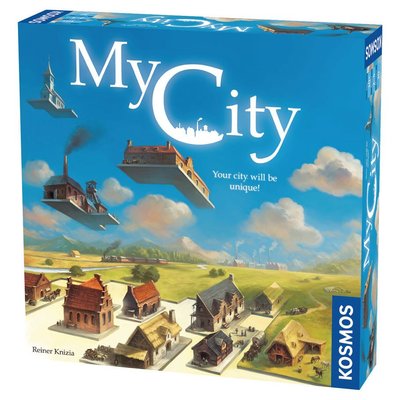
Rings. Number one for us is going to be a game called My City. Now, this is a legacy style game uh from Rhiner Cania that is a a polyomino tile placement game ultimately that you're going to be playing through uh several chapters. And each chapter is going to have kind of three games that you play within it. And each of those games is about 30 minutes each. So, if you're playing multiple in a row, of course, this will take longer than 30 minutes, but you can literally just play one game of it. It goes by really quick. And that's something that we really like about this game is that for a legacy type experience where you are progressing through a story, getting new game elements, stickering stuff, and all of those things, it is actually easy to kind of track what you're doing, track the changes that are happening in the game, and the games themselves play really quickly, so it's actually kind of palatable uh and easy to get through.
Something that we really liked. We played through My City twice uh the entire campaign two times. loved it both times. It's just super duper fun. And this is going to be a game where you are kind of a people arriving in an area and you are placing out these kind of three color of of tiles, ideally making big groups of the same color to start, but then you're going to be developing industry and you're going to be having, you know, life events happen uh that are going to change your board permanently. Uh you might sticker or get new um tiles and stuff that you haven't been able to place before. And then it's going to kind of change what happens from game to game. Then every new chapter brings about some even bigger changes. So now we're doing this whole thing and maybe that's going to be permanent or just for a short time. Uh, and I really enjoy all the things that come story-wise into the game, but you're always just trying to build out your player board area as efficiently as possible with these strangely shaped tiles. And I just really appreciate that the rules are simple. Each game itself is 25 or 30 minutes. So you can play through a whole chapter in a night. So you might play like three games back to back. And again, for something with a campaign where the rules kind of permanently change and things uh need to be remembered, a game that's just a little bit simpler, I think makes it a lot easier to actually take all that in and kind of get through this grander story and see it kind of build up over time.
So those are 10 games that are around 30 minutes or less that we really enjoy. some of which again provide a bigger game experience in a little less time which is always really nice. Uh if you don't always have time but I want to feel like I can crunch my brain just a little bit. Those are some of our favorites. But do us a favor in the comments. There's many games that fit this category. Filler games, party games and stuff. Get your picks for favorite kind of short quick games in the comments below. We always like to turn these into a chance for people to come and learn about maybe new types of games. So get your favorites in the comments below. We'd really appreciate that and we'll see youall next time. Bye everybody.