







Æterna Deep Dive
What the Community Thinks About Æterna
Æterna has generated strong reactions from board game reviewers, from enthusiastic endorsement to thoughtful criticism about its demanding nature. The game took home Board Stupid's Game of the Year award for 2025, with the reviewers calling it "an absolutely fantastic experience." At the same time, some players find the game's punishing mechanics challenging to enjoy, while others appreciate exactly that quality as a mark of elegant design. The consensus centers on one thing: Æterna is a game that demands respect and rewards careful planning.
Core Mechanics That Define Æterna
Area Majority and the Unrest Penalty
The beating heart of Æterna is a twisted take on area majority. Instead of rewarding players for controlling the most presence in Rome's seven hills, the game punishes dominance. The hills that end a round with the most workers erupt in unrest, and whoever leads those troubled areas advances along an unrest track. This inverted incentive structure transforms area majority from a straightforward "control it all" race into a delicate balancing act. Players must push for influence without appearing too greedy. Getting the majority in a hill gives you points, but leading a revolting area can cost you victory points and force you to pay maintenance or face doom tokens. Reviewers noted that this unrest mechanic is the "best part of the game" because it creates the psychological tension that makes every placement meaningful. You can score points here, but at what cost?
Card Drafting and Worker Placement
Æterna opens with card drafting as its rhythm engine. Players draft cards that offer building effects, passive abilities, one-time bonuses, and most importantly, workers. Those workers are desperately scarce. Once you've drafted your hand, you spend those workers placing them on the board to trigger actions and contest for majority. But the drafting phase does something clever: it builds in interaction before anyone places a single worker. The cards you choose not to take become available to your opponents, shaping what strategies remain open to them. Combined with worker placement on the board, where your actions can threaten majorities and trigger unrest, the game weaves interaction throughout from the opening card choice to the final scoring.
The Æterna Experience
A Puzzle of Elegant Constraint
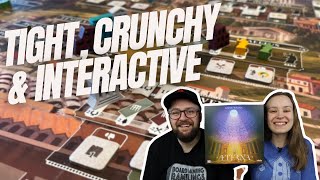
Playing Æterna feels like solving a spatial puzzle with a ticking clock. The game is relentlessly tight. Resources (workers, money, food) are limited, and the action phases follow rigid sequences. Reviewers described it as "brainmeltingly tight," and that tightness is by design. Each decision branches into consequences. Playing a card to gain workers locks you out of other options. Placing a worker to contest a hill affects not just this round's scoring but the unrest track for next round. The game trains you to think two or three turns ahead, calculating not just what you need now but what threats will emerge later. There's a moment of satisfaction when you've carefully assembled your pieces and executed a plan despite chaos. One reviewer captured it perfectly: you sit at the table planning which cards to play, realizing you don't have enough resources to do it all, then finding an elegant sequence of actions that unlocks everything, only to have an opponent take the one card you needed and watch your plan crumble.
The Tension of Narrow Victory
Æterna creates a visceral tension because so many paths to defeat sit just beside the path to victory. Push too hard for majority and you'll trigger unrest that costs you points or leaves you unable to pay maintenance. Neglect a hill entirely and you fall behind your opponents. The game doesn't let you dominate; it forces you to dance along the knife's edge. Reviewers consistently noted the interactive pressure, describing it as a "mean" game, but not in the attack-you-with-cards sense. Rather, it's a game where your opponents' thoughtful plays naturally create problems for you, and your best moves simultaneously benefit you and harm someone else. The tension comes from knowing that every smart decision you make is being evaluated by the table, and everyone will capitalize on vulnerabilities you reveal.
What Makes Æterna Stand Out
The Unrest Mechanic as a Moral Engine
The unrest track is not a side effect; it's the primary design innovation. Most area majority games award points for control. Æterna weaponizes control against you. This single mechanic redefines the game's entire psychology. It explains why Æterna feels different from other Martin Wallace designs like Brass: the game is not about building economic empires but about managing the consequences of influence. Thematically, it captures why Roman cities rebelled when power concentrated. Mechanically, it breaks the standard dominant strategy trap where the winning move is always "control more." Instead, Æterna asks: how much majority can you safely hold? This creates a completely different decision tree, one where losing a hill you held is sometimes the right answer.
Accessibility Through Constraint
Despite its strategic depth and tight resource management, Æterna plays with remarkable elegance. The rule book is lean, and the phase structure is straightforward: draft, act, score, advance unrest. Reviewers noted that while the first play feels overwhelming, the game's simplicity becomes clear on a second pass. There's no subsystem layered on subsystem; instead, all the tension flows from the core mechanic. This makes Æterna accessible to intermediate players while rewarding deep play from experienced gamers. You don't need to master dozens of card interactions to compete; you need to understand the unrest system and think ahead. The game scales well across player counts, too. With more players, the table becomes more crowded, making majority control harder and unrest more likely, which heightens the already-present tension.
Potential Drawbacks
The Unrest Mechanic Can Feel Punishing
The very mechanic that makes Æterna exciting also makes it feel mean to players who fall behind in the unrest race. If you've made one wrong judgment call early, you can spend the rest of the game climbing out of a doom token hole, struggling to pay maintenance on revolting areas you lead. One reviewer who initially loved Æterna eventually decided to remove it from their collection because they weren't comfortable being on the receiving end of that punishment. The game is unforgiving of mistakes, and unlike games where luck distributes fortune evenly, a player who makes poor decisions can find themselves systematically disadvantaged. This is a design strength for some players and a dealbreaker for others.
Cognitive Load and Playability Time
The tightness that creates elegance also creates analysis paralysis. Players who enjoy deep planning may find themselves stuck calculating multiple turns of consequences before committing to a move. One professional reviewer gave the game a middling score, noting there's "just a little too much going on" that prevented them from fully enjoying it. The 45 to 120 minute playtime window is wide enough that a game with experienced players plays quickly, but newcomers to the game face a heavy cognitive load. You're simultaneously tracking your card economy, your worker placement opportunities, the unrest clock, your neighbors' strategies, and long-term scoring paths. For players who prefer lighter games or quick decisions, Æterna can feel overwhelming rather than satisfying.
If You Enjoy Æterna
Reviewers who loved Æterna often mentioned they're fans of Martin Wallace's other designs, particularly Brass, though they note Æterna is its own animal. If you enjoy Galactic Cruise or Setti, you'll recognize the same type of deep, multifaceted game that offers multiple scoring paths and requires forward planning. Æterna occupies a similar difficulty tier and play weight. Players who appreciate games where player interaction emerges naturally from mechanics rather than direct conflict (like games centered on worker placement, territory control, or resource competition) will find Æterna's approach satisfying. If you love games where a single clever mechanism creates an elegant cascade of consequences, Æterna's unrest system offers that payoff in spades.
What Reviewers Are Saying
"This game is super tight. It is like brainmeltingly tight."
— Board Gaming Ramblings
"Interaction is woven in from the first moment. You've got card drafting which is intrinsically interactive. You then have this worker placement type thing which is also interactive. But this is also combined with an area majority type element."
— Board Stupid
"The core gameplay is so simple and smooth and elegant. I know this looks like a lot of icons, but they all become second nature almost immediately."
— Rahdo Runs Through