/pic7508098.jpg)















The Old King's Crown Deep Dive
What the Community Thinks About The Old King's Crown
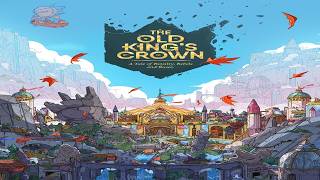
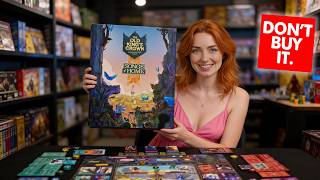
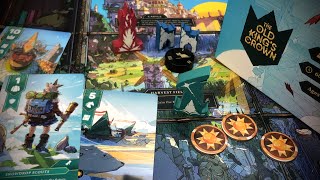
Reviewers agree on one thing before anything else: The Old King's Crown is stunning to look at. Board Game Critique described staring at the freshly unboxed components for twenty minutes before a single card was played. Stonemaier Games called the look of the game their favorite thing about it, naming designer and artist Pablo Clark directly and describing the tabletop presence as lavish and stunning. No Pun Included went further, framing the crowdfunded debut as an indie surprise from a first-time designer who also wrote the rulebook and illustrated every card in it, watching a loaner copy ahead of the crowdfunding campaign's own deliveries.
Where the community splits is on what that beauty is doing to the reviews. BigPasti built an entire video around the idea that a halo effect inflates how the game is perceived, scoring the aesthetic a ten out of ten while landing on 7.8 out of 10 for the gameplay underneath it. The Board Gaming Doctor arrived at the same 7.8 score independently, after comparing the game directly to Arcs and concluding they would usually choose Arcs instead because a fresh hand each round preserves a sense of agency that this game does not always offer. Board Game Critique took the comparison furthest, playing both games back to back for weeks and calling The Old King's Crown a beautiful tragedy, gorgeous to look at but heartbreaking to actually play, especially once a table grows to four. 3 Minute Board Games, working from a publisher-provided review copy, praised the world-building and called the solo mode one of the most involved they had seen, while flagging that the sheer amount of information to track made bluffing feel too chaotic for genuine mind games.
Core Mechanics That Define The Old King's Crown
Simultaneous Face-Down Clashes
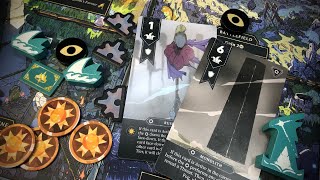
Each round plays out across three regions, and No Pun Included described the central loop plainly: players play a card face down to each region, then flip every card at once and compare who holds the largest number. Stonemaier Games singled out this structure as their favorite mechanism precisely because every player must commit to every region rather than picking which fights to join, turning each clash into a forced commitment rather than an optional skirmish. A herald placed ahead of time signals which location a player intends to win, and No Pun Included noted that being first to commit confers no advantage and every disadvantage, since every later move is made with more information than the one before it.
Asymmetric Factions and the Kingdom Card Auction
All four factions start with mechanically identical decks, differentiated instead by unique tactics tiles, faction cards purchased with a resource called lore, and a kingdom's-favor ability, per No Pun Included's breakdown of the game's layers of asymmetry. Before each round's clashes, players bid face down for kingdom cards in a blind auction. The Board Gaming Doctor explained that winning this auction only grants first pick from a shared pool of more than fifty cards, and that a card won this way can later be stolen by another player who outbids it in a future round. BigPasti counted fifty-one kingdom cards alongside the asymmetric faction abilities and called the resulting combinations immensely varied.
The Old King's Crown Experience
A Table That Stops Conversation
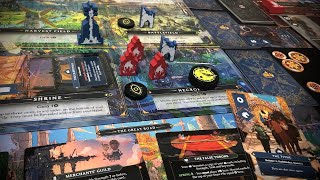
Multiple reviewers describe the physical presence of the game as an event of its own. Board Game Critique said people stopped talking when the board hit the table, pointing to the sprawling watercolor map and unique art on every card that built an atmosphere of a dying gilded kingdom. No Pun Included compared the effect to wandering the streets of an unfamiliar city, noting how each faction's own version of the same numbered card tells a story before a single rule is read. Stonemaier Games said they could get lost in the art mid-game, leaning on it to recover from moments of feeling overwhelmed by the amount of information on the table.
Bluffing Under a Knowledge Wall
Underneath the presentation, reviewers describe a tense read-your-opponent game that reveals its logic slowly. BigPasti argued that new players call the game random when it is close to deterministic, and that what feels like bad luck is really a knowledge wall: understanding every card in play, every faction's options, and every kingdom card on the table takes several games to climb. The Board Gaming Doctor described feeling genuinely helpless during a run of unlucky reveals and unfavorable kingdom cards where no amount of bluffing could change the outcome, contrasting that feeling with Arcs, where a fresh hand each round kept them feeling like an agent rather than a bystander.
What Makes The Old King's Crown Stand Out
Art That Tells the Rules
No Pun Included pointed to a detail other reviewers echoed: every faction's deck is mechanically identical to the others, but each card was illustrated separately so the artwork itself communicates how a faction plays before its abilities are explained. BigPasti made the same observation about the game's Ruse card, describing how the Uprising's version shows cheaply made wooden planks while the Nobility's shows a carefully laid stone monument, calling the pairing of art to mechanics the purest means of describing the factions' differences.
A Solo Mode Built to Last
The Simulacrim bot drew consistent praise across formats. Board Game Critique called it fantastic and said its priority-based bidding felt human, prioritizing high-value cards when it held kingdom's favor. The Board Gaming Doctor gave the solo integration five out of five, and 3 Minute Board Games called it one of the most involved solo modes they had ever seen in a hidden-placement game.
Potential Drawbacks
Dense Text and a Steep Rules Curve
Several reviewers flagged the same friction point: cards are gorgeous but hard to read across a table. Board Game Critique said reading card text from across the table was impossible and that every card being unique meant nothing could be memorized. Stonemaier Games agreed, noting they could not read upside-down text from across the table and found the layers of abilities overwhelming even after a single four-player game. No Pun Included separately flagged that the rulebook poorly explains the difference between actions and commands, leading many players to the same incorrect rulings.
Chaos That Grows With the Table
Player count changes the game's temperament sharply. Board Game Critique found four-player games devolved into chaos, with abilities repositioning or cancelling a player's cards with no way to anticipate it, and preferred the two-player game for feeling more stable and trackable. The Board Gaming Doctor echoed that chaotic feeling at higher counts and pointed to a run of poor kingdom card draws against the solo bot as an example of luck overriding strategy, ultimately deciding they would reach for Arcs more often for that reason.
If You Enjoy The Old King's Crown
Reviewers who compared the game most often reached for Arcs, the subject of Board Game Critique's full back-to-back comparison and a touchstone for both The Board Gaming Doctor and BigPasti, who described a kinship in design philosophy between the two games. BigPasti and The Board Gaming Doctor separately drew the same connection to Root, both pointing to its fully separate rule set for each faction as the more asymmetric counterpart to this game's shared deck. The Board Gaming Doctor also raised Challengers as a lighter alternative built around the same highest-number-wins core. No Pun Included traced the face-down reveal-and-compare mechanism back through Coup and Citadels. 3 Minute Board Games pointed viewers toward Libertalia for a simpler take on hidden clashes and Dune for a different angle on political maneuvering.
What Reviewers Are Saying
"12 cards face down across three regions. Zero way to track what anyone was doing. I played hoping to win the Highlands."
— Board Game Critique
"There is no doubt that The Old King's Crown is a majestic looking game. It has that unmistakable visual aura that can only be explained in the simplest of terms. It mogs. It mogs other board games."
— BigPasti
"It's a rich, brash melody, captivating with its arresting artwork and elaborate asymmetry. But give it a few listens and you'll discover a subtle melancholy underneath."
— No Pun Included