



Albion's Legacy Deep Dive
What the Community Thinks About Albion's Legacy
Albion's Legacy occupies a unique place in the hobby: a game with a modest BoardGameGeek rating of 6.7, released in 2015 and genuinely difficult to find, yet beloved by players who value thematic depth and emergent storytelling over polish. The Dungeon Dive's coverage reveals a game that transcends its component quality through exceptional game design. A 9 out of 10 reviewer on BGG captures this tension perfectly, noting that while the game contains abundant randomness, it empowers players to make tactical choices that meaningfully mitigate the worst random disasters. Another reviewer praises its strong theme and co-operative nature, observing that the randomness never feels like the game simply beating players down. Yet criticism exists: rulebook gaps have frustrated learners, and storage organization poses a genuine logistical challenge. What emerges across reviews is not universal acclaim, but genuine passion from players who recognize a deeply thematic cooperative adventure that rewards engagement with its world of Arthurian legend.
Core Mechanics That Define Albion's Legacy
The Camelot Hub and Modular Board Exploration
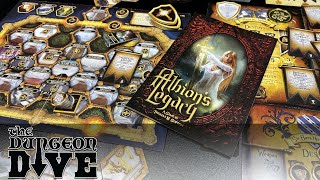
Albion's Legacy anchors all gameplay in Camelot, the fortified home base from which heroes venture into the surrounding realm. Camelot itself functions as a worker placement hub where characters can visit the treasury for relics, the forge to repair broken items, the monastery to boost altruism, the war room to enhance prowess, or the barracks to acquire new armor and weapons. The true brilliance emerges in how exploration unfolds outward. From the drawbridge to the north, heroes can only explore mountain hexes; from the docks to the west, only wetlands and rivers; from the sally port to the east, only forests. This logical constraint creates a tangible sense of geography, making Camelot feel like a real place surrounded by distinct regions. As these regions connect through hex placement, players can eventually explore all terrain types from any exit, but the initial containment creates an elegant progression of discovery. The modular board ensures no two games feel identical; the landscape players build is unique each session, reinforcing the emergent narrative that reviewers identify as the game's greatest strength.
Cooperative Resource and Character Management Systems
Heroes in Albion's Legacy are simultaneously the game's most powerful resource and its most vulnerable commodity. Each character possesses five attributes (prowess, movement, courage, altruism, loyalty) that determine how many dice players roll when facing challenges, but most can absorb only a single wound before retiring or dying. This squishiness forces players to think strategically about character deployment, rotating heroes in and out based on the threats they will encounter. The virtue token system operationalizes this rotation: players begin with six base virtue tokens plus one per hero, roughly ten "lives" for the entire party, and when a character is wounded beyond recovery or strategically sacrificed for a heroic action, players must discard a virtue token to bring in a replacement. This creates a constant tension: risk a character now and burn through a life token, or preserve lives for later? It echoes the tragic sacrifice inherent to Arthurian legend, where heroes fall in service of quests greater than themselves. Combat itself uses custom dice with attribute symbols and Mana Burst wild faces, creating that cinematic, swingy feel The Dungeon Dive praises for generating memorable moments, both triumphant and devastating.
The Albion's Legacy Experience
Immersion in Arthurian Narrative and Lore
Every element of Albion's Legacy reinforces its Arthurian setting. Character sheets feature flavor text rooted in legend: Sir Galahad's biography details his quest for the Holy Grail and his purity of heart. Relics carry storied names like Merlin's Staff, the Scepter of the Ninth, and the Banner of Emrys. Personal quests ask heroes to seek specific locations and overcome challenges to claim their unique artifacts, mirroring the personal trials woven through Arthurian romance. The Dungeon Dive reviewer notes that drawing a sequence of threat cards created an unplanned narrative: first a severe threat spawning a death knight and undead tokens, then general threats summoning more undead, creating an emergent story of a curse rising within Camelot. These moments of accidental storytelling are what players cherish; the game doesn't impose narrative but generates it through the collision of random cards and player agency. Many reviewers report that playing Albion's Legacy deepened their interest in Arthurian legend and mythology.
Dramatic Pacing and Escalating Tension
Albion's Legacy creates tension through dual pressure: heroes must earn quest coins by completing personal quests, exploring the realm, and defeating enemies, all while a despair timer ticks downward. Each game turn, despair advances: starting with six base despair tokens plus one per player, players must cover these tokens one by one, and once all flames are extinguished, the game ends in defeat. This timer ensures passivity is punished; you cannot simply farm equipment in Camelot indefinitely. The "key turn" mechanic compounds pressure: after all players take one turn, the first player gets an additional turn before the board fights back, threats move, and despair advances, creating a rhythm of hope followed by counterattack. A brutally difficult quest like the Holy Grail keeps players perpetually uncertain whether they will prevail, but the Dungeon Dive reviewer notes that losing never feels unfair. The optional rules let players tune difficulty to each table's sweet spot, so a game of Albion's Legacy rarely feels static; pressure mounts, heroes are sacrificed, and the desperate final turns often generate the most memorable moments.
What Makes Albion's Legacy Stand Out
Exceptional Content Density in a Compact Box
The base game ships in a small-to-medium box, barely larger than Popper's Ladder. The deluxe edition, including three expansions (Albion's Legacy, Old King, and Erin's Journey), somehow fits the entirety of its expanded content into that same box, managing what seems mechanically impossible: standee characters instead of miniatures, token enemies instead of elaborate sculpts, and cards instead of heavy plastic. The base game includes eight characters and three scenarios; the deluxe edition expands to thirty characters and over twenty scenarios. Each expansion contributes modular pieces: new realm tiles, new threat cards, new relics and items, new virtues, and alternative boards like Avalon that swap in for specific quests. The Bastion fortress expansion adds a secondary location in the mountains where heroes can repair, draw relics, and have encounters away from Camelot, easing logistical burden. A reviewer praises Lin Vander Studios for doing a lot with a little, and Albion's Legacy exemplifies this philosophy: nothing in the box feels wasted.
Character Progression and Specialization Through Items and Abilities
At first glance, Albion's Legacy characters feel simple: a few attributes, a special ability, maybe a virtue slot. But as games unfold, characters blossom. Heroes who equip armor and weapons gain damage reduction and attribute bonuses; those who claim relics add passive abilities; mounts grant movement and unique talents; and completed personal quests yield signature artifacts of tremendous power. A character who begins the game generic becomes, by endgame, a specialized tool tailored to the party's needs. The Dungeon Dive reviewer emphasizes that characters grow and diverge as play progresses, creating a sense of building a unique team. The retirement mechanic supports this: if the party faces dragons and one hero is terrible against dragons, that hero retires (burning a virtue token) and a better-suited character enters fresh. This is not a campaign where characters improve over multiple sessions but a single-game arc where equipment and abilities accumulate to transform a fragile adventurer into a capable hero.
Potential Drawbacks
Storage Challenges and Component Organization
The most consistently cited drawback is storage and organization. Albion's Legacy packs dozens of small tokens: generic enemy markers that are all the same size and shape but represent different enemy types; named enemy tokens that match specific threat cards and must be located quickly during play; virtue plaques; quest tokens; and numerous other chits. The Dungeon Dive reviewer describes this as a storage nightmare. Finding the correct named enemy token when a threat card is drawn, pausing the game to search through identical tokens, breaks momentum. One reviewer invested in external storage solutions and cheat sheets (available free on BoardGameGeek) to speed play, but acknowledges the organizational burden is real. The deluxe version exacerbates this: more content means more tokens, and the rulebook's recommendation to keep expansion decks separate is cumbersome to enforce through actual play. For players with limited table space, the modular board itself consumes real estate at maximum expansion. These are quality-of-life issues, not design flaws, but they represent a real friction point.
Rulebook Clarity Gaps and Starting Equipment Homogeneity
The second edition rulebook, while an improvement over the first edition, still leaves ambiguities, and several rules FAQs and fan-created clarifications exist on BoardGameGeek. A reviewer notes that relearning the game after time away proved more difficult than expected, requiring an hour of setup and rules review before smooth play resumed; the small font and compressed layouts make reference mid-game frustrating. Additionally, starting weapons and armor offer no variety: all characters begin with identical starting gear, differentiated only by name, a missed opportunity to reinforce character identity from turn one. The optional rules in the back of the rulebook, however, are well-designed and partially offset the base rulebook's limitations.
If You Enjoy Albion's Legacy
Players drawn to Albion's Legacy typically love cooperative hex-crawl adventure games with strong thematic elements and emergent storytelling. Gloomhaven offers a campaign-driven dungeon crawl with modular encounters and squad-based combat, though it trades Albion's one-shot adventure structure for long-term progression. Sword and Sorcery delivers similar tactical combat and character growth in a mythic-fantasy setting, though with a campaign focus. Mage Knight shares the puzzle-like resource management and the possibility of epic victories against brutal odds, though its learning curve is steeper. For hex-crawling exploration specifically, Runebound second edition offers a cleaner rules presentation and decades of fan-made expansion content, making it more accessible than Albion's Legacy. Tainted Grail weaves interactive storytelling into a cooperative experience, though its narrative-first design contrasts with Albion's mechanics-driven emergent tales. If the appeal is specifically the blend of Arthurian legend with tactical adventure, there are few direct alternatives; Albion's Legacy owns that niche.
What Reviewers Are Saying
"Albion's Legacy is a game that is rough around the edges but one overflowing with theme that creates interesting moments and emergent narrative situations from one turn to the next. It's a game that perfectly represents the phrase better than the sum of its parts. The loot is a little boring, the enemies are really nothing but an icon and a number, the UI and the art are okay, but when I look at all the various things that make up the game, I am left with a game that has engaged me on a level I haven't experienced in some time."
— The Dungeon Dive
"I love Albion's Legacy because while it does contain this randomness, I feel like the authors designed the game to help me manage that randomness. I can't remove it completely, but the game allows me to make tactical choices to mitigate the worst random disasters. Going into details would make this comment too long, but let me just wrap it up with saying that Albion's Legacy is a co-op with a strong theme, and while it's hard to beat, it never feels like just a randomness beating you up."
— The Dungeon Dive (featuring reviewer MJ Nac from BoardGameGeek)
"When you look at its pieces, this is the perfect game for that saying: it's it's greater than the sum of its parts, because its individual parts aren't all that great. It doesn't have a lot of fantastic art, the component quality is okay, it doesn't have a lot of flavor text, some of the encounters, it's it's kind of low on variety in the encounters, the enemies are just these really little boring chits that don't really have anything going on, but you start combining all of these various elements together and it just does such a fantastic job of creating that kind of midevil questing fantasy on the table, and this game got me into wanting to read more King Arthur."
— The Dungeon Dive