











Council of 4 Deep Dive
What the Community Thinks About Council of 4
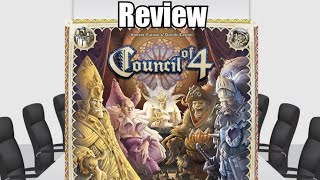
Board game reviewers have mixed-to-positive feelings about Council of 4. Reviewers consistently praise the core engine-building experience and the satisfying chain-reaction mechanics that emerge when merchants are placed strategically across connected cities. Getting Games and Rolling Dice & Taking Names both appreciate how the game teaches quickly and delivers an engaging escalation feel. However, some reviewers note a design tension: while the combo-building feels clever and rewarding moment-to-moment, the game's scoring structure creates a dominant race for high-value bonus tiles that can overshadow the engine-building satisfaction. One reviewer from Getting Games still enjoyed multiple plays but ultimately moved the game on, feeling the core loop had been exhausted. The consensus is that Council of 4 delivers an elegant, well-designed euro experience with meaningful decisions, though not every reviewer found lasting appeal after several plays.
Core Mechanics That Define Council of 4
Council Corruption and Engine Building
The heart of Council of 4 revolves around corrupting councils to obtain building permits and generating cascading resource flows. Each region has four nobles sitting on a council, represented by colored figures. On your turn, you can play cards matching those council members' colors to claim a permit card, or you can corrupt the council by pushing out one noble and replacing them with another. The beauty of this system is that it creates genuine player interaction: when you change the council composition, you force your opponents to adapt their plans or pay extra resources to continue their strategies. Getting Games notes that this decision space feels cleanly designed, with clear consequences for manipulation. The permits you claim give you immediate benefits and endgame bonuses, but more importantly, they let you place merchants on the board to build your empire.
Connected-Emporium Chain Reactions and Area Building
Once you place a merchant on a city, you unlock the bonus on that space. But the escalation magic happens when you place another merchant in an adjacent city: you activate both bonuses, and if that second merchant connects to a third, you trigger all three bonuses at once. Rolling Dice & Taking Names highlights how this creates a satisfying engine-building loop where early moves set up later cascades. Reviewers describe the moment when you place a single merchant and watch resources cascade across your network as genuinely fun. The modular board ensures that bonus placement varies from game to game, so each session creates different strategic incentives. You can choose to build tight clusters that generate powerful chain reactions, or spread your merchants across the map to secure control of entire regions for the region-matching bonuses.
The Council of 4 Experience
Clever Combo-Building Satisfaction
The dominant feeling reviewers report when playing Council of 4 is the joy of pulling off a clever combination. When you're building your network and you finally chain multiple bonuses together in a single turn, it feels rewarding. Getting Games explicitly calls out this sensation as part of what makes teaching the game enjoyable to others: "everyone I've taught it to so far has been like oh that was really cool." The combo potential draws players into planning ahead and visualizing how placements will interact. Rolling Dice & Taking Names agrees that the feeling of cleverness is one of the game's strongest selling points, noting that players get to feel smart by putting together combinations that generate resources in unexpected ways.
Escalation and Suspense from Cascading Effects
Council of 4 has an inherent tension as the game progresses. Early turns often feel quiet and contemplative, but as merchants accumulate and networks grow, individual turns become explosive. Getting Games describes this as "great escalation feel." The moment when someone suddenly activates a massive chain of bonuses creates suspense at the table, especially since everyone's watching to see if a player is about to pull away. Rolling Dice & Taking Names reinforces this, mentioning that near-miss moments (when you're one placement away from connecting to a high-value cluster) add real tension to decisions. You're always aware that your next move could trigger a cascade that shifts the board state dramatically.
What Makes Council of 4 Stand Out
Elegant Main Action / Secondary Action Structure
Getting Games praises the simplicity of Council of 4's turn structure: you have a main action (spend cards for permits or corrupt councils) and a potential secondary action (execute a follow-up move if you have resources). This clean framework makes the game teach quickly and play smoothly, even with the strategic depth that emerges from the options. There are no hidden rules or exception cascades to remember. The design respects the player's ability to plan ahead because the action space is clear and predictable.
Clear Escalation and Teachability
One of Council of 4's strengths is that newer players can understand what's happening immediately, while still discovering subtle strategic layers. Getting Games emphasizes that the game teaches well: the rules for council manipulation and merchant placement make intuitive sense. Rolling Dice & Taking Names and C Mon both note that the game's board state is transparent, so players can evaluate the consequences of their decisions without hidden information creating frustration. Even as analysis paralysis becomes a consideration in later turns, the clear decision tree prevents the game from becoming opaque or overwhelming for newcomers.
Potential Drawbacks
Race for Bonus Tiles Dominates the Meta
Rolling Dice & Taking Names raises a critical design concern: the Queen's bonus tiles (worth 25, 18, 12, and 7 points respectively) are so valuable that winning players consistently pursued the bonus-tile race rather than building impressive combo engines. In both games they played, the player who secured the first Queen's bonus dominated the final score. One reviewer noted that their final score of 77 points included almost 30 from a single bonus-tile action, making it nearly 40% of their victory. This creates an expectation problem: the game teaches by emphasizing combos and clever play, but actually winning requires prioritizing the high-value bonus tiles. Players who engage with the fun engine-building mechanics often discover too late that they've been playing for third place.
Analysis Paralysis and Frustration from Council Manipulation
Rolling Dice & Taking Names identifies a secondary concern: the decision space, while clear, can lead to substantial analysis paralysis, especially when players realize how impactful council changes can be. When you finally set up the exact council configuration you need, and an opponent changes it on their turn, the frustration is real. While reviewers acknowledge this is intentional player interaction, it creates moments of genuine annoyance, particularly if it happens repeatedly. Getting Games notes a possible runaway-leader scenario, though the fast endgame tends to arrest this before one player pulls too far ahead. The player-interaction mechanic is clever, but it adds friction to the experience.
If You Enjoy Council of 4
If Council of 4's engine-building and area-control mechanics appeal to you, consider these similar titles: Imperial Settlers and 51st State share the same designers (Simone Luciani and Daniele Tascini) and offer comparable engine-building escalation. Potion Explosion combines clever combo mechanics with satisfying resource cascades. Ticket to Ride shares the clean teach and transparent decision space that makes Council of 4 accessible. Gaea Project offers deep area-control gameplay with resource engine elements. All of these games reward clever planning and deliver that satisfying moment when your strategy comes together.
What Reviewers Are Saying
"Every single time you do that it activates everything behind it. This means you have a great escalation feel to the game as well as a bit of engine building."
— Getting Games
"It allows you to feel clever. I get to put together some combos using my servants and my gold and my cards, and combo that into some cool things that translate on the board. I get to turn things in, I get to generate resources, all those generate are fun actions in a game line. And I think there's some suspense to it too, that adds to the fun, just like one of my turns that I got one of the blues. I was expecting to be able to get the tile to do it, but I was taking a chance because I had to wipe the tiles and get two new tiles. I may or may not have gotten what I needed."
— Rolling Dice & Taking Names
"They did the same thing with Council of four. They said that was a very busy board, people didn't like the board's too busy, so we muted some of the colors, made the paths more well-defined. I said I need to share that with the audience because that is really cool, that they run the Expo, let people play it, listen, delay the game so they can fix it and make it a better game."
— Rolling Dice & Taking Names