/pic3615980.jpg)
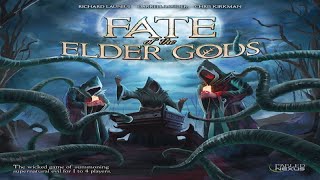
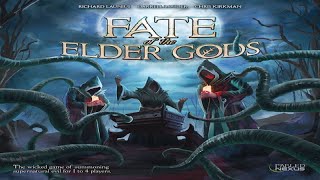
In Fate of the Elder Gods, players take on the ever-maddening role of cults trying to summon ancient evil and herald the fall of mankind! Each cult is in competition to be first to summon their god, but they all must also repel intrepid investigators working to seal off the gate to beyond with Elder signs. Gather arcane artifacts, cast powerful spells, embrace the Dark Gift of your Elder God, and be first to hasten doom...before it's too late!
During the game, players use a variable hand of spell cards to do one of two things to aid their cult in their mission: Use the spell's Astral Symbol to navigate the areas around Arkham on the unique Fate Clock board, or use the symbols in a location's Astral Column to ready a spell. Readied spells can be cast at any time, but while in a cult's Spell Reserve their primary Astral Symbol can aid in readying future spells, creating an engine for pumping out more potential power.
As cults travel to the six locations on the Fate Clock, they activate specific powerful abilities, such as gaining useful artifacts at The Museum or enabling their Elder God's Dark Gift at The Ceremony. As cults send more and more cultists to a location, they may gain control there, adding even more powerful abilities. However, cults must be careful how they navigate Arkham as a location with lots of activity will attract pesky investigators. Tempt fate too many times and the investigators may raid your cult's lodge, placing Elder Signs, and generally getting in the way of summoning your Elder God. Gain too many Elder Signs and it's game over!
If any cult can manage to raise their Summon Track to 9 before the investigators save humanity, their Elder God awakens and they win! Of course, "win" is a relative term as it will certainly herald the end of the world — but that's a small price to pay for eternal servitude to the Ancient Ones.


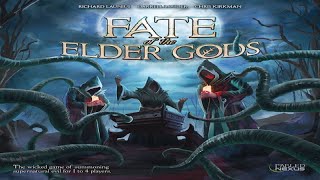
- Beautiful artwork and detailed miniatures.
- Unique theme of cultists summoning an ancient one, in a competitive manner.
- Engaging competitive atmosphere.
- Good replayability due to different Elder Gods and variability in gameplay.
- The spells and abilities add strategic depth and are not always available, requiring activation.
- Artifacts are cool and useful.
- The secondary abilities of locations are well-implemented and add strategic options.
- The board and menus are a bit too big, making it cluttered.
- Lack of variety in some spells.
- Curse cards can be annoying and force players to play around unknown effects.
- The game length can feel long, especially in a highly competitive 3-4 player game.
- Player powers might feel unbalanced to some.
- The theme could be easily cooperative but is made competitive, which may disappoint players expecting a co-op experience.
- Cultists summoning an Ancient One
- Arkham Horror
- Eldritch Horror
- Magic: The Gathering
- Risk
- Dead of Winter
Mechanics (from transcript analysis)
- Area Control — Players need to have a certain number of cultists in locations to gain secondary abilities, which is a form of area control.
- Drafting — Players select their unique Elder God abilities, which is a form of drafting.
- Hand Management — The game involves managing spells and deciding when to use them, with an emphasis on choosing between moving to a location or holding onto a spell.
- Push Your Luck — Dice rolls are used for certain actions and to determine the outcome of some events, introducing an element of risk.
- Set Collection — Collecting Elder Signs is one of the primary ways to win the game.
- Worker Placement — Players place cultists on different locations on the board to perform actions.
Video topics + discussion points
Quotes (from this video)
- This game does something that I've really really love which is hand management
- This is my most beautiful artwork to definition
- The artifacts which we haven't touched on I don't know I'm just the artifacts and curse cards we'll touch on those are the facts I feel like are really cool and useful as well
- I love the curse cards I think they're I think they're really cool they add an element of uncertainty
- This is a nine for me I cannot think of anything else for this
- It's a fun competitive atmosphere
- The theme of how you catch those I love because it's it's essentially the stars aligning
- The Beast from Beyond just adds more
References (from this video)
- Cutthroat gameplay
- Twist on Cthulhu genre by playing as cultists
- Cultists trying to summon their ancient one
- Arkham Horror
- Cthulhu games
Mechanics (from transcript analysis)
- Area Majority/Control — Control of a location is gained by having three or more cultists there and more cultists than any other player, which grants an additional action.
- Dice Rolling — Dice are rolled for various actions, such as when sacrificing cultists in the 'Other World' or during investigator raids, with different symbols having different outcomes.
- Hand Management — Players start with three spell cards and there is no hand limit, but they always draw back up to three cards at the end of their turn.
- Push Your Luck — Players can attempt to gain temporary control of a location by rolling a die, with a chance of success even without meeting the control conditions.
- Set Collection — Players may need to collect specific combinations of card symbols (e.g., white and green) to ready spells.
- Take That — Actions like initiating a raid on other players by placing investigators in their lodges, and curses that trigger negative effects for opponents, are present.
- Track Advancement — Players advance their summon marker on a track, with the goal of reaching the end to win. Elder signs can also advance on a separate track.
- Worker Placement — Players move a central 'fate piece' to different locations on the board to take actions, with the choice of card played determining movement.
Video topics + discussion points
Quotes (from this video)
- Viewer discretion is advised.
- I'm I apologize that it may feel a bit over like all over the place, but it's kind of difficult to explain how you move and what control and stuff is without explaining the abilities, but I couldn't really explain the abilities without explaining, you know, raids or spells or stuff like that.
- If I of course made any mistakes in explaining this game, let me know in the comments below and I'll like and love it so that it jumps up to the top and people can see while they are using this video.
References (from this video)
- The expansion 'Beasts from Beyond' adds monsters.
- The game has a fun theme of summoning Elder Gods.
- The game can be engaging with a good amount of strategy.
- The game is considered cutthroat, especially with an odd number of players.
- The rules can be complex and lead to frequent questions.
- Curses can be a nuisance.
- Summoning Elder Gods
Mechanics (from transcript analysis)
- action selection — Players choose actions from a set of available options on their turn, such as moving investigators, activating abilities, or casting spells.
- Area Control — Players attempt to gain control of locations by having cultists present.
- Card Drafting — Players acquire artifacts and spells, sometimes by drafting them.
- Dice Rolling — Players roll dice for various effects, such as checking for temporary control or resolving Cthulhu/tentacle symbols.
- Hand Management — Players manage cards in hand, including spells and gate cards, with hand limits.
- Set Collection — Players collect Elder Signs as a way to win the game.
- Variable player powers — Each player has a unique ability, like 'slothful sacrifice' or 'smooth with darkness'.
- Worker Placement — Players place investigator/cultist pieces on locations to trigger abilities or gain benefits.
Video topics + discussion points
Quotes (from this video)
- oh great Cthulhu come forth and devour this unholy world
- cutthroat games really don't work with odd numbers
- he was a piece of [ __ ] and there's no ifs ands or buts about that
- I love Cthulhu is like you're not supposed to know like is it aqua or is it it's a cut through Lou that's good no one knows
- yeah so for two days it's worse and for the first day we'll have actually built in with your eye that's right I forgot about that
- The real way to win the game is to have all
- I don't like to do it it's fine I fully expected to seem to be cut through so I'm not gonna be bad
- mortals can only control arcane hazard for so long
- I mean I if I didn't guess I probably know what triggers it but if I had to guess if I had to guess I'd say you take your turn don't you
- really the curse is um they're really more of just a nuisance they thing else
- the big no-no he starts a hammer and like he reports the whole process
- I don't really like cutthroat games or just not for me they're not for everybody and I just don't like them
- this is a disgusting turn of events like what happened
- I personally feel like this game is relies on me really paying attention
References (from this video)

- Unique board
- Liked the spell card mechanic
- Liked the area control element
- Unique abilities for each player
- Incredibly cutthroat and worked well
- Liked the art
- Gen Con hype game?
- Cultists summoning ancient evil
- Lovecraft
Mechanics (from transcript analysis)
- Area Control — Players gain control of regions which give them different icons and actions.
- Card Play — Players use a variable hand of spell cards.
- Deduction — Players had to remove elder signs/sigils.
- Unique Player Powers — Each player had a unique ability based on the god they were trying to summon.
Video topics + discussion points
Quotes (from this video)
- And then you have to balance the Defcon track and then balance your military while also uh balancing the victory points
- The fact that every player has a very busted player power, but because they're all bro because they're all broken, none of them are.
- This was the first game that I played that had that element. And I've always liked that ever since.
- It it's the battle of Helms's Deep H just with a different theme.
- So it wasn't the most highly narrative game, but it was something that I feel like this game needed right off rip.
- Just buddy cop buddy cop the game.
- The problem with modular expansions for games like this. And the reason why it's on this list is because I don't play this all the time.
- I would go out of my way to probably say this is the best pirate game.
- this one's gameplay just really does it for me.
- It hit number one because I'm I'd be more inclined to play BattleCon than I would any of these other games, but it also has been games that I haven't touched in a long time.
References (from this video)
- Unique theme and role reversal from typical Lovecraftian games
- High production value with great art and miniatures
- Interesting 'take that' mechanics and curse elements
- Multiple win conditions
- Can feel like it drags initially due to text-heavy nature and learning curve
- Requires memorization of location abilities
- Initial play might not be as enjoyable as subsequent plays once rules are known
- Playing as cultists trying to summon an Elder God to devour the earth, or trying to prevent investigators from stopping them.
- A world threatened by Elder Gods.
- Players manage resources and actions to achieve their cult's goals, with potential for player-vs-player 'take that' mechanics.
- Arkham Horror
Mechanics (from transcript analysis)
- Area Control — Players compete for control of locations on the board by having the most presence (cultists).
- Dice Rolling — Dice are used for various checks, including investigator infiltration and potential curse triggers.
- Hand Management — Players play spell cards to move their fate figure and perform actions.
- Hidden Information — Curses are held secretly by players until triggered, adding an element of surprise.
- Resource Management — Managing magic cards, artifacts, and cultist deployment is key.
- Variable player powers — Each player worships their own Elder God, and the goal is to be the first to summon it or prevent investigators from winning.
Video topics + discussion points
Quotes (from this video)
- It's like putting together just a perfectly fit puzzle.
- If you enjoy doing Excel spreadsheets, this game is for you.
- This game feels a lot like an RPG for miniatures.
- The math spreadsheet thinking part of the game, Oh My Heavens, our heads were hurting.
- It is it is is a social game it is a bidding game it is very much a economic game it's a bunch of different things crammed together that I think actually works pretty darn well.
References (from this video)

- eldritch gods / cults
- Lovecraftian mythos
Mechanics (from transcript analysis)
- area control / spell-casting via set collection — play color-aligned spell cards; move a central figure and summon cultists; discard cards to cast spells
Video topics + discussion points
Quotes (from this video)
- your videos are great I love your YouTube channel especially your playthroughs
- Lisboa is a beautiful game
- this was the funnest moment that I had at the convention
References (from this video)
- Cthulhu
Mechanics (from transcript analysis)
Video topics + discussion points
Quotes (from this video)
- The reason I highlighted Planet Unknown is that this is a game that is purely about building a planet.
- But I love the idea that instead of having a universe of planets that you can go and discover, instead you have one specific planet with a unique hook, a unique layout, beautiful art.
- So, in Hot Streak, it is a racing game for mascots.
- Delightful game. I think the the theatic and the uh mechanical twist make this game really stand out.
- Trading in the Mediterranean. Concordia is the game that I think has really broken through in this genre.
- They typically don't enjoy trading in the Mediterranean, but they really really enjoy Concordia.
- But if you're not into the Viking theme of I I guess exploring and pillaging, if you're not really into that, I think a game that stands out that's mentioned here is the game A Feast for Odin.
- But I think this game is just a really really good Eurothemed game that give players a lot of choices.
- So, Creature Caravan doesn't even really present itself as a zombie themed game, but it is.
- But I love that Ryan Locket put his own spin on zombie themed games by just having them be these lumbering creatures that that just follow you around.
- I say that because our game origin story, we have a different take on the the superhero theme in our collection now.
References (from this video)

- Artifacts provide powerful, varied effects (free spell activations, extra hand size, rerolls).
- Dark Gift/dice manipulation and artifact synergy offer strong, tactical options to influence turns.
- Gate cards provide flexible movement and wild locations, enabling planning.
- Runic Chalk increases spell capacity and works well with other effects (readied spells discounted).
- Jade Statue allows rerolls; Crown of Carcosa adds dice when contesting temporary control.
- Curses and elder signs can cause raids and loss of control, which can disrupt plans.
- Reliance on drawing and reading spells; color matching can constrain readiness and spellcasting.
- Nexus-related curses can swamp a player's Lodge with investigators, increasing raid risk.
- Very long turns and heavy decision trees; potential to prolong games.
- cult factions race to summon specific Elder Gods (e.g., Yog-Sothoth, Nyarlathotep) while investigators threaten to seal gates and raid lodges.
- board with six outer regions surrounding an abyss in the middle; the fate piece moves across astral columns and there are regions like the museum, library, gathering, ceremony, and streets of Arkham; investigators and cultists populate lodges and sey traits are used to summon Elder Gods.
- fully competitive, asymmetric play with each Elder God plaque providing a unique gift and players taking turns activating zones to advance on a summoning track.
Mechanics (from transcript analysis)
- Area Control — Control is gained if a player has more cultists in a region than opponents or has three or more cultists; if not controlled, a die roll can grant temporary control with a single Cthulhu-head result.
- area control and temporary control — Control is gained if a player has more cultists in a region than opponents or has three or more cultists; if not controlled, a die roll can grant temporary control with a single Cthulhu-head result.
- artifact and spell synergy — Artifacts like Jade Statue and Crown of Carcosa interact with spell preparation and temporary control, enabling rerolls and better chances to meet control requirements.
- artifacts and artifact slots — Artifacts provide powerful, one-time or ongoing effects (e.g., increase hand size, reroll dice, discount spell costs) and can be readied or discarded as part of actions.
- Card-driven movement — Players choose a card from their hand to move their cultist to a color-coded location (green, red, blue) and then activate that region.
- curse and cursed effects — Curses are drawn from a curse deck and can impose penalties; some curses affect how gates and rituals operate and can trigger further consequences if conditions are met.
- dark gift / elder gift — Elder Gods grant dark gifts activated when zones are controlled (e.g., destroying opponents' cultists, moving investigators).
- fate piece and astral column — A fate piece sits on an astral column; after placing a card, the fate piece is moved to the region matching that color, enabling the region's action.
- gate cards and wild locations — Gate cards act as wild locations; they enable movement to any location and can be discarded to move the fate piece; players typically hold one gate card unless using special effects.
- investigators and raids — Investigators populate regions; if enough investigators gather in a Lodge, raids occur with consequences for the players.
- Multi-Use Cards — Gate cards act as wild locations; they enable movement to any location and can be discarded to move the fate piece; players typically hold one gate card unless using special effects.
- readied spells and spell economy — Spells reside in a hand; spells can be readied (often requiring matching astral colors) to gain effects, with a limit of how many spells can be ready simultaneously.
- summoning track — Sacrificing cultists and rolling dice increases the summoning track; reaching nine points on the track wins the game; raiding and elder signs influence this progress.
Video topics + discussion points
Quotes (from this video)
- this is a fully competitive game
- artifacts which give us really nice effects
- the Nexus is bright and it is powerful
- I hope you enjoyed this playthrough
References (from this video)
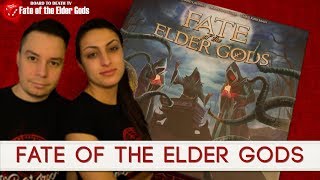
- Stunning UV printing and high-quality components
- Strong Lovecraftian theme with varied God abilities
- High player interaction and strategic depth
- Great replay value, plus a solo mode
- Long play time and slow start
- Notable luck influences from dice and spell draws
- Complex rules may be intimidating for new players
- summoning, cults, eldritch entities, cosmic horror
- Lovecraftian horror setting where players are cultists attempting to summon their God at various locations via lodges and relics.
- mythic horror with ritual and ritualistic object interaction
- Fabled Nexus
- Gurbin
Mechanics (from transcript analysis)
- Elder signs and curses — Accumulating elder signs influences effects and can curse players when triggered.
- God-specific powers — Each player controls a faction with a unique God that provides distinct abilities.
- Investigator mechanics and dice — Investigators impact locations; dice results can destroy threats or grant benefits.
- Lodge and location control — Players accumulate cultists in their Lodge and interact with locations that yield bonuses.
- Spell and artifact card play — Draw and resolve spells and artifacts; some require matching astral symbols and specific conditions.
- Summoning gauge — A progress tracker toward summoning your God; reaching thresholds influences victory.
- Symbol matching and spell casting — End-of-turn spell casting requires matching symbols to satisfy location requirements.
- Two-symbol repositioning — Playing two matching astral symbols can reposition a piece to any location.
Video topics + discussion points
Quotes (from this video)
- Lovecraftian theme game players take on the role of cultists trying to summon their God unto the world
- The UV printing is absolutely one of the best I've seen.
- The game is high in theme.
- Replay value is high with the different god abilities and solo mode.
- The game, however, is a little on the long side.
- Well-deserved 8 out of 10.