










Flourish Deep Dive
What the Community Thinks About Flourish
Reviewers approach Flourish expecting a light filler and tend to leave impressed by how much it rewards attention. Box of Delights introduced it as a quick gateway game from the team behind Everdell, and Board Games UnLocked admitted it surprised them by how much they enjoyed it. The praise centers on three things: the warmth of the theme, the production values, and the sense that a small rules set hides real decisions. Commentators describe the game as cute, delightful, and easy to sit down with, while still acknowledging that the choices under the surface are more interesting than they first appear.
Opinions split on how the game plays with others. The hosts of Meeple University were divided, with one leaning toward the cooperative version and the other enjoying the competitive mode slightly more. Board Games UnLocked said they would probably enjoy the cooperative mode more, because a big score from a neighbor becomes something to celebrate rather than something to resent. Brains On Games played competitively and came away praising the working memory workout. Most reviewers agree that switching modes changes the feel without changing the rules.
Core Mechanics That Define Flourish
Card Drafting Through Simultaneous Passing
The heart of the game is a drafting loop that reviewers returned to again and again. Each round, every player plays a card face down into their garden, then passes cards to neighbors before anything is revealed. Brains On Games pinpointed this step as the source of the tension, since the first turn is hard to plan around when nobody has played anything yet. Meeple University noted that the take, keep, and give rhythm is familiar from other drafting games, but that the hand of six leaves few spare choices. In solo play, the automated opponent McGregor receives the passed cards and shuffles them into his own deck, so they can come back around. Box of Delights described this extra layer as a question of what to pass and whether you want that card back.
Icon-Driven Compound Scoring
Scoring is where Flourish earns its reputation. Icons on each card, including roses, ivy, hydrangeas, fungi, hives, trees, and paths, score in several ways. Top-left icons pay out at the end of each round, bottom-right icons at game end, and some cards look across to a neighboring garden. Box of Delights walked through a card that scores one point for every rose in the garden and another that rewards matching cards held by a neighbor, showing how one placement can pay off several times. Brains On Games highlighted gate and pathway cards whose end-game payouts can reach six points, and noted that planning ahead for those payouts is part of the appeal. Friends and Follies then add adjacency and animal-based scoring on top. The result is a compound total built from many small categories, which reviewers enjoyed as a satisfying reveal even when it was hard to track in the moment.
The Flourish Experience
Quick Turns and Simultaneous Play
Reviewers consistently describe a game that moves quickly. Players act at the same time, and the four rounds turn over fast enough that the whole game fits in roughly twenty minutes. Box of Delights called it a gateway game that plays relatively quickly, with everyone choosing at once. The pace depends on the table, though, because Board Games UnLocked noted that players who tend to overthink their moves will find plenty of room to do so. The end-of-round checkpoints give the game a steady rhythm, and each round reads as a visible sequence of plant placements followed by scoring.
Working Memory and Shared Attention
Beyond the timing, reviewers spoke about the mental load. Brains On Games described constant mental math while tracking what sits in your own garden, in both neighbors' gardens, and in what you intend to pass, calling it a strong working memory exercise. Meeple University valued the interplay, noting that you have to watch what your neighbors are doing and pass them the cards that help their gardens. In cooperative play, Board Games UnLocked described players studying each other's gardens to work out what a partner needed, which created a quiet, collaborative puzzle with very little table talk.
What Makes Flourish Stand Out
Production and Tactile Presentation
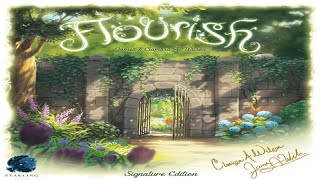
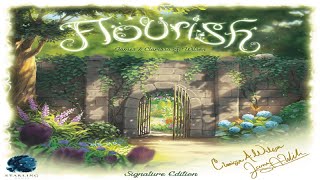
Almost every reviewer starts with the look. Box of Delights described the overproduction as a visual treat that invites players to relish the aesthetic, and Brains On Games called the artwork fantastic. Board Games UnLocked praised the thick components, the custom insert with a garden-style wall design, and pieces that are fitted to return to the box. Meeple University pointed to the beauty of the finished garden as a reason the game is worth setting up.
Modular Variants and Replayability
Reviewers repeatedly noted that the base game is only a starting point. Box of Delights pointed out that Friends and Follies come in the box of the signature edition and that players can layer one, both, or neither. Board Games UnLocked described a Garden Show variant that plays three consecutive games and awards ribbons, plus a two-player mode that simply passes two cards to a single neighbor. Brains On Games emphasized that the Follies add a visual spatial element, since you can rearrange the current round's cards before placing buildings. Reviewers generally agreed that an expansion should add one more wrinkle rather than bloat the game, and Flourish was described as meeting that bar.
Potential Drawbacks
Icon-Heavy Rules and Scoring Confusion
The most consistent complaint is the iconography. Meeple University said there are a lot of icons to learn, and that the rulebook's reference at the end helps, but they still wished the explanation were clearer. One host admitted being confused on first reading the rules, and noted that the game is not fully intuitive for players who are not already comfortable with icon-based games. Reviewers tend to frame this as a barrier for newcomers rather than a design failure, but it is a real hurdle on the first game.
Scoring can also feel fiddly in the moment. Board Games UnLocked found the scoring dials unnecessary and said a pencil and pad would be quicker, while acknowledging that the dials look good on the table. Tracking gets harder with the Follies, and Friends and Follies add extra layers that players can forget to account for. The most annoying moment, according to the same discussion, is the cooperative tally at the very end, when totals from several gardens must be added together.
Lightweight Feel Versus Crunchy Finish
The solo perspective in The Cardboard Herald exposed a tension that reviewers felt in different ways. The game feels approachable through the rounds, but the end-game scoring for a garden can become a crunchy reveal that arrives later than players expect. The same review suggested it is hard to pinpoint the mental state needed to sit down with Flourish, since it sits between a relaxed filler and a demanding scoring puzzle. Meeple University wished the cooperative game felt a little tougher, with less room to hold back the cards they wanted to keep. Box of Delights said the game feels a little niche in their collection, an honest read on how much space a lighter game with heavy scoring occupies on a crowded shelf. Board Games UnLocked also found the walls purely decorative in a recorded game, since the passing could be handled by simply handing cards across.
If You Enjoy Flourish
Reviewers placed Flourish near several familiar titles. Fans of Everdell will recognize the same design team, and Board Games UnLocked noted that Starling Games often makes games that look like gateway or family titles on the surface but carry real strategy. The same discussion compared the symbol matching to Splendor, where a built icon makes later purchases cheaper, and to Seven Wonders, because the game rewards chasing a scoring path while the cards in hand keep changing. King Domino came up as a contrast, since that game follows a more linear path toward its goal while Flourish keeps shifting. Meeple University expected a light card game in the vein of Sushi Go or Point Salad and found more tableau depth than they anticipated. Solo players will find Flourish a set of target scores to chase, as Box of Delights described when it presented the automated opponent and its medal thresholds.
What Reviewers Are Saying
"Really it's a simple game with lots of overproduction that makes it all a visual treat, but that's part of it. This is a game that's meant to look wonderful and you're meant to relish the aesthetic."
— Box of Delights
"The tricky part and what I think makes this game interesting is that the next thing you have to do before anyone reveals what card they've played is you have to pass one of the cards from your hand to each of your neighbors on either side."
— Brains On Games
"Overall for me, it was interesting. It was, I certainly enjoyed the game more playing it than I did when I heard the rules. It sounded, sounded very mechanical."
— Meeple University