






For Glory Deep Dive
What the Community Thinks About For Glory
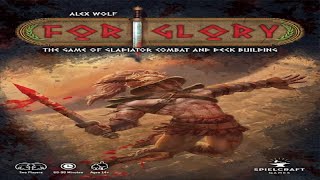
For Glory is a gladiator deck builder for two players, and reviewers agree on its premise: each player runs a gladiator school in ancient Rome, recruits fighters, courts patrons, and sends gladiators into arenas to win glory. Where they split is on whether the package holds together. Board Game Spotlight is a clear advocate. Its host calls the game a top ten title for them, praises its layers, and says they have been eager for it since playing the prototype. Board Games UnLocked is the sharpest critic of the head-to-head experience. Its reviewer found the game largely deterministic in a two-player match, gave the two-player version a five out of ten, and argues that the win condition is the core problem. 3 Minute Board Games is the most dismissive. Its reviewer and two separate playtest groups gave up partway through, calling the battles lifeless. Good Time Society offers a lighter, forward-looking take in a Kickstarter roundup, presenting the reprint of the base game and the Champions expansion as the reason to look again.
The disagreement comes down to how much randomness and momentum the game allows. Fans see a sharp, confrontational duel where every purchase matters. Critics see a race that can feel decided before the final arena fight, especially when winning one arena also grants a lasting power that the rival must then fight to take back.
Core Mechanics That Define For Glory
Deck Building With Reserves
Each player begins with the same small starting deck. During the Machinations phase, players spend coins and the cards in hand to buy from shared markets of gladiators, patrons, tactics, and economy cards. Purchased cards go into the discard pile, and the deck is redrawn back up to seven, so the deck cycles and grows more capable over time. Board Game Spotlight highlights the reserve as the mechanic that makes every turn a planning problem. A card a player does not want to discard can be placed in a reserve on the player board, then paid for later at one coin per card to return it to hand. The host asks how large a reserve a player can afford to carry into a fight, and the answer shapes the whole game. Board Games UnLocked agrees that the reserve is the most distinctive part of the deck building, since it lets players hold useful cards and pay to deploy them at the right moment. The same reviewer notes that a huge stockpile would not work well in a multiplayer game, because a player can only play one tactic per turn.
Arena Combat and the Race to Six Glory
Combat takes place in arenas. Three arenas are in play, two fleeting and one lasting. Once a gladiator is placed in one of the fleeting arenas, that arena becomes the battlefield for the rounds that follow. Whoever wins the lasting arena keeps its ability until a rival wins it back. Escalating thresholds on the Boast cards, which Board Game Spotlight reads as six, fourteen, nineteen, and twenty-four, determine when the arena phase begins, and the player holding Crowd's Favor controls when the fight starts. Influence from patrons caps how many gladiators a player can field, so the patron strategy is a limit as well as a resource. In combat, players alternate, gladiator speed decides the order of resolution, and each turn a player may play one tactic card to attack, exhaust, or damage a rival's gladiator. Reactions can prevent or redirect damage. Players can also pay three coins for late registration to bring an extra gladiator into an arena. The first player to reach six glory wins outright. Board Games UnLocked treats that instant win as the source of much of the frustration, while Board Game Spotlight treats the timing of tactics and reactions as the fun.
The For Glory Experience
Confrontation and Tension
Board Game Spotlight describes For Glory as very mean, a two-player confrontational deck builder where there is no avoiding interaction with the opponent. Tactics such as Snare, which exhausts a ready gladiator so it cannot act, and Brutal Strike, which deals direct damage, turn each combat into a contest of timing and information. Players try to strike the leader and block the rival's best gladiator before the arena resolves. The reviewer admits that they do not usually enjoy confrontational games, yet they get very into this one, and that tension is a large part of why the game works for its fans.
Frustration and Momentum
Critics describe a very different feeling. Board Games UnLocked calls its head-to-head match frustrating because the outcome of most decisions seemed set before the fight, and the leader kept pulling ahead. The reviewer felt that a player holding a lasting arena gains a permanent advantage, which makes the rival's effort feel wasted. 3 Minute Board Games describes the buildup as busy work: players buy cards, cycle through the deck, and wait for a battle that feels bloodless and slow to resolve. The reviewer concludes that a game one can laugh at is preferable to one that simply makes the player want to stop.
What Makes For Glory Stand Out
Gladiator Abilities and Variety
Board Game Spotlight praises the asymmetric abilities of the gladiators, which trigger during combat and add depth to every tactic choice. Board Games UnLocked agrees that the gladiators have interesting abilities and a range of types, and it singles out the Champions, which begin as a basic version and level up into stronger forms with bigger effects. The Spartacus champion, which takes on the text of a target gladiator, is one card the reviewer found difficult to track, which suggests that the variety is substantial. Good Time Society similarly points to the new upgradeable Champion cards as a reason the expansion stands out.
Components and Table Presence
Board Game Spotlight is enthusiastic about the artwork and the prototype's metal coins and swords, saying the prototype feels like a final product and recommending the Kickstarter page for the art in full resolution. Good Time Society frames the game's return as a reprint that is ready to be seen again, with the Champions expansion as the draw. Not every reviewer shares the enthusiasm for the visuals. Board Games UnLocked describes one set of card art as grotesque and says it prefers the more creative style of other art in the game.
Potential Drawbacks
Deterministic Head-to-Head Play
The most detailed criticism comes from Board Games UnLocked, whose reviewer argues that in a head-to-head match almost everything becomes predictable. Because the deck cycles so many times before a battle, both players tend to know what the other can field. The reviewer adds that once a player has a commanding lead, the rival has little reason to contest the arena that holds the remaining glory, so the first to six wins outright. The reviewer also notes that holding Crowd's Favor gives one player control over when combat happens, which compounds the advantage of whoever is ahead. The suggested fix is a victory point system scored across rounds, rather than an instant win on reaching six glory.
Long Games With Repetitive Battles
Length is a recurring complaint. The Board Games UnLocked reviewer says a head-to-head game took roughly an hour and a half, and that the machinations stretch between battles felt slow. 3 Minute Board Games reports that two different groups abandoned the game, describing battles that use a whole page of rules to resolve simple attacks. Board Games UnLocked contrasts the pace with Spartacus, which the reviewer says offers more intrigue and behind-the-scenes politics between battles. Players who value a steady rhythm of play may find For Glory hard to sustain at a table.
If You Enjoy For Glory
Board Game Spotlight draws the closest comparisons, saying that fans of Star Realms and Hero Realms, and of any two-player confrontational duel, should find For Glory appealing. The reviewer's reasoning is the shared sense of a direct, combative duel between two players, with the same thrill of setting up a strong turn against an opponent who is trying to do the same. For players who want the deck building and the head-to-head contest but with more depth behind the scenes, Board Games UnLocked recommends Spartacus. The reviewer describes Spartacus as offering more intrigue, a victory point structure rather than an instant win, and dice that make combat less deterministic. Anyone who finds the head-to-head frustrations discussed above to be a dealbreaker may find Spartacus the better fit.
What Reviewers Are Saying
"There are just so many unique layers to this game. That, to me, instantly, I was like, I love this game. I freaking love this game."
— Board Game Spotlight
"I just found in a head-to-head game basically everything to be completely deterministic, and that's what we were talking about, and I do not find that fun at all."
— Board Games UnLocked
"I'd rather play a game that's so bad I can laugh at it than a game I just want to stop playing because I'm bored."
— 3 Minute Board Games