/pic121746.jpg)
Hacienda has players competing for space on the South American pampas, aiming to bring their livestock to the most markets. You get three actions a turn to buy cards which then let you lay tiles to control land and herds, or you may buy extras, such as waterholes or the haciendas of the title to get bonus points.
The game has two card decks, one showing the different land types on the hex map, the other the different animals (pigs, cows, horses and sheep). Some cards are laid face up and you pay 3 pesos to buy the ones you want, or 2 pesos for an unknown card from the draw deck. You spend the cards to put your markers on land and to place your animal tokens on the board. Animals of a type go together to make a herd naturally, and each time a herd touches a market town on the board, you earn money for the size of herd and land attached. With careful hand and herd management, you can make good cash gains and also block your opponents. You need the money to buy more cards of course. 12 pesos also buys waterholes you can place next to your herds, or haciendas to go on your land or herds. If you run short of money, you can call a harvest and get cash off your land.
But the game is not about money. You score victory points halfway through the game and at the end. The more markets you are serving, the more points you get. The herds and the land get you points. The water and haciendas get you bonus points as well, which can be crucial to your success.
It should be noted, the game board has two sides: a symmetrical dog-bone shape of land types (appears in most of the photos), and a "random" more varied pattern of land types.
Online Play
http://www.spielbyweb.com/ (turn-based)
Yucata (turn-based)



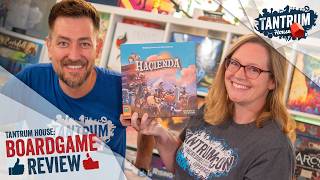
- Streamlined system with cards instead of money.
- Fresh coat of paint on the artwork.
- Plays out nice and big on the table.
- Has a lot of fun art and character.
- Plays up to five players.
- Pretty steady game once rules are understood.
- Low player-versus-player interference / analysis paralysis.
- Some wooden animals don't fit on the spaces.
- Player aids have microscopic sized icons that are hard to see.
- Scoring is a little convoluted and tough.
- Initial play can be tricky due to scoring and player aids.
- Placing animals and land markers on a board.
Mechanics (from transcript analysis)
- Card Drafting — Players draw cards on their turn.
- Set Collection — Players collect matching cards to play them.
- Tile Placement — Players place tokens on the board, including animal, land, water, wildlife reserve, or viewing platform tokens.
Video topics + discussion points
Quotes (from this video)
- The mechanics stay true to the classic original game.
- It kind of streamlines the fiddliness of exchanging money throughout the game.
- This is got a unique color scheme to it and plays out nice and big on the table. Has a lot of fun art and character things going on inside the game.
- My one beef with the animals is some of them don't fit on the spaces.
- The player aids you need to be able to see certain icons on to tell you what they do. That most of them are like microscopic sized on the cards.
- The scoring is a little convoluted, but you'll figure that out after you've done it once or twice.
- We were a little disappointed when it wasn't as streamlined and easy to get into for our first play because the scoring was a little tricky and the player aids were not as helpful as we would have liked.
References (from this video)
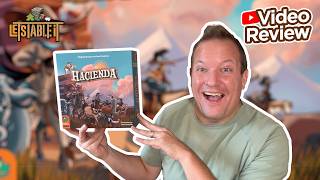
- Easy to learn but has decisions that require efficiency.
- Components are great, wooden animal meeples with cards.
- Double-sided tiles offer variety and replayability.
- Animal meeples always win (appeals to children).
- Scoring is kind of hard.
- Movement between numbers is narrow and it could be hard to know where each of the tokens are actually at.
- network building of placing animals and land markers to score points
- Argentinian wilderness
Mechanics (from transcript analysis)
- action selection — Players take three actions on their turn from a list of five different actions.
- Hand Management — Players start with cards, can take more cards, and must use matching cards to perform actions, aiming for efficiency.
- network building — Players place animals and land markers onto the map to score points in several different ways, building networks around visitor centers and water tiles.
- Set Collection — Discarding cards with matching terrains or animals to place markers and animals, or discarding six cards of different terrains to place a viewing platform.
- Tile Placement — Players place land markers, animals, and water tiles onto the game board.
Video topics + discussion points
Quotes (from this video)
- Let's Table It, where we get games to the table like this one here, Hacienda.
- It's a network building game of placing your animals and your land markers onto the map to score points in several different ways.
- The game is kind of easy to learn but just has decisions that will, you know, need to make you try to be more efficient, you know, being in Argentinian wilderness, you know, it kind of goes with that.
- Me and my kids have definitely enjoyed this one, you know, animal meeples always wins.
- The components are great, wooden animal meeples with cards, you can't lose with that.
- So really, if you want to save the pumas, the guanacos, the capybaras, and the armadillos in the Argentine wilderness, this game has your name on it.
References (from this video)

- Good-looking and cute.
- Not personally excited about it.
- Placed at the bottom of the ranking.
- tile laying and animals
- terrain
- El Grande
- Sagrada
Mechanics (from transcript analysis)
- Card Drafting — you draft cards.
- network building — score points based on the network that you have created with your animals as well as the terrains right next to them.
- Tile Placement — using those cards, you place tiles and things and tokens and so on.
Video topics + discussion points
Quotes (from this video)
- King of Tokyo is having a new version.
- Wingspan now will fit your pocket and
- Scythe. Oh boy, you can't imagine what will happen with Scythe.
- The hottest board games out there right now like a civilization game that will be super streamlined and good.
- To talk about the Jewel game first, we have to check Scythe and Expeditions because the Jewel game is kind of mixture of both of these.
- It's a two-player board game where one player will play there with the rules of Scythe and the other player will play Expeditions rules and they fight with each other.
- This sounds really exciting. How exciting? Let's rank it.
- To be honest, this has really made me want to play Scythe now. So I am excited.
- In King of Tokyo, you are trying to be the best monster possible.
- This is right up Yiannis's alley.
- So, this one goes here. Whoop.
- The third place goes to -60°, which is a heavy heavy Eurogame, and we don't have much information about it.
- Gray Loon takes us back into medieval times and this board game looks gorgeous and promises us two things.
- It's generally a mechanical Eurogame, which is not bad at all.
- And this time, the top step goes to Time Span, which is a streamlined civilization game that looks gorgeous.
- It's highly worried because of those asymmetric powers and things and it's simultaneous, which means that uh you basically will play at the same time most of the game so it's much quicker.
- So these were the hottest board games of the month. What do you think? Which one of these are you the most excited to try?
- Remember to support the channel cuz that's how we can do all this research, spend time in making that lovely presentation and uh not remembering all the names of the games and people and so on.
References (from this video)

- new version
- herding with birds
Mechanics (from transcript analysis)
Video topics + discussion points
Quotes (from this video)
- Hello everybody. Welcome to the Dice Tower most boring unboxings in the world
- This is a box made by AEG.
- Well, that looks interesting.
- I reviewed Pirate King before. This is a nicer box for it for sure.
- The embargo is as of the moment that I opened it.
- Rocket Ranchers, herding cats in space.
- Sushi Go Party! is a fun little game. It's quick.
- This is a fun little game, it's quick.
References (from this video)

- Modular board scales to player count
- Card-based action system
- Eco-themed setting
- Accessible in 45–60 minutes for 2–5 players
- Rule complexity can be steep for new players
- eco-conscious entrepreneurship
- Patagonia, Argentina
- economic_engine_building
- Taverns and Tiffen
- Grand Austria Hotel
Mechanics (from transcript analysis)
- Card-based action system — actions are driven by a card system that replaces traditional currency mechanics.
- economic_engine_building — players optimize resources and actions to grow their economy and score.
- Tile Placement — players place tiles on a modular board to develop their grid and economy.
- variable_player_powers — different player setups create unique early-game synergies.
Video topics + discussion points
Quotes (from this video)
- This is a two to four player game 60 minutes from Yellow.
- I love the fact that they went with cute critters.
- This looks like it's going to be a great game.
- I love when that flavor sort of adds to when you find these little things while you're playing the game.
- Orthogonally adjacent.
- It's so funny because if you you know, for board gamers, we say orthogonally adjacent all the time, but it's such a weird phrase.