



Insania Deep Dive
What the Community Thinks About Insania
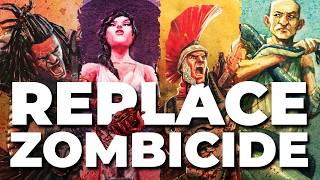
Insania is a cooperative horror adventure set in ancient Rome, where legionaries fight nightmarish creatures that blend mythos and undead imagery while their own sanity slips away. Reviewers on the Quackalope channel present it as a direct challenger to Zombicide and Cthulhu: Death May Die on a crowded shelf. In one video about downsizing a collection, the host said Insania could take the place of both games, describing it as a smaller, more contained package from an indie publisher that still delivers a one-shot adventure with a campaign option.
The gameplay walkthrough, filmed with developers Constance and Marcelo on Tabletop Simulator, gives the strongest sense of how the game feels at the table. The host called it "a weird amalgamation of Cthulhu Death May Die with the occult," adding that it brings a historical romance of Rome together with the overwhelming enemy swells of Zombicide. Reviewers noted that the digital platform was clunky, yet the brutality and card-driven tension still came through clearly.
Core Mechanics That Define Insania
The Initiative Track That Keeps Shifting
Every revealed creature joins a shared initiative order, and that order is not fixed. Creatures with movement icons shift their position each time they activate, so an enemy that appears early can quickly move ahead of the heroes. Portal activations and events add more creatures to the queue, and some events can pull the entire board forward or stall it. The developers explained that an event can be placed into the initiative and then discarded when its token reaches it, which means the timing of threats is always under pressure. The host singled this design out in the gameplay video: "One of the most fascinating things about the design choices here in Insania."
Effort Cards, Connections, and the Round Clock
Each hero works from a hand of effort cards that drive nearly every action. Cards pair along colored connection edges, and the combined numbers have to meet a threshold to hit an enemy, search a location, or close a portal. Recharging refills the hand at the top of each round, but the deck can run out. The designers explained that running out of effort cards can cost the group the game, which makes hand management and the pace of the scenario part of the same system. The host praised this as a subtle timer: "It is also one of the more elegant or responsible round replacement timers I've seen a board game of this style do." The result is a clock that is felt through the cards rather than announced on a tracker.
The Insania Experience
Brutal Horror Set Against Roman Spectacle
Insania commits fully to its setting. Gladiatorial arenas, Roman legionaries, and the political collapse of the empire all sit beside creatures that come from outside the known world. The host described the enemies as "flesh abominations" that mix "mythos and the undead, the demons, the architecture of whatever it is that lives behind" the visible world. Reviewers felt the game does not soften its horror, and the host argued that it "doesn't apologize" for its brutality. For players who want gritty, unflinching fantasy, this tone is the main attraction.
Narrative Pressure and the Sanity Clock
The tension in Insania comes from a one-shot structure that gives the table very little room to recover. The host framed this as the core appeal for players who like a climax: "Well, in this type of game, I never want to be a walk in the park. I want to feel squeezed as we hit that threshold. I want to have to plan the actions." Insanity adds a second layer of pressure. Insanity cards can grant strange abilities, but the host noted that most of the time they arrive as painful, negative effects because the world is literally crumbling. Players have to decide whether to absorb the damage, defend an ally, or spend effort to protect their own mental state.
What Makes Insania Stand Out
Flexible Play: One-Shots and Linked Campaigns
Constance explained that each scenario works on its own as a one-shot, so a group can sit down and jump into whichever chaos it wants. A larger, more story-focused campaign ties the scenarios together with carryover, and the designers mentioned one-night campaigns that let a group play a short, multi-part story in a single evening. The host valued this structure because it matches the reality of adult game nights: "Insania gives us that oneshot scenario, that challenging cooperative adventure, that party of explorers going off and fighting something evil and unknown. It gives it to us in at least an equivalent way to how Zombicide does." The option to link the scenarios is what sets it apart for players who want a campaign without a long-term commitment.
Character Growth Through Items and Boons
Heroes grow by finding and equipping items, and matching item connections unlocks boons with individual powers. The priestess Livera can read the future in the entrails of slain enemies, while the gladiator Atacus carries a sword and armor that deepen his combat options. Items can also be traded, and a single well-placed weapon can transform a hero's options for the rest of the scenario. The host praised how this blends both styles: "Insania gives me that rich deep character building without compromising either of these two sides." Players are rewarded for planning their connections, which makes each new find feel meaningful.
Potential Drawbacks
Mature Content and Tonal Risk
Insania is rated 18+, and the reviewers were direct about who may pass on it. The host noted that the game "plays with sexuality, plays with brutality, plays with human form and history," and that some items have oddly phallic designs that will not suit every table. A designer acknowledged that the 18+ rating, as with Kingdom Death: Monster, will keep some players away from the game. The host also drew a line between thematic content and gratuitous content: "The one issue that I have is when I feel like something's put into a game for the sake of just being gratuitous." Groups who want more restraint should review the art and items before purchase.
Chaos, Luck, and Prototype Uncertainty
The reviewers acknowledged that Insania is not built to be fair in every moment. Events can change a scenario abruptly, and the developers said the session was played on hard difficulty with fire and stronger enemies enabled. The developers also said the rules were still being tweaked, and the host noted that a few mechanics, such as the central district action cost, might change before release. The gameplay also became heavy when many enemies filled the board, even though the host did not find the rules complicated. Players who dislike variance may find the swings frustrating, while players who enjoy a tense, unpredictable board may find them exciting.
If You Enjoy Insania
Reviewers pointed to Zombicide as the closest reference point, especially for its scenario escalation, random loot, and character development. They also tied the brutal tone of Zombicide: Black Plague to Insania, describing it as a "brutal, gritty, hard, challenging game" that asks owners to add expansions and modules before it feels complete. For players who want lore-heavy horror with character growth, Cthulhu: Death May Die remains the clearest comparison, and the host credited that game with more personal, progressive characters. Players who enjoy the gruesome art and unapologetic horror of Kingdom Death: Monster will likely find the same appetite here. Fans of gladiatorial stories will also recognize the setting, which the host linked to the gladiatorial movies and TV shows from HBO.
What Reviewers Are Saying
"Insania gives us that oneshot scenario, that challenging cooperative adventure, that party of explorers going off and fighting something evil and unknown. It gives it to us in at least an equivalent way to how Zombicide does."
— Quackalope
"Well, in this type of game, I never want to be a walk in the park. I want to feel squeezed as we hit that threshold. I want to have to plan the actions."
— Quackalope
"One of the most fascinating things about the design choices here in Insania."
— Quackalope