/pic5282722.png)
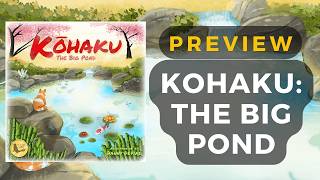
Kohaku is a peaceful koi-pond-building, tile-laying game. Each turn, players will draft both a Koi and Feature tile from the central pond board to place into their personal koi pond.
Score points by surrounding flowers with koi containing matching colors, placing frogs next to koi tiles that have dragonflies, and ensuring that baby koi have a safe place to hide by placing them near rocks.
Butterflies score based on line of sight, so make sure to line them up with similar-colored koi. Turtles and statues bring a sense of balance to your pond and score points more easily, but sometimes aren’t as valuable as some of the other features.
You must carefully plan the placement of your tiles, because once they are in your pond, they can’t be moved! With no restrictions on the shape of your pond, you can build a unique layout to maximize your koi pond’s appeal.
After there are no koi tiles available to refill the central pond board, the game ends. Players will total the points scored by each feature in their pond. The player with the most points wins.
—description from the publisher


- Beautifully deceptive
- Visual feast for the eyes
- Great intro game for new players
- Elegant tile drafting
- Plays best at two players
- Crunchy and thinky gameplay emerges over multiple plays
- Cultivating a koi pond
- Japanese garden pond
Mechanics (from transcript analysis)
- Pattern Building — Players try to match koi to scoring ornaments around them, score for dragonflies near frog tiles, and butterfly tiles score based on matching koi colors in rows/columns.
- tile drafting — Players draft two tiles per turn: an ornament and a koi tile.
- Tile Placement — Players lay out drafted tiles in their own pond in a patchwork style, alternating between ornaments and koi.
Video topics + discussion points
Quotes (from this video)
- two-player games are perfect for date night
- finding the right two-player game for you can be almost as difficult as finding the correct rules for a game of Uno
- Wow I'm impressed these two player board games have gotten so much better over the years
- forget wine and dining how about wine and a board game good day and enjoy your next game goodbye
References (from this video)

- Gorgeous crunchy puzzle
- Easy to teach
- Incredibly deceptive depth
- Requires significant strategic thinking in tile placement
- Designing and scoring a koi pond
- Japanese garden pond
Mechanics (from transcript analysis)
- Pattern Building — Arranging tiles in a checker-style pattern to expand the pond.
- Tile Placement — Placing tiles to score koi and match them with ornaments.
Video topics + discussion points
Quotes (from this video)
- i thought i'd take a little bit of a different angle with this talking sanctuary video topic where i'd showcase some board games that remind me of my dad and the relationship that we have
- the adversity that he has gone through you know he's lived through the vietnam war he had to leave his home his entire family had to leave and um he became a boat refugee where he spent three days and three nights on the open ocean
- it was an incredibly emotional experience to be able to walk in his shoes and just really see his reactions to how everything had changed as well as not changed
- these are games that i have either played with my dad over the years or their games that i'm really keen to get out on the table this father's day and have a go
- one of the fondest memories that i have with my dad in terms of board gaming is the time he taught me how to play chinese chess
- this game just encapsulates you know the cons that my dad and i have together and the appreciation of you know how he's inspired me to become the person that i have
- i know that's those raw memories that make those experiences resonate with you for the rest of your life
References (from this video)

- Zen Pontar
- Cascadia
Mechanics (from transcript analysis)
Video topics + discussion points
Quotes (from this video)
- I got this awesome new puzzly game called Shallow Sea, and it's just like Cascadia.
- I also got this really popular game called Harmonies, which a lot of people say is kind of like Cascadia.
- Hey, I even got recommended this game called Kohaku, which is a Zen Pontar lane game that's very reminiscent of Cascadia.
- I got Calico, which is like Cascadia, and Cities, which is kind of like Cascadia, too.
- Well, have you heard of life of the Amazonia? It's just like Cascadia.
References (from this video)

- Beautiful tile laying game
- Peaceful
- Gorgeous art
- Cheaper version available now
- Second edition will have cardboard tiles instead of chunky acrylic tiles from the first edition
- Koi pond
Mechanics (from transcript analysis)
- tile laying — A beautiful tile-laying game where players create a koi pond.
Video topics + discussion points
Quotes (from this video)
- I'm Grant with Grant's gamerex back with my monthly video on the best games coming to retail uh this is the month of March 20122
- I guarantee I pronounce that wrong but I did my best okay founders of taakan
- You know so you can play you can play how our Health Care system is flawed here in America hey we want to treat patients but we want to make money doing it we don't care if you're healed if we don't make money so do you want to be frustrated by America's Health Care System then play Clinic
- if you've never played flux it is a small card game that is wacky and wild and always changing and that is the point of the game
- so if you're looking for a sort of Stone Age theme uh that involves a bunch of luck but is very accessible to all family members then check out fire and Stone from Pegasus
- it's sort of a murder mystery mixed with an escape room Style game
- this is actually a revised version of a game that came out in 2012 and a lot has changed here it is not the same game that came out in 2012
- they are educational publisher they publish educational games but they don't feel like educational games the whole you know the point of the game is to be a good game and to have a fun game and to have interesting gameplay all while educating you on a particular theme
- I love the community of board games and we help each other find good games
References (from this video)

- Gorgeous and has pretty acrylic tiles.
- Reviewer likes this type of scoring opportunity game.
- Cute aesthetic plays a part.
- Reviewer has never played it.
- Might be too abstract for some.
- Koi fish
- Butterfly game
- Kingdoms
Mechanics (from transcript analysis)
- Set Collection — Involves collecting sets of tiles.
- tile laying — Involves tile laying to score opportunities.
Video topics + discussion points
Quotes (from this video)
- And this is uh Jason and the Argonauts. So, a solo quest with uh silver foiled cards, you know,
- But I felt like it was a bridge too far. I hope that they I I think a couple of of little tweaks honestly could have turned it into a really good game.
- Um, I think stealth in board game form is a little hard to pull off.
- Why why why would you call this Legacy of Mars?
- The legacy is the biggest complaint about this. The calling it a legacy, calling it legacy of Mars, I think is a problem.
- It's just a big old gamble on a piece of tech that you don't know is proven, right?
- My pick of the week is Jason and the Argonauts, a solo quest.
- I really like the theme. Jason the Argonauts is a great theme. I think the production value here of Envorn Games is fantastic.
References (from this video)

Mechanics (from transcript analysis)
Video topics + discussion points
Quotes (from this video)
- I love this game.
- It's a great tile placement like intro game.
- The art in this game is just amazing.
- This game is the breakfast lunch and dinner of games.
References (from this video)
- Calming artwork and tactile tile placement
- Accessible to new players as an intro puzzle game
- High variability through multiple expansions
- End-game timing can cause disruption if tiles are scarce
- Some players may find the scoring rules a bit fiddly
- Koi pond garden / nature-inspired tile placement
- A koi pond garden filled with koi, dragonflies, butterflies and other pond life
- abstract puzzle-building
- Sagani
- Point Salad
Mechanics (from transcript analysis)
- Compound Scoring — Scores are earned by surrounding koi with specific feature tiles; each feature tile has its own scoring rules.
- End-game trigger — Game ends when the koi tile supply is exhausted; then scores are tallied.
- pond management — Placed tiles refill and shift on the pond board to expose new scoring opportunities.
- scoring by feature tiles — Scores are earned by surrounding koi with specific feature tiles; each feature tile has its own scoring rules.
- tile drafting — Players draft two adjacent tiles (one koi tile and one feature tile) from a shared board.
- Tile Placement — Tiles placed must alternate between koi and feature tiles and must be placed adjacent to existing tiles after the first two.
- Tile placement constraints — Tiles placed must alternate between koi and feature tiles and must be placed adjacent to existing tiles after the first two.
Video topics + discussion points
Quotes (from this video)
- I love this game.
- It's a great tile placement like intro game.
- The art in this game is just amazing.
- This game is the breakfast lunch and dinner of games.
References (from this video)
- Offers opportunities to score points through feature tiles.
- Satisfying combos can be made with adjacent tiles.
- Expansion adds interesting new modules and gameplay changes.
- The 'Big Pond' expansion makes the game more interactive and competitive.
- The blue koi (wilds) are a helpful addition for scoring.
- New feature tiles like fountains, herons, mandarin ducks, cats, wildflowers, and bamboo add variety.
- The base game can feel solitary.
- The 'Big Pond' expansion is not ideal for solo play.
- The cat feature tile offers zero points if the condition isn't met, making it a potential waste of space.
- Herons prevent adjacent fish tiles from being placed in future turns, which could be restrictive.
- Koi pond
Mechanics (from transcript analysis)
- Action Point Allowance — Players can spend coins to skip tiles they don't want, influencing their drafting choices.
- Area Control — In the 'Big Pond' expansion, players place markers on features they intend to score, and the shared pond concept implies a form of area influence.
- Pattern Building — Tiles are placed in a checkered format, alternating between koi and feature tiles, with restrictions on adjacent placement of the same type.
- Set Collection — Scoring often involves collecting sets of specific colored koi tiles or combinations of features.
- tile drafting — Players select two adjacent tiles (one koi and one feature tile) from a central offering.
Video topics + discussion points
Quotes (from this video)
- So, whoever has the most points would end up winning.
- So, you're going to take one koi tile and one feature tile always.
- The sund dials expansion requires you to have the sund dial in front of you.
- The third module is the blue koi.
- So, when you're playing multiplayer, you're going to set up a new central board.
- So, after you place your tiles, you will take one of your player markers.
- So, um yeah, I think it's definitely a cool competitive way to play Kohaku.
References (from this video)

- Beautiful components (deluxe version)
- Peaceful and zen-like experience
- Beautiful game
- Unlikely to publish the deluxe acrylic tiles again due to cost.
- Creating a pond with koi fish, frogs, and lily pads.
Mechanics (from transcript analysis)
- Set Collection — There are scoring mechanics related to having the most of certain elements and having them adjacent.
- tile laying — The host states it is a tile laying game.
Video topics + discussion points
Quotes (from this video)
- May the fourth be have been with you yesterday.
- Our first game we're talking about is Kohaku, the big pond expansion and reprint.
- Pressed. Wait, this game sounds incredible.
- I love Ascension, and even though I'm not the biggest Lord of the Rings fan, I I would want to play this because it looks amazing.
- So, this is Justin Gary's deck building game.
- On the table today is a Battle of Hoth.
- Empire Strikes Back, the best of of the best movie ever released in the Star Wars universe.
- So, this is a game based on Memoir '44.
- And I think I like this implementation of the game better because you're the Empire instead of the Nazis.
- Hoth did not fall today, friends.
- Rebel scum, uh, you did it.
References (from this video)

- Modules add variety and change scoring
- Big pond edition adds depth and interactivity
- Enhances existing game without changing it beyond recognition
- Tile placement is fantastic
Mechanics (from transcript analysis)
- big pond edition (central pond) — A big shared pond edition where players work on one central pond with limited scoring discs each turn.
- Compound Scoring — Modules add different features and objective cards that modify scoring; choices affect setup and scoring each game.
- modules / variable scoring objectives — Modules add different features and objective cards that modify scoring; choices affect setup and scoring each game.
- pull-back scoring — You may pull back a scored feature to score it later, affecting end-game scoring.
- scoring discs and coin economy — Score discs are used each turn; coins are used to influence tile acquisition and starting positions.
- Tile Placement — Take two adjacent tiles, one fish and one feature, and place it in your pond.
Video topics + discussion points
Quotes (from this video)
- This is a fantastic tile placement game that I have been enjoying for several years, and I am so excited about all of the new.
- I love all of these new modules because they change the scoring so much.
References (from this video)

- Beautiful artwork and fish imagery
- Pleasant and approachable gameplay feel
- Compact package with clear components and rules
- A lot of punch-out components to separate
- Sticker/print alignment not perfectly seamless on some copies
- Original acrylic version reportedly had tape issues that could irritate fingers
- Array
- Koi pond / water-inspired environment
Mechanics (from transcript analysis)
- Compound Scoring — Scoring is guided by scoring cards and a scoring board to track progress.
- scoring — Scoring is guided by scoring cards and a scoring board to track progress.
- Set Collection — Tiles are collected in groups to achieve scoring and complete patterns.
- Tile Placement — Tiles are placed onto a main board to form configurations or patterns.
Video topics + discussion points
Quotes (from this video)
- this artwork is amazing
- it's such a pleasant game I'm excited to play this again
- look at this it's really nice
- the main board that the tiles will be placed on
References (from this video)

- Aesthetic pond-building theme with rich tile details
- Checkerboard placement adds strategic depth
- Varied scoring options based on multiple features
- Placement rules can be fiddly and slow down play
- Koi adjacency constraint may frustrate some players
- Koi, water features, pond aesthetics
- A koi pond building scenario
- abstract puzzle with pattern-based scoring
- River Valley Glass Works
Mechanics (from transcript analysis)
- Compound Scoring — Score based on tile patterns in rows/columns and tile features (dragonflies, rocks, baby fish, flowers).
- End-game scoring — Score is tallied after all tiles are placed based on tile features.
- pattern-based scoring — Score based on tile patterns in rows/columns and tile features (dragonflies, rocks, baby fish, flowers).
- Placement with adjacency constraints — Place tiles adjacent to existing tiles with a checkerboard-style restriction that koi cannot touch another.
- Tile drafting from a central pool — Draft koi tiles and water features from a central pond.
- Tile Placement — Place tiles adjacent to existing tiles with a checkerboard-style restriction that koi cannot touch another.
Video topics + discussion points
Quotes (from this video)
- The player to have the best collection of stones will win the game.
- This game also has a number of expansions that are available and really shake up the way you play the game.
- So which would you rather play, Kohaku or River Valley Glass Works?
References (from this video)

- Relaxing, beautiful components and art
- Simple rules with strategic depth
- Great for two players and family-friendly
- Dynamic board and floating tile mechanic keeps decisions fresh
- Scoring can be dense or calculation-heavy for some players
- Not ideal for players seeking very long, epic games
- Two-player balance may feel different from multi-player variants
- Nature and koi pond landscaping with floating tile mechanics.
- A koi pond garden with decorative tiles and aquatic-themed features.
- Abstract, tile-placement with pattern-scoring
- Skull King
Mechanics (from transcript analysis)
- Demand-based scoring and color patterns — Certain color combinations and configurations yield point bonuses; butterflies add row/column scoring elements.
- Drafting — Players draft one fish tile and one feature tile each turn.
- Floating tiles — Tiles shift as tiles are taken, keeping the board dynamic.
- Pattern scoring — Scores are earned by forming specific patterns around features (flowers, pagodas, dragonflies, etc.).
- Tile Placement — Placed tiles affect scoring patterns and must be connected to existing pond.
- Tile/Map Shifting — Tiles shift as tiles are taken, keeping the board dynamic.
Video topics + discussion points
Quotes (from this video)
- Spoilers: it's a great game.
- It's a fantastic game.
- This game is gorgeous.
- It's relaxing to put this koi pond together.
- We love it.
- The frog i love the frog.
References (from this video)

Mechanics (from transcript analysis)
Video topics + discussion points
Quotes (from this video)
- happy pride month
- diversity inclusion and that's for everybody
- patience is a virtue
- play games