/pic5255217.png)
You are movie producers in a failing film production company. You have one last chance to make a successful film - otherwise the company will collapse and you’ll never work in this town again! You have to use the resources at your disposal to produce this film on time and under budget, ensure it’s a high enough quality, and make some sense of the resulting story. No time to waste - roll camera!
Roll Camera! is a cooperative or solo dice worker placement game of resource management and a central geometric puzzle representing your shooting arrangement. You throw the custom D6 Crew dice, each face representing a different production department (camera, light, sound, actor, production design, visual effects) and assign them to actions, either on the main board or on your individual player boards. Your player board features a specific head of department (Director, Producer, Cinematographer, Editor, Production Designer or The Star) and contains unique action spaces that can be used on your turn.
Place the Crew in specific arrangements matching those on the Shot cards, resolve the constant Problems getting in your way, and hold production meetings to play Idea cards from your hand to help out. Everything costs time and money, and you lose if either one runs out. You must also ensure your film reaches a certain level of Quality in order to win!
At the game's end, you'll have a unique sequence of completed Shot cards which you can "premiere" using the story cues -- it's the filmmaking game that results in a "real" movie!
—description from the designer

- Humorous theme
- Cute characters
- Attention to detail
- Movie production
- Making a movie (blockbuster/Oscar-winning or so bad that it is good)
Mechanics (from transcript analysis)
- Dice Rolling — Rolling dice that represent crew.
- Worker Placement — Assigning crew to do different things like set design, boardroom meetings, or clearing out alligators.
Video topics + discussion points
Quotes (from this video)
- For these next five, I've got two words for you. The saving.
- And for a Shakespeare nerd like me, this really sings to my heart.
- But you put it in a board game, and I am so in.
- Manny Vega never misses with his designs.
- Sandara Tang's artwork is just flawless.
- I love the attention to detail on this one.
References (from this video)

- Good cooperative fun
- Great for filmmakers
- filmmaking
Mechanics (from transcript analysis)
- cooperative play — This is a cooperative game.
- Problem Solving — You can solve all the problems that are going to turn up every single turn.
- Set Collection — You can build sets.
Video topics + discussion points
Quotes (from this video)
- Back at it again with the top 50 board games in my collection.
- We're nearly at the top 10. I cannot believe it.
- Great collection. Don't you agree?
- Five more fantastic, terrific, stupendous. Stupendous, that's not a word. Great games. I want a game night like
References (from this video)
- Interesting player roles and unique abilities.
- Engaging cooperative gameplay with clear problems to solve.
- Thematic integration of filmmaking concepts.
- Visually appealing component setup (sets).
- Ability to create humorous or 'schlocky' movie outcomes.
- Constant struggle with money management.
- Frustrating problems that hinder progress.
- Difficulty in completing scenes due to resource or dice availability.
- The game can feel like a 'shitty movie' is being made, which might not appeal to all players.
- Filmmaking
Mechanics (from transcript analysis)
- Card Drafting — Players draw and play 'idea cards' and 'scene cards' which influence the filmmaking process and script.
- cooperative play — The players work together to achieve a common goal, as highlighted by the host saying 'that's the power of cooperative games'.
- Dice Rolling — Players roll dice to perform actions, and different dice faces represent various resources or actions needed for filmmaking.
- player powers — Each player has unique abilities and a special 'player privilege' that influences their role in the game.
- Problem Solving — The game presents problems that players must resolve using their dice and actions, which can hinder their progress or affect the film's quality.
- Resource Management — Players manage 'money' and 'time' resources, which are crucial for performing actions and completing objectives.
- set building — Players build physical sets on the table, and their placement and arrangement are important for shooting scenes.
- Set Collection — Players build set pieces by placing tiles on the board, aiming to complete specific configurations for scenes.
Video topics + discussion points
Quotes (from this video)
- we are playing roll camera
- the filmmaking board game
- we are trying to make the best movie
- it's gonna look real pretty
- we're making the wes anderson film apparently
- i think we're making a shitty movie boys and girl
- that's the power of cooperative games
- this is video evidence that she doesn't listen
- we're making a low budget kill bill
- your movie sucks
- we can't just make a bad movie we have to make a purposefully bad movie
- they had an argument and it's kind of like that movie with vince vaughn and jennifer aniston the breakup
- it did not do well in the box office but it is a cult classic kind of cannibal holocaust
References (from this video)
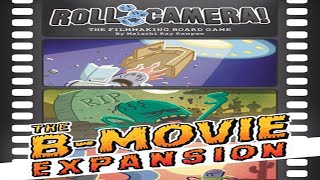
- adds more content
- adds more scripts
- adds more problems
- adds more ideas
- adds more production companies
- adds genre tokens
- adds equipment
- adds more characters
- adds more uses for dice
- adds ways to mitigate die rolling
- adds scenarios
- If you don't like the original game, you won't like it after the expansion.
- Doesn't change anything, just adds more richness and options.
- The new script requirement doesn't really add anything except a slight wrinkle.
- The randomness of the scene cards can be a negative.
- It can be an annoyance if you're getting beat up on quality stuff and can't gain points.
- The advantage of randomly removing parts of the game may mean you don't get what you're looking for.
- The middle script requirement can be annoying if you're not getting the scenes you need.
- making a B movie
- Pandemic
- Million Dollar Script
- Arabian Nights
- Call to Adventure
Mechanics (from transcript analysis)
- Cooperative — It's Cooperative exactly yeah
Video topics + discussion points
Quotes (from this video)
- I think if you don't like the original game you're not gonna like it after the expansion yeah it doesn't change anything it just adds more richness and more options
- the advantage of randomly removing parts of the game is replayability yeah the problem is you may not get things that you're exactly looking for
- the equipment I think is great especially because they're not you don't have to be lucky like in pandemic you have to be lucky to draw them and here they're there already to be used
- this is a solid game where to me the story that we're building is kind of inconsequential
- nines from both of us from the B-movie expansion great job love to see more
References (from this video)

Mechanics (from transcript analysis)
Video topics + discussion points
Quotes (from this video)
- i understand a lot of people really enjoy solo games but um generally they're they're not really for me
- it's essentially a fun thing that we like to do and we have to make sure that it doesn't turn into work
- thousands of games come out every year and i feel like every couple of months i bump into something that i'm just like whoa that's totally new
- i personally think patchwork is engine building because you're just kind of building up an income engine
- sprinkles on the icing on the cake
References (from this video)

- Top-notch components and production values
- Strong, family-friendly theme that’s easy for kids to grasp
- Solid integration of theme and mechanics through cooperative play
- Multiple player roles with unique abilities add variety and strategy
- Good replayability via new scripts and scenes across sessions
- Cooperation can be challenging and punishing when players miss actions
- Budget and scheduling pressure can slow pacing and create tense moments
- Dice randomness can occasionally make certain scenes difficult to fulfill
- Table space and setup time can be nontrivial for larger groups
- Filmmaking, teamwork under budget and time constraints
- Film studio production environment with multiple sets and scenes to shoot
- Procedural production pipeline with dynamic problems influencing script and scene outcomes
Mechanics (from transcript analysis)
- budget and schedule management — Track money (budget) and schedule on separate dials; actions affect one or both resources and can influence quality
- dice-placement — Roll crew dice to activate actions and resolve on-card problems; certain boxes require matching icons or equal dice, with wilds from the special effects die
- editing room and scene ordering — Place completed scenes in the editing room; order (top-to-bottom) determines when they contribute to the final movie and quality bonuses/penalties
- locking and rerolling dice — Players can lock dice to commit them to actions; locked dice reduce future roll options but can be removed and rerolled by subsequent players if the action hasn’t been taken yet
- problem_card advancement — Draw problem cards that slide to the right, increasing specificity and difficulty; when three are out, a new one cannot be drawn
- production meeting and idea cards — Gathers idea cards during production meetings; players choose actions that best help the group, with some cards moving to a to-do list and others discarded
- set building and tile placement — Pay dollars to acquire set tiles, place them on a grid, and rotate or rearrange pieces to enable scenes
- wild / special effects die — A wild die can represent any icon to help meet action or scene requirements; can facilitate doubles or triples for more efficient fulfillment
Video topics + discussion points
Quotes (from this video)
- The game is pretty solid between its theme and its mechanics
- Plan and shoot a movie with your family and friends
- The dice rolling times makes scenes impossible to form until you build up the skills
- The components are top-notch
References (from this video)
- Strong thematic flavor
- Engaging cooperative feel
- Rule overhead can slow play for some groups
- May not appeal to players seeking leaner euro experiences
- Cinematic creation
- Film production setting in a collaborative environment
- Team-driven production flow
- Cascadia
- Bonfire
Mechanics (from transcript analysis)
- Team coordination — Players coordinate actions and roles to simulate film production.
Video topics + discussion points
Quotes (from this video)
- it's a fantastic game
- it's a quick 5 minute game
- I think it's a clever way to have both the tile laying and the animals
- the theme is really cool and the production is mind-blowingly beautiful
- I would rather play the other games that we have here than play this one
- Bonfire is an excellent game
- it's a card game with a beat and it's literal you have to do it on the beat