


Simurgh Deep Dive
What the Community Thinks About Simurgh
Simurgh, the 2015 worker placement game about clans of humans and dragons, draws a measured response from the Board Games UnLocked channel. In its full review, the host calls the game surprisingly good, with a lot of interesting systems, while also saying it clearly shows its age. The verdict is affectionate but restrained, landing at roughly 6.5 out of 10. The host has kept a copy in the collection for years without playing it, and the decision to part with it reads as a recognition that the game no longer earns its place on the table next to newer titles.
The channel also features Simurgh in list-format segments. A top 100 countdown praises it as a smart and streamlined game, and a box art countdown ranks it at number 5, chosen primarily for its artwork. Those segments are warmer and more personal than the full review. Taken together, the channel's view centers on pacing, dragon-driven combos, and presentation, with criticism aimed at a thin resource economy and at the uneven quality of the expansion modules. This perspective comes from a single channel, so it should be read as one reviewer's take rather than a broad survey of players.
Core Mechanics That Define Simurgh
Worker Placement With Vassals and Dragon Riders
Each turn gives a player a run of Free Actions followed by one Main Action, usually placing a worker on an Action Space or recalling workers back to the supply. The reviewer stresses that the Free Actions carry much of the game's texture, since dragon abilities, resource spending, and exploration moves all happen before the single placement. Spearmen and Dragon Riders behave differently on the board. Some spaces accept any worker, while others are reserved for one type, so players must plan how to use each kind of Vassal. Recalling is also flexible. A player can pull back any number of workers rather than all of them, which lets someone hold a spot on a tile they are still using.
An Expanding Board Built From Action Tiles
The board grows during play as players draw and place Action Tiles. The reviewer describes several kinds of additions. Ordinary tiles open extra worker spots that others can use, while exploration tiles sit on a green track, where a Dragon Rider descends and pays resources at each step for increasingly better rewards. Public objectives are placed by sending a Dragon Rider out, drawing three tiles, and paying resources to lay them down, after which every player can see what the table is competing for. Emptied tiles are discarded into the Chronicle, and the size of that pile is one way the game ends. The reviewer cites 14 tiles in a long game as the trigger. Public objectives can also close the game, and the reviewer names them as the most common ending in practice.
The Simurgh Experience
Pacing Driven by the Players
The reviewer's most lasting memory of the game is its pacing. Game length is set by the group rather than a fixed clock, and the reviewer compares the moment a game suddenly brakes to the deliberate endings of Alexander Pfister designs such as Great Western Trail and Maracaibo. In Simurgh, that feeling arrives early, because the exploration tiles and public objectives drive both resources and victory points. A player with a lead can push the game toward its close, hoping the endgame scoring does not overtake them. A quieter moment on the table makes the same point: one group found that removing workers shortened the game quickly, so the players cooperated to keep spaces occupied and stretch the final turns. The reviewer describes the moment when everyone realizes the game is nearly over, yet still has more to do, as a highlight.
Combo Chains and Tension Around the Lead
Dragons are the centerpiece of combo play. Each one carries three unique abilities, and a single turn can chain several of them. A token becomes two meat, the meat becomes three spears, the spears let a Dragon Rider advance along the exploration track for 10 points, and the main action still follows. The reviewer finds that sequencing satisfying and says the combos are what make the game feel special to play. The same engine creates tension, since a player with four or five dragons can outpace opponents who hold one or two. The reviewer calls that outcome thematically sensible, but warns it can feel lopsided, with players who lack dragons watching someone else run away with the lead.
What Makes Simurgh Stand Out
Public Objectives That Reward Reading the Table
The reviewer values the decision to make objectives public. Once a Dragon Rider places one, every player can see what is contested and judge whether a rival is ahead before committing resources. That openness trades the sneak of grabbing exploration tiles for direct competition over shared goals, which the reviewer names as the quality that marks Simurgh out. Space is also generous. Most locations can host several players, so the reviewer does not find the game especially cutthroat, and only a handful of single-occupancy spots create direct conflict. The top 100 segment echoes that appreciation, praising the design as smart and streamlined.
Artwork and Presentation
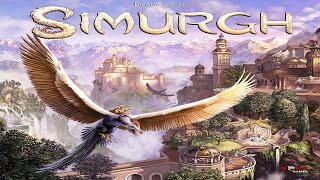
Art is the strongest praise across the channel's discussion. The full review calls the artwork phenomenal and notes that the background art on the Dragon Lords expansion board merges with the base game board, which the reviewer finds really nice. The box art segment treats the cover as one of the most attractive in the list, with the host admiring its atmosphere and its theme, the leaves of the trees, and the architecture carved into the mountain. That host also observes that Simurgh is rarely discussed and that its cover invites a closer look. The full review adds that the game is surprisingly clean and straightforward to teach, a quality the reviewer contrasts with newer releases that are not always so easy to learn.
Potential Drawbacks
A Thin, Frustrating Resource Economy
The reviewer's central criticism is the resource economy. Players juggle six resources, namely stone, wood, meat, vegetables, scrolls, and weapons, and the reviewer finds that the game leaves them managing basic goods with little else to do. Meat and vegetables are the hardest to reach. They come mainly from tiles that require the very scrolls and weapons players may lack, and the reviewer recounts games where a player was left landlocked with no route to act. Because placing workers and dragons depends on those goods, that scarcity can leave a player sitting idle while others combo. The reviewer calls the resource squeeze an odd decision that sits poorly beside the game's combo-rich design.
Expansion Quality and Underpowered Player Powers
The reviewer's assessment of Call of the Dragon Lords, released a year after the base game, is mixed. The Dragon Vault board is praised, and the diversity module, which adds objective tiles and dragons, is called the best part of the package. Forgotten Metropolis is criticized for taking up a huge amount of table space, while the house ability cards are called unexciting and the Rogue module is described as confusingly worded in its setup. Player powers in the base game draw a similar critique. They are easy to forget amid the rush to track resources, and the reviewer wishes they were stronger. The reviewer also suggests that a future reprint could tighten worker spots, loosen resource access, make the exploration tiles more interesting, and give players conditional abilities that become powerful once unlocked.
If You Enjoy Simurgh
Readers who like Simurgh's pacing should look at Great Western Trail, which the reviewer names when describing a rondel-style game that suddenly brakes into careful play. Maracaibo shares that deliberate turn, and the reviewer ties both games to the same feeling of a race that slows as the scores tighten. Players who want stronger individual abilities should try Toot: Walk-On's expansion, which the reviewer holds up as the kind of player power Simurgh could have had. The full review is worth watching from Board Games UnLocked for the reviewer's complete reasoning.
What Reviewers Are Saying
"It's surprisingly good. It has a lot of interesting systems, but at the same time, definitely shows its age."
— Board Games UnLocked
"What's interesting is that the players dictate the speed, because any time a worker or anything is removed from a tile and the tile empties, it gets discarded to that pile."
— Board Games UnLocked
"I really like the the atmosphere and the theme that this, that this cover gives off. It is so pretty to look at."
— Board Games UnLocked