






Small World of Warcraft Deep Dive
What the Community Thinks About Small World of Warcraft
Reviewers generally treat Small World of Warcraft as a successful marriage of two things they already enjoy: the territory-grabbing play of Small World and the setting of Blizzard's Warcraft universe. Edo, Gaming with Edo described it as the best of Small World in spirit, calling the execution perfect and easily recommendable to anyone who is big into Warcraft or big into Small World, with the Alliance faction rules as the one soft spot. TableTop Wolf placed it among the favorite games of their year, saying the area control clicked within the first couple of rounds after they had found other games of that style too fiddly.
The reception does lean heavily on affection for the franchise. Mark Maya, Board Game Coffee came to the game as a long-time World of Warcraft player and said they would love it even if it were only a reskin of Small World. That caveat matters: the enthusiasm comes largely from fans of the franchise. One review was notably tentative. The Board Game Coffee giveaway episode had only played Small World once and said they could not say much about the Warcraft version, so it offered no firm verdict.
Core Mechanics That Define Small World of Warcraft
Area Control
Reviewers describe the game as an area control contest across the map of Azeroth. Watch Review summarized it as a two to five player territory game in which each race spreads its control across regions and earns victory coins for every region it occupies, plus any bonuses from its powers. Conquest is governed by token counts: an entry region needs at least three tokens, each later region costs two, and the requirement rises when enemy tokens, wisp walls, or mountains are present. Defeating an enemy token forces the defender to redeploy, which is what keeps battles swingy. TableTop Wolf noted that the Murlocs, a non-player race that starts on the map, claim the lowest-cost regions first and respawn when removed, so the board never fully empties. Edo compared the basic loop to Risk, with pieces placed on regions and then moved outward across the map.
The Race and Decline Cycle
The defining rhythm is the race and decline cycle. Each turn a player either expands the active race or puts it into decline, and reviewers emphasized how much that choice matters. Edo, Gaming with Edo explained that declining leaves one token on each occupied region, which stays on the board but can no longer move, while the race's special power is discarded. Those declined tokens still score, so a player can hold an active race and a declined race on the board at the same time and collect points from both. Edo also pointed out that the switch can be made on any turn, meaning a player could in theory stay with one race all game, though that would be rough. The result, as Edo framed it, is a push and pull between how much territory remains to take and how much a player is willing to give up.
The Small World of Warcraft Experience
Thematic Excitement for Warcraft Fans
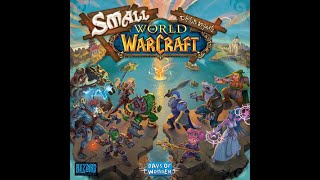
The most consistent emotional hook is the thrill of seeing familiar Warcraft races and locations on the board. Mark Maya described the game as a meeting of two favorite worlds, praised the artwork, and kept pausing the unboxing to recognize characters and landmarks, saying Blizzard "really know how to make things look pretty." TableTop Wolf admitted to being a sucker for an IP like this, which explains why the theme lands so strongly with longtime fans. The experience is less about a new theme discovered and more about a familiar world reappearing in a tactical setting.
Tense Decline Timing in the Late Game
Timing the decline is where reviewers felt the most tension. In their solo playthrough, TableTop Wolf reached the final turns tied with the Murlocs and had to decide whether to keep conquering or to decline. They chose to fight on, and a closing dice roll that came up zero left them short, costing them the game by a narrow margin. Their own verdict was that declining one turn earlier would have been the better move. That feeling of watching the window close is the emotional core of the late game, and it is the reason the decline choice is discussed so often.
What Makes Small World of Warcraft Stand Out
Art and Component Quality
Components earned praise for their look and feel. Mark Maya described the map tiles as thick, sturdy cardboard with bright colors, and said the artwork on the locations, race tokens, and fan-style reference sheets was a pleasure to examine. Each player receives a large reference sheet, which Mark Maya compared to the one in Tapestry as the only other game they owned with a sheet that size. The rulebook, roughly fifteen pages on heavy paper, felt more substantial than it was, and the tile art of cities, swamps, and ruins drew repeated attention during the unboxing.
Race and Power Combinations
Reviewers repeatedly highlighted the variety created by pairing races with special powers. Watch Review explained that six race and power combinations are visible in a row, and a player who wants one further down must pay a coin to each combination above it. Edo described the pairings as random, with each race carrying different abilities, and TableTop Wolf showed in a solo game how a race's defensive rule shaped every choice on the board. Because the pairings change from game to game, the combinations are a large part of why reviewers described wanting to play again.
Potential Drawbacks
Decision Load and Faction Rules
Edo noted that the decline system can slow down players who do not enjoy heavy decision-making, since almost every turn raises the question of whether to keep expanding or switch races. The same review found the Alliance faction rule set "a little meh" compared with the rest of the design. These are fair concerns for groups who want a quick, uncomplicated turn, and they suggest that the game rewards players who enjoy weighing options against one another.
Dice Luck in Close Finishes
Dice carry real weight, especially in the endgame. TableTop Wolf lost a nearly tied game on a single failed roll, and the reinforcement die used to take a final region when few tokens remain can decide the outcome. Mark Maya, Board Game Coffee also questioned whether their reinforcement die was balanced, noting that it was very light and appeared clipped on one side, though they were unsure whether that was intentional. Players who dislike luck deciding close games should weigh this before buying.
If You Enjoy Small World of Warcraft
- Small World: Edo framed this edition as the best of Small World, which makes the original game the natural next stop for players who want the same conquest and decline loop without the Warcraft theme.
- Tapestry: Board Game Coffee compared the size of the reference sheets to Tapestry, the only other game on their shelf with a sheet that large, so players who enjoy a dense reference system may find a similar appeal.
- Risk: Edo compared the basic placing-and-moving loop to Risk, so players who enjoy that style of territory conquest but want a lighter, faster-playing version will find a similar feel here.
What Reviewers Are Saying
"As a sort of best of Small World game is fantastic, just perfectly executed, totally dug it. I thought the sort of alliance faction rule set was a little meh but other than that, easily recommendable to anyone who's big into Warcraft or big into Small World."
— Edo, Gaming with Edo
"I second guessed myself by not going into decline on turn six even turn seven was probably a little bit too late I feel and I've paid the price but this was a lot of fun."
— TableTop Wolf
"I don't see how I wouldn't like it even if it's just a reskin of Small World that's okay you know that's okay because I played Small World once and I liked it so I am okay with it."
— Mark Maya, Board Game Coffee