


















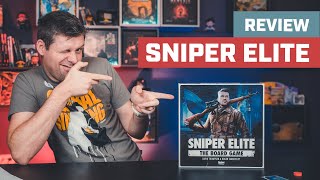



Sniper Elite: The Board Game Deep Dive
What the Community Thinks About Sniper Elite: The Board Game
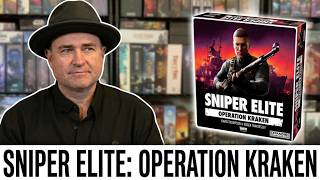
Reviewers generally treat Sniper Elite: The Board Game as a stealth game that works best when players are willing to lean into its theme. Published by Rebellion Unplugged, the board game studio attached to the Rebellion video game company, it casts one player as a sniper hiding on a dry erase map while the other players, controlling squads of German soldiers, try to corner them. Board Games UnLocked is enthusiastic about the design and says they have more fun as the sniper, though they note the hunter side is engaging too. Rolling Dice & Taking Names describes the game as a simple stealth experience with enough variety to keep replaying it, while also admitting that the hidden-movement format does not suit every group.
The main point of agreement is that the theme comes through clearly. Reviewers repeatedly compare the sniper's sneaking to old war films where guards hear a noise and fire into the dark. The main point of disagreement is the hidden-movement format itself. Fans of the genre praise the tension, while players who do not enjoy hidden-movement games describe the hunting side as a constant guessing game. Board Game Critique places Sniper Elite among action-oriented hidden movement titles that rely on line of sight and noise, which helps explain why it lands differently for different tables.
Core Mechanics That Define Sniper Elite: The Board Game
Hidden Movement
The sniper's movement is the backbone of the game. Reviewers explain that the sniper moves in secret on a personal map, usually marked with a dry erase marker, while the hunters attempt to deduce where they are. Movement is judged by distance. A short move of zero to one spaces makes no sound, while a move of two or three spaces can be heard by any guard standing next to the path, and the sniper must point to the affected figure to signal that a noise was made. Rolling Dice & Taking Names walked through this process and described how the hunters then ask questions, sweep sectors, and narrow down possible positions. The result is a deduction puzzle that changes from turn to turn, because every guard action gives the sniper new information to hide from.
Reviewers also point out the importance of the objective system. The sniper draws two objective cards, and the suits on those cards determine which sectors of the board hold the targets. If both cards share a suit, one must be replaced. This keeps the two objectives in different parts of the map, so the sniper has to travel and the hunters must decide where to commit their forces.
Bag Building and Shooting
Shooting is resolved with a bag of tokens, which is the mechanic reviewers discuss most often. The sniper decides how far away the target is, then draws a number of tokens equal to that distance. Hit tokens are needed to succeed, while misfire and noise tokens can ruin the shot or reveal the sniper's position. Rolling Dice & Taking Names noted that the noise tokens create a real risk: if enough are drawn, the sniper has to admit that the gun jammed and the hunters now know where they are. Reviewers see this as a clever way to make a shot feel dangerous without relying on dice. Loot cards add a second layer, since the sniper can choose from a deck of items such as silencers, which change the odds of being heard.
The Sniper Elite Experience
Tense
Reviewers describe most sessions as a slow, nervous back-and-forth. The sniper is never fully safe, because one wrong move can alert the nearest guard. The hunters, meanwhile, spend much of the game trying to work out where the sniper might be while the clock runs down. Because the sniper's noise is announced to the table and the hunters' positions are hidden from the sniper, both sides spend the game second-guessing each other, which is what makes the tension feel earned rather than arbitrary.
Asymmetric
The game is clearly asymmetric. The sniper plays alone against a table of hunters, and the hunters split control of up to three German factions. Reviewers describe the hunters as having an advantage in numbers, but the sniper has advantages in information and surprise. Each faction has a general with special abilities, and officers can station guard dogs or search sectors, which lets each game play out differently. Reviewers who enjoy the hunter side often say that coordinating several factions and sharing information is where the fun is.
What Makes Sniper Elite: The Board Game Stand Out
Strong Theme and Clean Adaptation
Reviewers consistently praise how faithfully the board game captures the feel of the video game series. Board Stupid singled out the way the source material translated into a board game without becoming overcomplicated. Players who know the series see familiar elements such as sneaking through German buildings, eliminating lone guards, and completing objectives while avoiding detection. The design rewards that familiarity without requiring prior knowledge of the video game to enjoy the core loop.
Map Variety and Production Quality
Board Games UnLocked highlighted the expansion, Eagle's Nest, which adds a second double-sided board with additional locations and a different setting. Reviewers note that this variety is unusual among hidden movement games, which often rely on a single map. The production also earns praise. Reviewers describe the thick components, the textured map surface, the weighted poker chips in the Kickstarter version, and the washed miniatures as signs of a polished product. Rolling Dice & Taking Names said the components are "really really really nice," and the game's presentation is often cited as a reason it feels premium at the table.
Potential Drawbacks
Hidden Movement Is Not for Everyone
The most common criticism is that hunting a hidden sniper can become a long stretch of guessing. Reviewers who dislike hidden movement games say the hunters end up making a series of educated guesses, and that the sniper has to hide very effectively to avoid being pinned down. Board Games UnLocked admitted that the game did not click for them, even though many players in their group enjoyed it, and framed their reaction as a matter of personal taste rather than a flaw in the design.
Some Mechanics Feel Too Strong or Too Random
Some reviewers questioned the balance of certain abilities. Rolling Dice & Taking Names felt that an officer ability allowing the hunters to ask whether the sniper is in a particular sector was too powerful, because it narrows the search dramatically. Others found the shooting system frustrating in a different way. Because shots can only target the sniper's current location, hunters may take random shots at the spot where they suspect the sniper is hiding, and the bag draw can make the outcome feel unpredictable even when the tactics were sound.
If You Enjoy Sniper Elite: The Board Game
Players who enjoy Sniper Elite's hidden movement will find similar satisfaction in Specter Ops. Reviewers who played both games see a close parallel: one player secretly moves across the board on a personal map while others try to track them down, and both games reward careful deduction over raw speed. Players who appreciate the tension of trying to slip past enemies without being heard will also appreciate the paranoia of Mind Management, which places deduction and hidden information at the center of play.
For players who enjoy the asymmetric structure, with a single player facing a group that must coordinate, Pandemic offers a cooperative model where the group works together against a threat. Players who want a more thematic, tension-driven take on sneaking through hostile territory can look at The Bloody Inn, which shares the feeling of moving through a dangerous space where every choice carries risk.
What Reviewers Are Saying
"I have a blast every time. It doesn't matter. I have more fun as the sniper but I have fun playing the other way too, just because you start learning how to do stuff and the randomness of not knowing exactly what objective is out there."
— Board Games UnLocked
"You have a dry erase board of the map, and I was playing as a sniper, and on my turn I would, I would move. If I move zero one spaces, nobody hears me. If I move two to three spaces, if I walk beside somebody, this is an adjacent space, I have to point to that figure to let them know that they potentially heard something."
— Rolling Dice & Taking Names
"It's one of those few that IP that translated pretty well into into a board game. They didn't over complicate it."
— Board Stupid