












Space Hulk: Death Angel – The Card Game Deep Dive
What the Community Thinks About Space Hulk: Death Angel – The Card Game
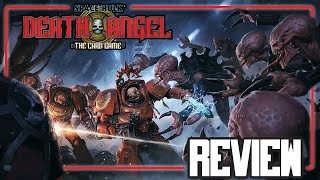
Reviewers describe Space Hulk: Death Angel – The Card Game as a demanding cooperative game with a strong sense of place. It adapts the Games Workshop miniatures classic into a card format, sending small teams of Warhammer 40,000 Space Marines through derelict ships infested with Genestealers. Opinions converge on one point: the game is hard, sometimes punishingly so, and it rewards players who accept that losses are part of the design.
TableTop Wolf gives the game a five-star rating and places it among the top three tabletop games Games Workshop has ever produced. That reviewer's enthusiasm centers on solo play, which fits into a short session and keeps the tension high. Board Games UnLocked offers a more mixed view. In its ranking segments the channel calls the game very difficult and very tense, and it lists the title among games the host had initially misjudged. The host's first experience was a two-player session that felt frustrating because of the dice, and the opinion shifted after playing solo with full control of the squad.
The shared view across these discussions is that the game's identity comes from its solo potential and its tension. Reviewers disagree mainly on how much randomness they will accept and whether the experience justifies the difficulty of finding a copy.
Core Mechanics That Define Space Hulk: Death Angel – The Card Game
Cooperative Play Against the Game System
Space Hulk: Death Angel – The Card Game is fully cooperative. Players share one outcome and work against the scripted threats of the ship itself rather than against each other. TableTop Wolf explains that the goal is to reach the final location in the deck and complete its objective, which requires clearing a stack of Genestealer cards on either side of the current location. Each location has its own setup for where the aliens can emerge, and an event at the end of each round determines where they appear and often moves them around the map. Board Games UnLocked notes that the cooperative pressure does not disappear when the game is played alone. The uncertainty about where the aliens will come from and how far the squad can advance stays constant, so the solo experience keeps the same stakes.
Action Selection Across Move-and-Activate, Support, and Attack
Each turn, players choose from three action types: move and activate, support, and attack. Move and activate lets a player change a Space Marine's facing, activate terrain, or move forward and backward along the line. Support places a support token on a Terminator to improve a future roll. Attack lets a Space Marine strike Genestealers within range and in its facing, using both Terminators of the matching color. TableTop Wolf highlights a restriction that shapes planning: a team's next action cannot repeat the action it played in the previous round. Combat is resolved with a six-sided die, where a skull counts as a hit. TableTop Wolf observes that this gives roughly even odds on each roll, while the enemy must roll higher than the number of Genestealers in the stack to kill a Space Marine. The result is that every early kill matters, and falling behind makes survival harder.
The Space Hulk: Death Angel – The Card Game Experience
Tense, Punishing Solo Strategy
Reviewers describe the experience as tense and strategic. Board Games UnLocked calls it very difficult, very tense, and very strategic, and the sense of pressure builds as the Genestealer stacks grow. Solo play gives the player direct control over which Space Marines survive and where they face, which reviewers find satisfying when a well-planned corridor holds. The game is harsh, and TableTop Wolf admits that the win rate is low, but that difficulty is the source of its appeal for many players.
Thematic Corridor Warfare
The theme receives consistent praise. Board Games UnLocked compares the atmosphere to the corridor sequences of the film Aliens, with turrets falling and enemies pouring through vents. The reviewer adds that the Warhammer setting does not overwhelm the experience, so players who are unfamiliar with the lore can still feel the tension of moving a squad down a narrow hallway and covering each other's flanks.
What Makes Space Hulk: Death Angel – The Card Game Stand Out
Simple Rules and a Fast Solo Session
TableTop Wolf singles out the rules as a strength. The reviewer says a true solo game can be played in roughly twenty minutes to half an hour, and that the rules stay manageable because players rarely need to consult the rulebook mid-game. The core game includes six squads, each with distinct weapons such as a power sword, a thunderhammer, lightning claws, a flamer, an assault cannon, and a librarian with special powers. TableTop Wolf argues that this variety makes each game feel different in composition, even when the rules stay the same.
Spatial Play with Facing and Flanking
Reviewers value the spatial layer of the game. Space Marines in a line must watch their facing, because a Genestealer attacking from behind can flank a team member. Players can flip or switch positions within the line to change which direction each Space Marine faces. Board Games UnLocked describes the squad as a single row that must be managed carefully, and that management is what gives the game its strategic depth without requiring a large table or many components.
Potential Drawbacks
Dice Variance Can Decide a Run
The most common criticism concerns randomness. Board Games UnLocked admits that the dice made the first two-player session feel unfair, and TableTop Wolf warns that a few bad rolls can decimate an entire run in seconds, particularly because Terminators have only one health. Some players respond by swapping in their own dice or testing the dice for bias, which shows how strongly the swings affect the experience.
Availability, Cost, and a Demanding Rulebook
The game is out of print, and expansions are costly on the secondary market. Board Games UnLocked notes that the cost reflects the title's status and that it is unlikely to return unless Games Workshop chooses to revisit it. TableTop Wolf also criticizes the rulebook as weak, which can make learning the game harder than it needs to be. Two-player play receives a more lukewarm response than solo play, so groups should be prepared for a game that feels best without a partner.
If You Enjoy Space Hulk: Death Angel – The Card Game
Players who value cooperative tension and an alien-infested setting should consider the games in its comparison group. Marvel Champions and Battlestar Galactica share the cooperative structure in which the table fights the game system together, and they reward careful planning under escalating threats. Fans who want the physical side of the Games Workshop experience may prefer the original Space Hulk miniatures game, which reviewers mention as the source of this card version. Space Crusade and Descent: Journeys in the Dark offer related Games Workshop adventures built around moving small forces through hostile spaces, which suits players drawn to the squad-based tactics of the card game.
What Reviewers Are Saying
"I can play a true solo version of space Hulk in about 20 minutes to half now it's simple rules are amazing cuz any game you don't have to constantly look up a load of different rules it's just brilliant game design."
— TableTop Wolf
"As a solo game it's so much better because you have full control over your lineup. You get to manipulate and move them and face them in any direction that you want."
— Board Games UnLocked
"It's very difficult very tense and very strategic almost difficult because we need to do with that die there's a way you can tell if a d20 is weighted I think you put it in like salt water or something."
— Board Games UnLocked