/pic5313583.jpg)
Four millennia ago on the eastern bank of the Nile river was laid the foundation of the Temple of Amun-Ra. Over the course of two thousand years, the temple complex was gradually expanded and became widely known as "The Most Select of Places" (Ipet-Isut), boasting the largest religious building in the world. Today, the site is known as Karnak, located at Luxor in modern-day Egypt.
Join ancient Pharaohs in creating and growing one of the most impressive sites the world has seen, honoring the Egyptian gods Horus, Ra, Hathor, Bastet, Thoth, and Osiris. You must carefully manage the balance of your actions, preparing for the reckoning by the goddess Maat.
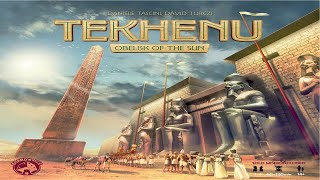
The game board in Tekhenu: Obelisk of the Sun is divided into six sections, each associated with an Egyptian god: Horus, Ra, Hathor, Bastet, Thoth, and Osiris. In the center stands an impressive obelisk (Tekhenu) that casts its shadow onto different parts of the board. As a result, the area around the obelisk is divided into sunny, shaded, and dark sections, depending on how the obelisk casts its shadow at that particular moment. As the game progresses, the sun's rotation alters which sections are sunny, shaded, or dark.
The game takes place over multiple rounds. Each round, players draft dice and perform actions associated with the value of the die and the section from which the die was drafted. Dice come in five colors, and each die is considered Pure, Tainted, or Forbidden depending on the color of the die and the position of the obelisk's shadow. While you may never draft Forbidden dice, you are free to draft any other die, whether Pure or Tainted.
As you draft the dice, you must consider not only the general availability of dice — if no dice are available in a given section, then you cannot readily perform the action associated with that section — but also which value die to draft. You must also consider the purity of the dice to draft, as you must balance your Pure and Tainted actions if you want to have a more favorable position in turn order.
When you draft a die, you can perform an action depending on the section you took the die from. Each of the actions corresponds to a different Egyptian god: Horus, Ra, Hathor, Bastet, Thoth and Osiris. Instead of a god action, you can choose to produce, generating resources based on the color and value of the die, but beware of producing in excess of your production capacity, as this is Greed and adds Taint to your balance!
Two scoring phases occur during the game, during which players earn victory points based on the workshops, quarries, buildings, statues and pillars they have built, as well as the happiness of their people and production capacity of their resources. However, players must also keep a healthy amount of resources around to sustain their population or they suffer negative consequences.


Images


- The game itself (multiplayer) is fantastic and shines brightly, offering variety in strategies.
- The solo variant made the game shorter.
- The idea of the pyramid tiles is unique and thematic for Egypt.
- The game was in the host's top 10 of 2020 (referring to the multiplayer version).
- The solo variant is 'hot garbage' and 'horrendously bad'.
- There is zero player aid for the solo mode.
- The AI opponent does everything for free, without consequences or resource costs.
- The AI always takes the highest value die, disadvantaging the player.
- The AI doesn't have to worry about 'taint' or 'balance' which can affect player victory points.
- The AI gets resources, builds statues, takes scribes, moves up tracks, and takes cards all for free.
- The solo variant lacks hindrance and predictability, unlike other good solo variants.
- The tie-breaking mechanism (flipping a token) is cumbersome and fiddly.
- The player has to make decisions for the AI opponent.
- The AI opponent ramps up on happiness and population tracks to gain an unlimited number of points at the end.
- Players have to pay for buildings in the scoring phase, but the AI does not.
- The solo variant lacks a player aid.
- The solo variant does not mimic another player at all.
- The AI is inconsistent in its actions.
- ancient Egypt
- Feudum
- Teotihuacan: City of Gods
- Râ
Mechanics (from transcript analysis)
- Dice Drafting — Players take dice to perform actions or produce resources. The solo AI always takes the highest value die.
- pyramid building — Tiles are placed on a pyramid, and there is a mechanic involving flipping tokens to determine placement or ties, which the host found cumbersome.
- Resource Management — The game is about crucial resource management, and the solo AI does not have to manage resources as players do.
- Set Collection — Collecting cards and decrees contributes to scoring, which the AI leverages for points without cost.
- Track Advancement — Players advance on happiness and population tracks, which the AI does for free and to significant advantage.
- Worker Placement — Actions are based on available spots, and the AI can take actions without player-like restrictions.
Video topics + discussion points
Quotes (from this video)
- the solo variant is hot garbage
- i hated this solo variant
- the turn structure card is is hot ass
- botox or whatever his name is does everything for free
- it's extremely aggravating as the player
- absolutely horrendously bad in my opinion
- i despise games where other players when you're playing this game
- this game is fantastic against other players
- the solo player doesn't have to weigh any of those
- it's all rewards and no penalties for this player and that is just not fun
- this was a very bad solar variant
- i'm gonna give it a three
- no player raid everything for free horrendous
References (from this video)
- More avenues for strategy and variety than Teotihuacan.
- Challenging and mentally engaging gameplay.
- Rich Egyptian theme.
- Unique turn structure with the obelisk.
- Versatile cards offer multiple benefits.
- Good rulebook.
- Acceptable penalties for negative situations.
- Visually busy and overwhelming board.
- Unintuitive board layout.
- Feels longer than it is due to decision paralysis.
- Some mechanics (like statue building) were missed opportunities by players.
- Board aesthetics are not appealing to some.
- Less streamlined and clean than Teotihuacan.
- Could have had a cleaner board design.
- Obelisk of the Sun
- Ancient Egypt
- Teotihuacan: City of Gods
- Great Western Trail
- Vinhos
- Crusaders: The Eternal War
- CO2: Second Chance
- Feudum
Mechanics (from transcript analysis)
- Card Play — Cards offer various benefits, including dice mitigation, bonus points, and additional actions.
- dice manipulation — Players pick dice and move them, with dice values and colors impacting actions and costs, including negative consequences for certain values or overflowing resources.
- Objective Cards — Decree cards provide endgame objectives and scoring opportunities.
- population track — Increasing population unlocks new cards and provides end-game scoring.
- Resource Management — Managing resources like paper, stone, and food is crucial.
- Set Collection — Collecting sets of cards or resources is part of the strategy.
- Turn Order Tracking — The obelisk acts as a tracker for turn order and time.
- Worker placement (implicit) — While not explicitly workers, dice are used to perform actions on the board.
Video topics + discussion points
Quotes (from this video)
- This just feels like it has even more going on.
- The boards are just extremely busy.
- It just got a little weird in my head for me.
- The board layout is just not user friendly at all.
- I think this is a if you're expecting Kot Walk On you're going to be sorely disappointed.
- If you're going to have a game this complex but the board is this I don't think that's the thing it's not all over the place but it feels it like it is and that's the problem.
- I like actions that you gain something for other people doing things.
- I love endgame like objectives like secret objectives.
- This game does not have that like I see so many different paths to victory.
References (from this video)
- Engaging dice drafting and resource management
- Satisfying engine building potential
- Strong thematic integration with ancient Egypt
- Good player interaction
- Board can feel a bit busy
- Some players found certain mechanics confusing initially
- Ancient Egyptian civilization and gods
- Ancient Egypt
Mechanics (from transcript analysis)
- Dice Drafting — Players select dice from a common pool to determine available actions and their strength.
- End game scoring — The game features scoring phases based on various achievements like buildings, statues, and resources.
- Engine Building — Players can build structures and gain abilities that improve their resource production or action efficiency over time.
- Resource Management — Players must manage various resources such as gold, granite, limestone, bread, and papyrus to perform actions and build.
- Scoring tracks — Players advance markers on various tracks (e.g., happiness, victory points) to track progress.
- Set Collection — Players collect different types of resources and cards to achieve objectives and score points.
- Worker Placement — While not explicitly named as worker placement, the act of taking dice from a central pool and placing them to perform actions is similar.
Video topics + discussion points
Quotes (from this video)
- My anus is just glued shut thanks to that.
- He's the god of shitty DLC.
- I hate your mouth sorry eat my mouth.
- The board is quite busy, I wouldn't say a little.
- We're living in the apocalypse.
- It's like someone trying to say sloth.
- Cat, if you don't take your ass time I'm gonna cut your fingers off with scissors.
References (from this video)
- Rotating obelisk and dice from light and shadow
Mechanics (from transcript analysis)
Video topics + discussion points
Quotes (from this video)
- welcome to another episode of talking sanctuary where we talk about life and board gaming in general and it's completely unscripted except for this little book here where i've written some of my notes
- i just want to say a massive massive thank you to all the people who are subscribed to this channel people who constantly like the channel watch the videos comment share talk about board games on this platform itself all of those interactions don't go unnoticed and all of those interactions mean a huge great deal to me
- and without further ado it's time to get on to my top five anticipated board games to play in 2022 yes
- wow that just absolutely impresses me
- wow that is beautiful
- this game ticks all of those boxes and that's something that i just really want to play and want to play now
- thank you once again for supporting me and board game sanctuary i look forward to seeing you in the new year with some more crazy funny and also awesome board game content this is danny signing out
References (from this video)
Mechanics (from transcript analysis)
Video topics + discussion points
Quotes (from this video)
- i look kind of concerned, right? Look: my eyebrows are down.
- i'm a sick individual. But uh... i buy games for the dumbest reasons.
- As good as game as i've heard Terraforming Mars is, i'm going to wait until recessed boards are available before i make a purchase, because that seems like a pretty, uh... decent complaint about the game.
- Da da da da DA!
- Call me "Shorlock."
- Oh, just forget about it.
- Box Fart-O-Meter: zero. Are we surprised? i don't think so.
- Really, really bad! i'm not... at ALL impressed with the component quality on those!
- i think that's probably what he turned out to be in life.
- i'm such a jerk... i'm a jerk to Personal Assistant for no reason!
- i guess it's the future? i THINK that's what's happening? It's the future, and everybody's got wacky hair.
- The board is kind of not... lying flat, i've noticed. It's not really... it's kind of bubbling up. Have you ever ever had that problem?
- i'm going to save you... my casual racism.
- The people on these cards look like... kind of nerdy!
References (from this video)

- A very new game to the collection.
- The reviewer was fixated on the game.
- There are cats you can get and put in the game.
- It's an Egyptian game which is beautiful.
- The game is amazing.
- Really crunchy, really decisionally, really thinky.
- The reviewer overpaid to get the expansion.
- David Turczi is described as a 'punk'.
- Ancient Egypt
Mechanics (from transcript analysis)
- dice worker placement — Combines dice rolling with worker placement mechanics.
Video topics + discussion points
Quotes (from this video)
- we're actually gonna sit here and tell you our top 10 favorite games of all
- I don't like startling games I think that they have bad business practices I don't like the way they treat their customers myself included I don't like them don't like them one bit love the game
- the fact that I didn't buy any of that stuff because the base game is just so darn good enough
- if you don't own everdel please do go steal it find the Starling games web as Warehouse break into it steal all the copies you want
- my number six is a feast uh for Odin
- it's almost like a Sandbox game a little bit more rigid
- shockingly shockingly something that you would never expect to see in an Uber Rosenberg game is Dice
References (from this video)
- Has not been played, so its ranking might be lower than expected.
Mechanics (from transcript analysis)
Video topics + discussion points
Quotes (from this video)
- If I wanted to play the same game but be really stressed, Silver Frost would be my go-to.
- I argue I'd almost argue that it's the best artwork of any of the Everdale games.
- Whereas normal Everdale, you can kind of chill and just be like, 'Yeah, let's build these fun things and look at my little critters.'
- the landlord's game was the basic blueprint for Monopoly.
- and arguably the best game ever made. So really what we've ranked is completely wrong.
- that is quite dull. Let's say you're rolling. The only so I feel like the boring bit about it is that you're just rolling dice and you land where the dice tells you.
- Monopoly Legacy.
- The board state changes. Buildings go into disrepair and crumble around you.
- There are elections. Hire one of you becomes a mayor of the city. You can control other people's turns and what properties they're going to buy.
- How do you improve Cludo Legacy?
- Well, just dying over and over again.
References (from this video)
Mechanics (from transcript analysis)
Video topics + discussion points
Quotes (from this video)
- there are six cards corresponding to the six action areas
- the total of 16 rounds in the game
- whoever has the most victory points is the winner
References (from this video)
- Innovative dice drafting with color/shade interaction
- Stunning beige Euro aesthetic that looks unique on the table
- Tight two-player pacing with meaningful decisions
- Strong design space allowing multiple strategic directions (gods, people, statues)
- Steep learning curve for newcomers to the system
- Some components/setup can feel fiddly or dense at first
- Balance of tainted vs. pure dice can feel unforgiving in certain scenarios
- resource management, dice drafting, and construction in a sun-worshipping society
- Ancient Egypt; temple construction and ceremony around obelisks
- abstract, Euro-style with strong thematic veneer
Mechanics (from transcript analysis)
- balancing phase (mod phase) — After action selection and die drafting, players balance tainted vs pure dice and set a new turn order.
- Dice Drafting — Draft dice from obelisks with color and shading affecting which actions are available.
- grid/track building — Construct buildings and statues on a grid that interacts with scoring tracks and pillar adjacency.
- per-turn action resolution — On your turn you pick a die and perform an action associated with that die's value and color.
- scoring phases — Multiple scoring moments across the game, including temple complex, Osiris-related scoring, and end-game tallies.
Video topics + discussion points
Quotes (from this video)
- the kiddo is a dice drafting game
- it's beige it looks awesome
- this is amazing, I really want to play it again and again
- I really like this technology course; it's like adding a way to build your own strategy
- two-player mode makes pacing snappy and exciting
- this is the new game from board and dice
- it is designed by daniel tashini and david tercy
- the table is pretty small, but the game feels big in how it rewards planning
- this is amazing i really want to play it again and again
References (from this video)

- Incredibly complex yet manageable once learned
- Beautiful table presence and components
- Multiple strategies to try each game
- Dice light/shadow mechanic is innovative
- Satisfying end-game scoring with lead changes
- Replayable with different approaches
- Each section like a mini-game
- Tense and competitive to the end
- Rules become simple once learned
- Very complex - not for casual players
- Long play time (1-2 hours minimum, 3-4 with teaching)
- Heavy rule book
- Intimidating first impression
- Lots of components
- Egyptian mythology
- God worship
- Monument building
- Statue construction
- Civilization advancement
Mechanics (from transcript analysis)
- Action selection via dice
- Card Powers
- Dice Drafting
- Light/shadow dice mechanics
- Mini-Games
- Multiple mini-games on board sections
- Resource Management
Video topics + discussion points
Quotes (from this video)
- If you know somebody who likes board games and you're wondering what to get them because you don't like board games... hang on to this list
- Lots of game in a small box
- It stresses me out in such a good way
- Every time you play it's a completely different experience
- Like six little mini games in one
- There's so much to do and you'll never do it all
- It's complex and it's so tasty
- If you got that board game lover who likes more complex games, you gotta do to can you
- Ultra tiny epic - it's the ultimate stocking stuffer
References (from this video)

- Unique die placement mechanism
- Interesting thematic design
- Multiple strategic paths
- Solo mode available
- Complex rule set
- Potential analysis paralysis
- Temple construction in ancient Egyptian society
- Ancient Egypt
- Players as nobles building temple of Ammonura
Mechanics (from transcript analysis)
- action selection — Choose actions based on die value and god's specific ability
- Die placement — Players take dice from an obelisk area to perform actions
- Resource Management — Collecting and managing various resources like bread, papyrus, limestone, granite
Video topics + discussion points
Quotes (from this video)
- Players take the role of nobles in ancient Egypt building the temple of Ammonura
- As the game progresses, the obelisk rotates, making some dice become unaccessible