
















Trick Shot Deep Dive
What the Community Thinks About Trick Shot
Hockey on the table
Reviewers who cover Trick Shot tend to start with the sport before they get to the mechanics. The shared view is that it captures the feel of hockey more faithfully than most sports board games, with passing lanes, checking, and scrambles for loose pucks all showing up in play. Reviewers describe the turns as snappy and fast, which they see as its biggest strength in a genre that often slows down under stats and roster management.
Admired, with a few caveats
The praise is consistent, but reviewers are not uniformly enthusiastic about every detail. Several call it one of the best sports games they have played and an easy recommendation for hockey fans. Others point out that the rules take real effort to absorb, and that the game gets noticeably better once the basics are familiar. The overall picture is of a design that rewards repeat play more than a single session.
Core Mechanics That Define Trick Shot
Push-your-luck dice pool
Each turn starts with one die, and every action a player declares adds another die to the pool. Rolling X symbols means failure, which ends the turn, so the longer a player keeps acting the more likely something goes wrong. Reviewers describe this dice pool as the engine of the tension. Spending a stamina token lets a player reroll the symbol dice, but a line change is the only way to refresh spent tokens, so every reroll has a cost later in the game.
Line cards and asymmetric lines
Each side draws line cards tied to the chosen arena, and a line change swaps the active card for a new one and refreshes the stamina tokens. Because the card for each line changes over the course of a game, the two teams play differently at different moments. Reviewers say this creates a guessing game about which card the opponent will use next. Drive Thru Games compares the way cards are used and then picked back up to the systems in Concordia and Flotilla.
The Trick Shot Experience
Tension at every decision point
The core feeling is the choice between pressing on and pulling back. Reviewers describe bailing out as a real cost, because stopping before a failure means no line change and no refreshed tokens for the next turn. That balancing act is what keeps each turn engaging, and reviewers say the decision is rarely obvious. The pressure builds as the dice pool grows, and a bust can hand the turn to an opponent who suddenly has the better position.
Fast turns with a hockey rhythm
Reviewers say games move quickly once the flow is familiar, and that a single period can finish sooner than expected. Passing and checking produce the classic hockey pattern of one team moving the puck around, probing for an opening, and occasionally finding a clean chance. Those moments are not constant, but reviewers say they feel satisfying when they arrive. Some also note that an early goal can feel abrupt in a first game, though it is not common.
What Makes Trick Shot Stand Out
Hockey details built into the rules
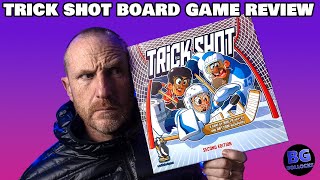
Clear-ice passes, slap shots, bank shots off the boards, and fights are all described as thematically tied to hockey rather than bolted on. Penalties send a player to the box and affect who returns to the ice, and arena cards let groups play on real NHL-style rinks with their own special rules. Reviewers say these pieces combine into a game that feels like hockey without dragging down the pace.
Designed for two players
Reviewers consistently treat the two-player game as the sweet spot. Drive Thru Games says it works fantastically as a two-player game, and Foster the Meeple calls the two-player setup optimal. Rules for more players do exist, with turns passing around the table, but reviewers say the game shines one-on-one. Foster the Meeple also notes a quick mode for a single period, a regular three-period game, and an arcade-style option for younger players that removes some of the more complex rules.
Potential Drawbacks
A steep learning curve for newcomers
The most common concern is that the rules are dense for anyone who does not already know hockey well. Board Game Hangover says the rules are a bit too complex for an average hockey fan, and Foster the Meeple noted that a non-hockey player had trouble with some of the rules until a hockey player explained them. Reviewers suggest printing the action reference sheet and teaching the game with a hockey fan on hand for the first few plays.
Face-offs and a few hockey liberties
Face-offs always happen at center ice, which reviewers say is a simplification, since real hockey also stages face-offs in the offensive zones. Drive Thru Games also raises a small component gripe about the player cards, which are harder to flip over than they should be. Availability is a practical concern too. The unpainted version was sold out when Drive Thru Games reviewed the game, so buyers may need patience to find a copy.
If You Enjoy Trick Shot
Reviewers reach for Blood Bowl first when describing Trick Shot, and they mention Blitz Bowl in the same breath for players who like football-style tactical sports games. Rumble Slam, a wrestling game, is named as a favorite in a similar spirit. Players who enjoy card-retrieval systems from Concordia or Flotilla will recognize how cards are used once and then picked back up. Anyone who likes the idea of a dice-based push-your-luck game with a sports theme should find Trick Shot a natural next step.
What Reviewers Are Saying
"and you have a really really cool tension of like okay i've got the puck in a decent situation here and i'm gonna start adding dice and"
Drive Thru Games
"this game like recreated the feeling of hockey way more Faithfully than I ever thought would have been possible"
All You Can Board
"it's very thematic it plays like hockey it is as close to a game of hockey you can get in a board game"
Foster the Meeple