





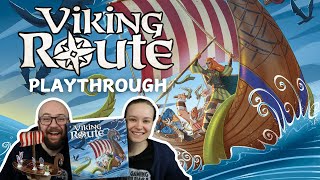


Viking Route Deep Dive
What the Community Thinks About Viking Route
Board gaming reviewers have embraced Viking Route as a standout cooperative experience that delivers on both mechanical innovation and thematic adventure. Ares Games, traditionally known for their extensive war game catalog, has ventured boldly into hobby game territory with this title, and the community response reflects genuine enthusiasm for what the publisher has accomplished. Reviewers consistently praise the game's willingness to take risks with its core navigation system while maintaining the cooperative gameplay that makes the experience feel grounded and purposeful rather than gimmicky.
Core Mechanics That Define Viking Route
Magnetic Navigation and the Compass System
At the heart of Viking Route sits one of the hobby's most distinctive mechanical choices: a real compass that responds to magnetic markers positioned around the board. The compass is not decorative; it is the physical embodiment of wind direction and the primary means by which players navigate their Drakkar. Reviewers found this system deeply satisfying because it merges theme and mechanism in a way that feels natural. As players move magnetic ravens and wind tokens around the board to manipulate navigation, the compass physically responds to their positioning, creating a dynamic interplay between player intention and mechanical consequence. The wind direction constantly shifts during play, forcing teams to adapt their strategy and creating natural tension between wanting to move in a particular direction and being subject to the navigational whims of the game world. This approach transforms what might have been a random navigation element into something players can meaningfully influence, rewarding clever positioning and forward thinking.
Cooperative Mission and Scenario Structure
Viking Route organizes its gameplay around scenario-based missions, each with its own distinct objectives, enemies, and spatial layouts. Rather than playing through a single long campaign, each session focuses on a contained adventure: sailing to collect magical stones, defeating legendary creatures like the Kraken, or navigating past ancient dangers. Each player controls a Viking character with asymmetric abilities and special powers, meaning team coordination requires understanding not just shared goals but also each player's unique strengths. One character might excel at combat, another at resource gathering, a third at manipulating ship components. This asymmetry encourages players to lean on each other and think about action sequencing carefully. The scenario structure also means that learning curves are gentler; new players can grasp the flow of a single mission without worrying about multi-hour campaign arcs, yet the modularity allows for rich variety across multiple plays.
The Viking Route Experience
Sense of Adventure and Mythic Exploration
Playing Viking Route feels like piloting a crew through legendary waters. The game's framing device, Odin's ravens guiding the Drakkar past the world's edge toward mythical lands, sets an adventure-steeped tone that reviewers found genuinely engaging rather than merely thematic window dressing. Players navigate through encounters with creatures, manage resources under pressure, and work together to achieve objectives that feel earned rather than handed out. The combination of the physical compass system with the scenario narrative creates a immersive experience where mechanical interaction and thematic storytelling reinforce each other. Reviewers noted that the pacing of scenarios keeps tension high without demanding the multi-hour commitment of heavier cooperative games.
Meaningful Cooperation Without Quarterbacking
Because player roles are asymmetric and turns involve both shared consequences and individual decision-making, Viking Route sidesteps one of cooperative gaming's most common pitfalls: the dominance of one experienced player directing all other actions. Reviewers appreciated that planning together required discussing options rather than one player simply telling others what to do. The asymmetric nature of character abilities, combined with turn order flexibility that allows players to choose action sequence each round, creates natural opportunities for collaboration without removing individual agency.
What Makes Viking Route Stand Out
The Magnetic Compass as a Production and Mechanical Statement
The choice to use an actual compass as a game component, suspended on a board surrounded by magnets, marks Viking Route as willing to take production risks. This is not a gimmick; reviewers were careful to distinguish between novelty for novelty's sake and genuine mechanical integration. The compass becomes the shared reference point for the table, a piece everyone watches respond to magnetic positioning, creating a tangible feedback loop that cardboard components alone cannot replicate. Every time a player moves a magnetic token, the table watches the compass respond, reinforcing the consequence of their action. This creates a meditative, almost mesmerizing quality to turns that combines spatial puzzle-solving with a dash of physical play.
Flexible Player Count and Role Scalability
Unlike many cooperative games that struggle at certain player counts, Viking Route's asymmetric roles and flexible turn order mean it scales gracefully from two to four players. At two players, characters may control multiple Vikings, requiring a different kind of coordination. At higher player counts, the interplay between distinct roles creates more dynamic negotiation. Reviewers noted that the game never felt padded at lower counts or overwhelming at higher ones; the mechanics naturally adapted to available players, and the experience remained engaging regardless of group size.
Potential Drawbacks
Magnetic System Sensitivity and Setup Consistency
While reviewers universally praised the magnetic compass, a few noted that the mechanism's responsiveness can vary depending on how carefully magnetic tokens are positioned. In early prototype versions, reviewers observed occasional inconsistencies in compass behavior when tokens were placed at certain angles. However, they acknowledged these as prototype-era concerns and expressed confidence that production refinements would resolve them. The setup also requires some care to ensure the board is level and magnets are properly placed, adding a small pre-game ritual that some players might view as minor friction.
Scenario Difficulty and Replay Scaling
A few reviewers noted that the difficulty curve across scenarios can feel uneven until teams develop stronger familiarity with character roles and board layouts. This is not unusual for cooperative games, but it means new groups may find some scenarios more punishing than others early on. The asymmetric nature of roles also means that team composition affects difficulty in ways that aren't always obvious before play, which can occasionally lead to scenarios that feel either trivial or brutal depending on which characters are activated first.
If You Enjoy Viking Route
Fans of Forgotten Waters, which similarly offers crew-based cooperative adventure with strong theming, will find much to appreciate in Viking Route, though the games differ in presentation and core mechanics. While Forgotten Waters emphasizes story branching and choose-your-own-adventure flow, Viking Route grounds players in puzzle-like spatial positioning and resource management. Players who cherish Spirit Island for its asymmetric powers and deep team coordination will recognize similar structural DNA here, though Viking Route runs faster and with less AP overhead. Pandemic fans seeking a fresh cooperative system will appreciate that Viking Route reinvents the engine rather than tweaking it. For those drawn to games like Flash Point: Fire Rescue, Viking Route offers a comparable playtime and cooperative tension, but with a navigational twist that makes failure feel like bad luck with the elements rather than simple bad decisions.
What Reviewers Are Saying
"It's thematic that like the wind is steering us in one direction, but we can manipulate something with our equipment."
— Board Gaming Ramblings
"There's a lot to love here, pandemic inspired turn structure, but with more flexibility and freedom like Spirit Island and a really, really, really cool central mechanism of trying to manipulate a compass through magnetism to be able to get where you need to go."
— Rahdo Runs Through
"I got a chance to see a preview of this last year and how the magnet works and it's it's so cool. It's very very unique while not being just a gimmick."
— Ryan and Bethany Board Game Reviews