







Warhammer Quest: Blackstone Fortress Deep Dive
What the Community Thinks About Warhammer Quest: Blackstone Fortress
Reviewers generally treat Warhammer Quest: Blackstone Fortress as a successful revival of the Warhammer Quest line from the 1990s. The fantasy setting of the original has been replaced by the Warhammer 40k universe, but the core promise is the same: a dungeon crawl played solo or with friends, where each expedition feeds into a longer campaign. Rolling Dice & Taking Names places the game squarely in the cooperative dungeon crawler tradition and recommends it to anyone who enjoys challenging co-op experiences, while Drive Thru Games ranks it second on its solo top ten and praises the new Warhammer Quest games for what they do with the system.
The areas of agreement are fairly consistent. Reviewers praise the tactile action economy, the sense that each expedition matters, and the way the 40k setting gives the dungeon a distinct identity. The main disagreement is about how much the game's repetition matters. Gaming Rules! enjoyed the game but described it as a bit repetitive, with much of the play consisting of moving around a dungeon, rolling dice, and shooting enemies. That reviewer accepted the trade-off because the game was enjoyable in the moment. Reviewers who value variety in every session may find that mismatch more difficult to overlook.
Core Mechanics That Define Warhammer Quest: Blackstone Fortress
Dice Selection and Action Economy
The most frequently discussed system is the way players turn dice into actions. Rather than simply rolling for outcomes, players select dice from their pool and assign them to specific actions, and some actions require dice of a particular result. Rolling Dice & Taking Names singled this out directly, describing the dice selection mechanic and the act of spinning dice to take actions as the elements it loved most. The result is a game where the player's choices are visible in every turn, and where a poor roll can be managed rather than simply endured. Because character abilities and gear determine which dice are useful, the system also ties the dice pool to the characters' growth over time.
Campaign Progression Through the Precipice
The second defining system is the campaign structure. Between expeditions, players return to Precipice, the port city that has grown up against the side of the Blackstone Fortress, where they rest, recover, trade loot for resources, and prepare for the next run. Drive Thru Games highlighted this hub as the most interesting part of the design, calling the blend of dungeon crawling with town visits and one-off side adventures a particularly strong combination. Characters persist and become more capable, which gives each expedition a sense of continuity that many dungeon crawlers lack.
The Warhammer Quest: Blackstone Fortress Experience
Tension From Persistent Consequences
Reviewers describe a real sense of risk. Rolling Dice & Taking Names noted that characters can die and stay dead, and that the campaign material includes consequences for failure, so that a failed mission can send the group back to the start. The reviewer compared this to a legacy-style game in which choices carry forward. That stakes-driven feeling is one reason reviewers describe the game as absorbing. Players who are invested in their characters tend to feel tension in each fight because the outcome has effects beyond the current session.
Satisfaction of a Shared Playthrough
The second feeling reviewers emphasize is the satisfaction of playing the game with others and seeing the results of hours spent. Tabletop Minions described playing through the base game with a group and treating the session as a reward for the time spent assembling and painting the miniatures. The rhythm of moving around the board, rolling dice, and fighting enemies can feel familiar after several expeditions, but reviewers who came to the game for its theme and components tended to find that rhythm enjoyable in its own right. The experience is less about surprise and more about the pleasure of commanding a well-built party through a hostile space.
What Makes Warhammer Quest: Blackstone Fortress Stand Out
A Hub Where Races Mix
Reviewers consistently point to the Precipice as one of the game's most distinctive features. Drive Thru Games described it as a place where lots of different races from the 40k universe mix, with one-off side adventures that make the setting feel alive between major expeditions. Rolling Dice & Taking Names also praised the way characters of different races work together, noting that this cooperation fits the far future setting. The hub gives the game a personality that goes beyond a list of rooms and monsters.
Miniatures and Theme
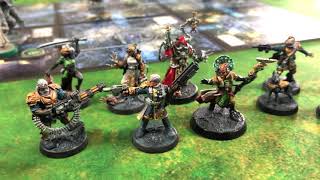
The physical presentation is another frequent point of praise. Tabletop Minions and Gaming Rules! both focused on the miniatures and the Warhammer 40k look, and one reviewer said it felt good to play a game with miniatures they had spent years painting. Tabletop Minions also described the game's corridor and doorway terrain as a useful addition to a collection built around the setting. Board Games UnLocked included the game in its top-ten list, which places it among the titles that reviewers keep recommending.
Potential Drawbacks
Repetition Within Expeditions
The most common criticism is that the rhythm of play can become repetitive. Gaming Rules! described the game as moving around a dungeon, rolling lots of dice, and shooting bad guys, and admitted that it was a bit repetitive. That reviewer still enjoyed the playthroughs, but the observation suggests that players who expect each session to bring new mechanics may find the core loop limiting over time. Campaign progression helps mitigate this, but the moment-to-moment play is the element reviewers flag most often.
Fit With the Original Warhammer Quest and Fantasy Fans
Some reviewers who love the classic Warhammer Quest argue that other games capture its feel more closely. Drive Thru Games said that Shadows of Brimstone does the old-school Warhammer Quest style better, even while praising Blackstone Fortress as a newer take on the line. The 40k setting is also a limitation for players who prefer fantasy. The same reviewer noted that they were not a 40k player and preferred the Age of Sigmar universe, so the theme may be a barrier for those who do not already enjoy the setting.
If You Enjoy Warhammer Quest: Blackstone Fortress
Players who enjoy Warhammer Quest: Blackstone Fortress's dice selection system will find a similar satisfaction in Gloomhaven, where card and resource decisions shape each turn and the campaign carries persistent consequences across sessions. Those who value the campaign and town-hub structure may also enjoy Aeon's End, which pairs cooperative play with a steady progression of options and a tight focus on turn-by-turn choices. For players drawn to the dungeon-crawl format, Talisman offers a board-based adventure with a more open structure, while Pandemic Legacy appeals to those who want choices and permanent consequences to shape a long campaign.
Players who like the Warhammer 40k setting and its miniatures may find Kill Team and Warhammer Underworlds a natural extension, since both share the universe and the appeal of building a collection. Those who grew up with the original 1990s line may want to compare Blackstone Fortress with Warhammer Quest itself, and players who know Silver Tower will recognize the same family of dungeon-crawl systems, which Drive Thru Games noted the Warhammer Quest line shares with that game.
What Reviewers Are Saying
"I love the action, I love the dice selection mechanic and spinning the dice to take actions, and and certain dice are required for certain actions, and I love how your character can be built up over the time."
— Rolling Dice & Taking Names
"Blackstone Fortress is from Games Workshop. It is move around a dungeon, roll lots of dice, shoot bad guys. But I enjoyed it. Yes, it was a bit repetitive with just moving around and rolling dice and shooting bad guys, but yeah, it is what it is."
— Gaming Rules!
"I really really like what these new Warhammer Quest games do, specifically Black Stone Fortress. Now that Black Stone Fortress is a Warhammer 40k universe thing, there's been two games kind of using this similar system as this setting, the more fantasy Age of Sigmar universe, Silver Tower and Shadows Over Hammerhal, which you can actually kind of combine in some ways. This one does it better."
— Drive Thru Games