















For the Emperor Deep Dive
What the Community Thinks About For the Emperor
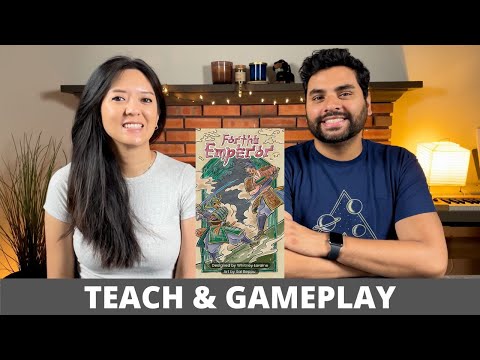
For the Emperor has earned surprising unanimity among board game reviewers: this tiny-box card game is a masterclass in design restraint and mechanical elegance. The consensus is not "this is an amazing game," but rather "this is an excellently designed two-player experience that punches far above its modest component count." Reviewers from Chairman of the Board to the Cardboard Herald recognize For the Emperor as a game that knows exactly what it is and executes flawlessly within those bounds. Designer Whitney Lraine and publisher Allplay have created something that feels inevitable once you understand it, yet surprising in how much game lives inside such a small package. Some reviewers wanted more depth, and a few identified a potential second-player advantage, but these objections come from a place of appreciation rather than frustration: reviewers simply liked the game enough to wish it went further.
Core Mechanics That Define For the Emperor
Area Control
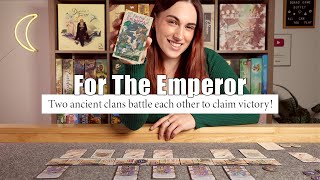
For the Emperor strips area control down to its essence. Seven battlefields sit between you and your opponent. Each battlefield has a capacity (how many total cards can be played there), determined dynamically as the game progresses. The first battlefield to reach four cards becomes the four-card zone; the next becomes three; others become two or one. This creates a tension that builds gradually: early in the game, you do not know which zones will be the most contested, but certain cards can force these decisions early, giving you control over the board's shape. Whoever has the most strength (the numerical value on their cards) in each battlefield wins that zone and claims a point. Whoever controls the majority of zones at game's end wins. The elegance lies in the fact that you are not simply stacking numbers; every card has a special power that manipulates the battlefield itself. You might force your opponent to take back all their cards, double the strength of your cards in one zone, or permanently change a zone's capacity. This is area control where the board itself becomes a contested resource.
Combat: Deck and Hand
Both players receive identical decks of only 10 cards, yet you never play with full information. At any moment, you hold only three cards in your hand. This constraint forces deeply tactical play: you cannot always follow your intended strategy because the cards available to you dictate what you can do on any given turn. With 10 cards split across both players, you develop card memory quickly. Within a few games, you know what your opponent has played, what they might hold, and what they might play next. The hand size creates constant pressure. Should you play your strong card now, or save it for a moment when it might matter more? Should you burn your best card for its ability, knowing it prevents you from using its strength elsewhere? The hosts of the Cardboard Herald podcast noted that whoever goes second seems to have a systemic advantage, suggesting that response and adaptation matter more than initial positioning. The simplicity of the card pool (only 10 unique cards for each player) means all games use the same deck, yet infinite tactical variation emerges from how those 10 cards are drawn and managed.
The For the Emperor Experience
Tension and Mind Games
Reviewers consistently describe For the Emperor as tense, mutual pressure where every decision carries immediate consequence. There is nowhere to hide in a two-player game with high interactivity and a fully symmetrical setup. The Cardboard Herald's hosts, comparing it to Battle Line, noted the game's "completely symmetrical" two-sided structure keeps both players locked into the same tightening pressure round after round. The tiebreaker system reinforces this: every player holds back one card from play, using it only if any battlefield ends in a tie. This creates a second-order mind game. Playing your best card early might give you a clean win, avoiding the tiebreaker entirely; holding it back keeps your opponent guessing about your power level. Knowing your opponent has an unknown-strength card still in hand creates perpetual uncertainty. This is board gaming as intimate conflict.
Elegance and Accessibility
For the Emperor accomplishes something difficult: it feels sophisticated without being imposing. The cards are clean, one-line effects that resolve instantly. Text does not overwhelm the cards; instead, it enhances them. New players grasp the core concept in minutes (play cards to win zones), yet the special powers add layers of deception and control without ever requiring a rulebook mid-turn. Jenna from the Board Game Garden described it as a quick, easy-to-teach game that still offers meaningful decision-making. This is not a game for mastery over years; it is a game where competence arrives quickly and satisfaction is immediate. The 22-minute playtime respects your time while feeling complete. Nothing is left unresolved; each game reaches a decisive endpoint.
What Makes For the Emperor Stand Out
Perfect Mechanical Refinement
One reviewer summed up a universal observation: "It's just very refined and it just seems to me like it's almost been like perfectly tweaked with what all these abilities can do." This game does not include unnecessary rules, card abilities that need clarification, or mechanical bloat. Every element serves. The card powers are balanced (strong-value cards have weaker abilities; weak-value cards have stronger abilities) yet each card feels distinct in how it shapes the board state. The battlefield capacity system emerges organically from play rather than being imposed by external rules. This is design that feels inevitable, as if there were no other way to make a two-player lane battler, yet in truth it represents careful iteration and restraint.
Exceptional Value and Accessibility
For the Emperor costs less than $15 in most markets, making it one of the most affordable two-player experiences available. The component cost is honestly low (cards and a rulebook), yet the production quality is genuine. Sai Pepu's illustrations carry personality and clean beauty, and the card stock is pleasant to handle. Reviewers consistently remarked on this value proposition: you are getting a complete, well-designed, beautiful game for $8 to $25 depending on region. This is not a loss-leader or a beginner's game that will bore experienced players. This is a legitimate two-player game that happens to be small and affordable. Chairman of the Board framed it perfectly: "It's small, it's affordable and the gameplay is high quality."
Potential Drawbacks
Limited Strategic Depth
Several reviewers noted that while For the Emperor is tactically rich, the strategic layer is thin. With only 10 cards and 22 minutes of play, there is only so much planning ahead a player can do. The game rewards reading your opponent and exploiting current board states more than it rewards pre-game preparation or long-term strategy. Ryan and Bethany from Ryan and Bethany Board Game Reviews put it plainly: "I just felt like I was left wanting more. It's a little bit unsatisfying in that way. I would have wanted to play more of these cards, more card options, maybe you have a 20 card hand and you only play eight of them." This is less a flaw than a design choice: For the Emperor is intentionally compact. But if you crave games where strategy unfolds across dozens of turns with many viable plans, this one may feel slight.
Potential First-Player Disadvantage
One of the co-hosts on the Cardboard Herald podcast raised a concern that emerged across multiple play sessions: "Every single time I've played, whoever has gone second has won." In a two-player game, going first should be an advantage or at least neutral; if going second is consistently better, the game may need rebalancing or the concern may reflect playstyle rather than design. Going second allows you to react and adapt your entire game based on your opponent's first move. In a game where response and adaptation matter heavily (as they do in For the Emperor), this reactive advantage may outweigh the privilege of initiative. The other co-host agreed, suggesting that the ability to respond to your opponent is more powerful than the ability to set the board's initial state. This is not a fatal flaw, but it is worth testing with multiple playgroups.
If You Enjoy For the Emperor
For the Emperor draws lineage from classic two-player lane battler and area control games. If you love Hanamikoji (where you draft cards to win zones and read your opponent's intentions), you will find For the Emperor a natural companion. If you enjoy Air, Land and Sea (the portable two-player dueling card game with hand management), For the Emperor offers similar tension in a different costume. Reviewers also compared it favorably to Love Letter (where information management and deduction matter) and Battle Line (where you compete for control across multiple fronts). The game sits comfortably in the tradition of quick, elegant two-player confrontations that can be played anywhere and taught to anyone, yet offers enough texture to satisfy experienced gamers. It is not a gateway to deeper strategy games, but a complete experience unto itself.
What Reviewers Are Saying
"So it's just very refined and it just seems to me like it's almost been like perfectly tweaked with what all these abilities can do. With a lot of these games, one thing that normally concerns me is if there's too much of an information dump on those cards, where you just kind of it feels like a bit of a chore using the powers on them. These ones are all very simple to resolve and easy to understand and how to use them and exploit them."
— Watch Review
"This one is a super strong example of that and hopefully I've kind of spread the word a bit and can maybe put it on your radar to give it a try yourself. It's small, it's affordable and the gameplay is high quality."
— Chairman of the Board
"It's a very fun easy get to the table two-player game that I have really really enjoyed. Each of the different cards or some of them do have different abilities that allow you to add tokens, move different things, and there's a bunch of different abilities. It is a very fun easy get to the table two-player game."
— Board Game Garden