








Dungeons & Dragons: Builders of Baldur's Gate Deep Dive
What the Community Thinks About Dungeons & Dragons: Builders of Baldur's Gate
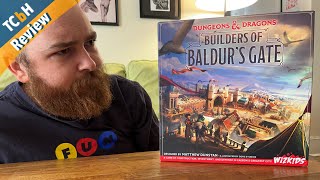
Builders of Baldur's Gate, designed by Matthew Dunston and published by WizKids, is one of the more divisive titles in the Dungeons & Dragons board game line. The Discriminating Gamer ranks it second on a list of the best D&D board games and says it charmed him. Brian Drake and Carla of The Dice Tower each put it on their top 10 lists for 2025, while admitting it is a mess on the table by the end. Other coverage is much cooler. A separate Dice Tower review gives it a five out of 10, and The Cardboard Herald calls it a good, fun game whose systems never quite come together. Rolling Dice & Taking Names split down the middle: Marty liked it, while Tony said plainly that he was not a fan.
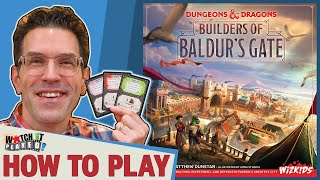
Some of this coverage has commercial ties. Watch It Played's rules teach was sponsored by WizKids. Paul Grogan of Gaming Rules! produced a sponsored tutorial and playthrough and says WizKids has been a client for many years. The Cardboard Herald reviewed a copy provided by WizKids.
Core Mechanics That Define Dungeons & Dragons: Builders of Baldur's Gate
Three Actions and Worker Displacement
On a turn, a player does one of three things: build a building, send a worker to a location on the board, or collect income. Watch It Played explains that the city is split into nine colored districts, each with special worker locations. The Cardboard Herald adds that the locations offer favor tracks, gold, supplies and new building cards. Workers do not come home on their own. They return only when someone builds in that district, when another player sends a worker to the same spot, or when their owner spends a supply. The Cardboard Herald's podcast compares this to the worker displacement in Stonemaier Games titles: instead of blocking a space, moving onto an occupied spot hands the other player their worker back, which in effect helps them. The same podcast describes a game where one worker was stranded for the rest of the match because every plot in that district had already been built and its owner never gained a supply.
A Tableau of Connected Buildings
Buildings come from a hand of cards and cost gold. Only eight plot markers are open on the board at any time. After each build, a token drawn from a bag decides where the next plot appears. Solid lines connect the plots, and when someone builds on a plot linked to one of your buildings, you collect that building's bonus. Rolling Dice & Taking Names note that even building next to your own headquarters pays out two gold. The cards you build also form a personal tableau. The Cardboard Herald describes four building types, each with an income effect that is either a constant bonus or an action that fires when you collect income. Rolling Dice & Taking Names call the income phase the real engine, since players choose the order in which their buildings resolve and can chain supplies into victory points.
The Dungeons & Dragons: Builders of Baldur's Gate Experience
Tension Over Where the Next Attack Lands
Each district has four plots. When the fourth plot token is drawn for a district, that district is attacked. Players defend with watchtowers and keeps. Rolling Dice & Taking Names explain that a keep adds two points of defense and a watchtower one, and that the attack strength rises after each assault. If the defense holds, contributors score points. If it fails, anyone with buildings there who added nothing to the defense loses control of them. The Cardboard Herald adds that the district's special location then costs one more favor to use, though the income effects on your cards survive. Gates connect districts and score for the intact buildings around them.
For its fans, the attack system is the draw. The Discriminating Gamer praises the push-your-luck tension of never knowing which district the bag will point to next. Rolling Dice & Taking Names describe players watching three districts at once, where one wrong token triggers an attack. A player might build a keep instead of a building to shore up a defense. They also found the defense almost semi-cooperative, since players rely on each other to meet the attack value.
A Table That Gets Crowded
The physical production gets praise across the board: plastic buildings, wooden pieces and catapults, and distinct fortification minis. The problem is the state of the board late in the game. The Cardboard Herald found that the board clutters quickly and the connection lines get hidden under pieces. The Dice Tower reviewer says it is hard to see what attaches to what. Brian Drake notes that it looks fantastic while being played but rough when done. Carla calls it a hot mess that goes on forever and ever.
What Makes Dungeons & Dragons: Builders of Baldur's Gate Stand Out
A Lean Action Menu
Rolling Dice & Taking Names appreciated that there are only three actions and three resources, with no system where one resource can stand in for another. Paul Grogan calls it a medium-weight or even light-to-medium game that plays smoothly in about 90 minutes with fairly quick turns. For a Euro set in the Forgotten Realms, that accessibility is a real selling point.
Combo Engines
Players who enjoy building a chain of effects will find plenty to work with. Marty of Rolling Dice & Taking Names said he loves combo-heavy games and targeted buildings that turned supplies into victory points every income phase. The Cardboard Herald says the game offers a lot of decisions each turn.
Potential Drawbacks
Runaway Leaders and Strong Cards
The most common complaint is balance. On The Cardboard Herald's podcast, Eric described a starting hand that combined into roughly 10 victory points a turn and a final score of about 140 to 50. The written review states that in half its games one player was so clearly winning that everyone else fought for second, with no guardrails and no catch-up mechanics. The Dice Tower reviewer suspects there are broken cards. Tony of Rolling Dice & Taking Names singled out a building that lets its owner use a worker action twice, which let Marty race up a faction track. Eric also initially saw the attacks as a catch-up mechanic but changed his mind. Contributing even a little to a defense keeps your buildings safe, and losing board pieces does not take away the cards in your tableau.
Theme and Pacing
Several reviewers feel the setting sits lightly on the design. The Cardboard Herald says the theme is pasted on and the city could be any European town, and it calls the unnamed attacking force a misstep. The Dice Tower reviewer says the game has nothing to do with Baldur's Gate and suspects it did not get much playtesting. That reviewer also saw the ending dragged out, because players who did not think they were winning had no reason to push toward the finish. The Cardboard Herald adds that much of the worker placement took a back seat, with many actions rarely used.
If You Enjoy Dungeons & Dragons: Builders of Baldur's Gate
The Cardboard Herald points D&D fans who want a worker placement tableau builder toward Lords of Waterdeep, saying it does all of these things better. Rolling Dice & Taking Names compare the bonus for building next to another structure to Terra Mystica, so fans of that adjacency reward may find something familiar here.
What Reviewers Are Saying
"Deeply thematic, beautiful production, great minis for parts of the buildings, the fortifications that you build, and just really fun. There's a great tension there because you never knew where the attack was going to hit next."
— The Discriminating Gamer
"There are a lot of cool and interesting systems and mechanisms going on in this game. And it gives you a lot of decisions to make on your turn."
— The Cardboard Herald
"There's some really cool concepts here, but there's a lot of problems with this game. There is a lot of luck involved as to the tiles that come out as you're trying to control different areas on the board."
— The Dice Tower