Game Info
Year
2024
Players
2-6
Age
14+
Playtime
60 min
Collection
Ratings
Creator Score
Expansions & Family
/pic175966.jpg)
/pic5726297.jpg)
/pic4912015.jpg)
Mechanic profile
Not enough video data yet
Vibe profile
Not enough video data yet
Description
Tabletop RPG set in the Arkham Horror universe using the Dynamic Pool System d6 dice mechanics for investigators in 1920s Arkham
Arkham Horror Family
(6 games)
Part of the Arkham Horror family — see Arkham Horror for the combined view.

Featured Videos


Ask a Rules Question
All mentions
Browse transcript mentions, sentiments, pros/cons, mechanics, topics, quotes, and references.
Total mentions: 2
This page: 2
Sentiment:
pos 1 ·
mix 1 ·
neu 0 ·
neg 0
Showing 1–2 of 2
Video er-8YWX70rk
Review at 1:06 sentiment: mixed
video_pk 69607 · mention_pk 166214
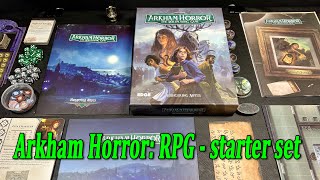
Click to watch at 1:06 · YouTube ↗
Overall sentiment (raw)
mixed
Pros
- Good value for the price ($35 for a starter set).
- Lots of physical components and evidence for players to interact with.
- The core D6 dice pool system (DPS) is easy to conceptualize and track.
- Dice pools are public knowledge, making it easy to keep track of combatants.
- Dice can be spent at almost any time for actions or reactions.
- The starter set provides a complete, closed-box experience for a few sessions.
- Encounter maps are visually appealing and usable for other games.
Cons
- Not recommended for solo play; better solo horror RPG options exist.
- Rules are scattered throughout the scenario book, making lookup difficult.
- The 'learn as you play' format for RPG rules can be cumbersome.
- Lack of character creation rules in the starter set is a significant drawback.
- Limited utility of the starter set components for future plays.
- The game relies heavily on tightly scripted scenarios with few random elements for the GM.
- Player-focused puzzles are not preferred by the reviewer.
- GM tools for generating random mysteries or encounters are lacking.
Thematic elements
- Investigating a mystery behind a lurking dread and a ravenous hunger consuming the city, stopping a force feasting on fear before a true horror is summoned.
- Arkham, Massachusetts in the 1920s
Comparison games
- Call of Cthulhu RPG
- Arkham Horror board game (first edition)
- Arkham Horror (second edition board game)
- Mansions of Madness 2nd Edition
- The Walking Dead starter set
- Call of Cthulhu RPG (latest starter set)
- DND Essential Set
- Forbidden Psalm
Mechanics (from transcript analysis)
- Action/Reaction System — Players can spend dice to perform simple or complex actions on their turn, as well as reactions to events on other players' or enemies' turns.
- Character Health/Wounds — Characters have a pool of dice representing their health. Taking wounds limits the number of dice returned to the pool on a new turn.
- Character Progression (in starter set) — Leveling up occurs twice during the scenario, allowing players to improve skills or gain new abilities.
- Dice Pool System (DPS) — A dynamic pool system where dice are spent for actions, and dice also represent health. Players roll dice from their pool, with successes needed for actions. Horror dice are added to pools when taking mental trauma, and rolling a '1' on a horror die can lead to trauma.
- Investigation — Involves examining evidence, solving puzzles (like sliding puzzles), and interacting with NPCs.
- Mental Trauma — Mental injuries or afflictions can be placed on a character sheet, and using dice for actions may require adding a horror die. Rolling a '1' on a horror die leads to rolling on a trauma table.
- Player-focused Puzzles — Puzzles are designed for the players to solve, not their characters, which the reviewer finds a negative aspect.
Video topics + discussion points
No key topics recorded for this video.
Quotes (from this video)
- I do not recommend this game for solo play.
- If you're looking for a solo horror RPG there are simply better options out there.
- It's a boxed mystery game with player-focused puzzles focusing on an investigation with definitive answers.
- One of the positives is all of the cool stuff you get in this game for the price.
- The rules are scattered about through the scenarios through the different acts throughout the different scenes and so it makes it very difficult to find where a rule is if you need to go back and remind yourself.
- Longtime viewers of the dungeon dive will know that I am not a fan of player focused puzzles when it comes to um RPG.
- The core mechanism the D6 dice pool system they call it the DPS system and that is the dynamic pool system where your pool of dice are spent to do actions and your dice also represent your health.
- For me that's a huge bummer I frame almost all of my RPG thoughts around character creation.
- This Starter Set is completely 100% focused on these pre-generated characters and for me that's a huge bummer.
- Overall I think the system is pretty cool.
- I am still very curious and somewhat excited about checking out the full game when it is available.
References (from this video)
No references stored for this video.
Video 0TAJkzi_Qs8
Unknown Channel Rules Teach at 0:00 sentiment: positive
video_pk 10685 · mention_pk 31550
Click to watch at 0:00 · YouTube ↗
Overall sentiment (raw)
positive
Pros
- Strong art direction and presentation that fits Arkham Horror aesthetic
- Dynamic dice pool offers meaningful decision points and resource management
- Versatile action economy with simple/complex and reaction actions
- Clear division between narrative and structured scenes supporting GM guidance
- Intriguing horror and trauma system with long-term stakes
- In-depth character creation and progression with archetypes, knacks, and insight
- Campaign structure and starter scenarios to help new groups
- No initiative rolls keeps combat fast and reactive depending on who starts a conflict
Cons
- Potentially slow decision-making on complex actions due to die allocation
- Rules complexity may be steep for new RPG players
- Horror/trauma mechanics can be unforgiving and heavy for some groups
- Healing may be limited and trauma permanent in some cases
Thematic elements
- Cosmic horror, investigators confronting ancient deities and eldritch entities
- Arkham, Massachusetts, 1920s-1930s Lovecraftian mythos
- mythos-driven, episodic with both narrative and structured scenes
Comparison games
- Arkham Horror (board game)
- Eldritch Horror
- Mansions of Madness
- Arkham Horror Card Game
Mechanics (from transcript analysis)
- Archetypes, knacks, and XP progression — Eight archetypes with knacks; XP spent to improve skills, purchase new knacks, and possibly multiclass; advancement creates unique characters.
- Combat and injury — Attack resolution based on weapon stats; damage reduces dice pool; injuries trigger alternatives and healing options; long-term consequences managed via rules.
- Combat: Damage Based — Attack resolution based on weapon stats; damage reduces dice pool; injuries trigger alternatives and healing options; long-term consequences managed via rules.
- Dynamic Pool System (DPS) — Players start with six six-sided dice; dice are spent to take actions and perform tests; pools refill at the start of a scene or on a character's turn; damage and horror reduce the pool and can cause wounds or trauma.
- Horror and Trauma system — Rolling horror dice when trauma occurs; one die per horror point; trauma can lead to lasting effects with trauma tables and is not healable.
- Insight and personality traits — Characters gain Insight tied to traits; insights can be spent to improve outcomes, gain clues, or alter trait effects; traits have positive/negative aspects that interact with insights.
- Narrative Choice — Narrative scenes require no dice for simple actions and progress differently; structured scenes follow turn-based combat with rounds and dice spent for actions.
- Narrative vs structured scenes — Narrative scenes require no dice for simple actions and progress differently; structured scenes follow turn-based combat with rounds and dice spent for actions.
- Simple, Complex, and Reaction actions — Three action types: simple actions auto-pass; complex actions require choosing how many dice to roll and can fail; reactions spend one die to interrupt another action.
Video topics + discussion points
No key topics recorded for this video.
Quotes (from this video)
- the dynamic pool system
- you start out with the maximum of six d6s in their pool of dice
- there are two types of scenes narrative and structured narrative scenes
- no initiative roles in this game
- horror can be healed through complex actions such as introspection or counseling but trauma can never be healed
- as a board gamer I like the concept of having a limited number of actions and I can spend those actions how I want
- the book itself is 256 pages and broken up into eight chapters covering the lore of the world rules character creation equipment game master tips ancient ones descriptions allies and enemies and a pre-written five scene scenario
- off the bat the art is topnotch Arkham Horror board and card games have always had great art there is a certain style to it that is consistent in all the games and that remains here
- I like how the book uses beige background pages except for the chapter on the ancient ones the background there looks like a dimly lit night sky really nice touch
- I think this is going to make for some really interesting decisions during game play
- as a longtime player of other Arkham Horror themes I look forward to immersing myself in a world where I can visit Miskatonic University check out a book from Daisy Walker from the Library, have a drink at the nightclub, try to outwit Carl Sanford and go toe-to-toe with the Shoggoth
References (from this video)
No references stored for this video.
Transcript Navigation
Showing 1–2 of 2