


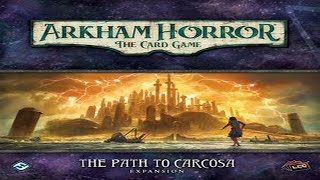





Arkham Horror: The Card Game – The Path to Carcosa Deep Dive
What the Community Thinks About Arkham Horror: The Card Game – The Path to Carcosa
The Path to Carcosa stands as one of the most thematically focused campaigns in Arkham Horror: The Card Game, earning respect from the community for its consistent exploration of psychological horror and madness. Reviewers consistently highlight the campaign's tighter narrative focus compared to earlier expansions, with one notable reviewer observing that "that's all about madness and going crazy" when describing how Carcosa differentiates itself from other campaigns. The expansion presents a cohesive story centered on the King in Yellow, a fictional play that drives investigators toward supernatural madness. Players appreciate the atmosphere created throughout the eight scenarios, though some note that the campaign's heavy reliance on psychological tension makes it feel more oppressive than other paths through Arkham. The core appeal lies in the integration of thematic elements with mechanics that reinforce the feeling of slowly losing grip on sanity throughout the investigation.
Core Mechanics That Define The Path to Carcosa
Doubt and Conviction Mechanics
Carcosa introduces a dual-track system with "Doubt" and "Conviction" tokens that track the investigators' mental state throughout the campaign. This system reinforces the madness theme at a mechanical level, where choices and failures accumulate mental trauma rather than just physical damage. Players must navigate scenarios where their investigator's mental fortitude becomes as critical as their ability to solve puzzles or fight enemies. The back-and-forth nature of these tokens creates constant tension, as gaining conviction might prevent taking horror but simultaneously locks the investigator into certain paths of resolution. This mechanic is particularly effective because it makes the horror thematic; the investigators aren't just facing external threats, but internal psychological battles that reshape how they approach the investigation itself.
Agenda Advancement and Ritual Mechanics
Several scenarios in Carcosa feature complex agenda structures where investigators must choose between pursuing different objectives, each with distinct consequences. The campaign uses ritual-based mechanics in key scenarios where a supernatural ceremony must be interrupted or completed, creating scenarios with split paths and meaningful player choice. These mechanics force hard decisions about resource allocation and risk, often leaving investigators feeling like they are one step behind the unfolding supernatural events. The scenario designs emphasize that time pressure and limited information lead to consequences that carry forward through the campaign narrative.
The Path to Carcosa Experience
Mounting Psychological Dread
The campaign excels at building a persistent sense of wrongness that grows throughout the eight scenarios. Players note that the flavor text and scenario design create an unsettling atmosphere; locations describe disturbing details in passing, and non-player characters behave in increasingly unhinged ways. The second scenario, The Last King, exemplifies this approach: reviewers highlight how the initial description seems like an ordinary event, "a place out of a fairy tale," but gradually reveals itself as a nightmare where guests transform into horrific creatures. This escalating unease creates a campaign experience where players feel themselves descending into madness alongside their investigators.
Investigation into Forbidden Knowledge
Carcosa centers on the investigators pursuing understanding of a mysterious play called "The King in Yellow," which slowly corrupts everyone who engages with it. The campaign presents itself as an investigation into a supernatural mystery where gathering clues and reading flavor text is not just mechanically necessary but thematically integral; the more the investigators learn, the more at risk they become. This creates a unique psychological pressure, where success in traditional investigation mechanics actually advances the horror narrative rather than providing relief.
What Makes The Path to Carcosa Stand Out
Cohesive Narrative Across Eight Scenarios
Unlike campaigns that present standalone scenarios loosely connected by theme, Carcosa maintains a tight narrative arc where each scenario directly advances the central plot about the King in Yellow and its supernatural influence. The campaign's story unfolds deliberately, with investigators learning more about the threat while simultaneously making choices that affect the campaign's conclusion. This narrative coherence gives the campaign weight; scenarios aren't just mechanical challenges but chapters in a larger story, making success and failure feel consequential beyond just mechanical record-keeping.
Emphasis on Atmosphere Over Combat
Carcosa prioritizes creating an unsettling psychological experience over action-oriented gameplay. While other campaigns feature combat encounters and tense action sequences, Carcosa leans into investigative tension, strange encounters, and the slow revelation of disturbing truths. This design philosophy makes the campaign feel unique within the game's ecosystem. When combat does occur, it often feels like a desperate response to supernatural threats rather than the primary challenge, which reinforces the horror atmosphere.
Potential Drawbacks
Restrictive Deck Building in Campaign Mode
The campaign's narrative focus comes with mechanical restrictions that limit investigator flexibility. Players report that running specific deck archetypes through Carcosa becomes challenging because the campaign's restrictions, such as required card limitations or campaign-specific deck modifications, can force suboptimal deckbuilding decisions. These restrictions serve the narrative but sometimes create frustration for players who want to test specific strategies or use favorite card combinations.
Relative Difficulty Variance and Punishing Failures
Carcosa's scenarios vary significantly in difficulty, and failure in certain scenarios can create lasting complications for future runs. Some reviewers note that the campaign's mechanics, particularly around agenda advancement and trauma accumulation, can make comebacks difficult once momentum shifts against the investigators. The tight campaign narrative means that a single bad scenario can set up future challenges that feel insurmountable, particularly on higher difficulty levels where resources are already tight.
If You Enjoy The Path to Carcosa
Players drawn to Carcosa's psychological horror focus should explore The Circle Undone, which shares Carcosa's emphasis on narrative consequences and dark atmosphere while introducing ghost-themed mechanics and witchcraft elements. For those who appreciate Carcosa's supernatural mystery structure, The Forgotten Age offers a different tone but maintains a cohesive campaign narrative with exploration-based gameplay. The Feast of Hemlock Veil, a more recent campaign, takes psychological horror even further with biological corruption themes and a night-based scenario structure. Players who love the madness theme specifically should seek out the Return to Path to Carcosa expansion, which deepens the campaign's mechanical complexity and adds new scenarios that explore the King in Yellow mythology further.
What Reviewers Are Saying
"I played the path to Carcosa. I played as William York when I first started, which was really cool. But what I mostly enjoyed was the story, specifically the story that I and the other person I was playing with created through our cards and the investigators that we played. Mr. York did not survive through the whole Carcosa campaign. In fact, he died around the midway point."
— Shelfside
"The island commune of Mont Saint-Michael lies off the northwestern coast of France it is beautiful elegant and enigmatic. A place out of a fairy tale only this tale is one of horrors and madness. During low tide you would be able to reach the island on foot by crossing the tidal causeway that emerges from the sea however by the time you reach the coast the tide is much higher than you'd anticipated."
— War Games Unlocked
"The Last King is probably the first scenario in Arkham Horror that I would consider to actually be a scary or tense scenario when it comes to the theming of it. The vibe of this scenario is off. The vibe of this scenario is just something is strange immediately when you're reading the first text on the act and agenda where you know the party is happening and then you read on this the location flavor text and it's like oh this guy just has no hands. He's just bony stumps asking for my coat."
— Playing Board Games