





Meeples & Monsters Deep Dive
What the Community Thinks About Meeples & Monsters
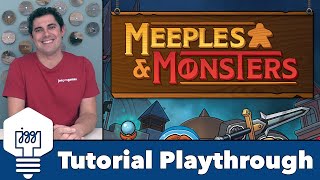
Meeples & Monsters, published by Alderac Entertainment Group, presents an interesting case study in board game design. Some reviewers celebrate its fast-paced progression and charming theme, while others find the execution at odds with its ambitious premise. The game appeared on multiple "most anticipated" lists in 2022, indicating genuine enthusiasm within the hobby, though opinions on the final product vary considerably.
Core Mechanics That Define Meeples & Monsters
Bag Building at the Heart
Bag building forms the core engine of Meeples & Monsters. Each player maintains a personal bag of tokens representing their army, starting with peasants and corruption meeples. As the game progresses, players draw a handful of meeples from their bag each turn. What makes this system compelling is deliberate cultivation: players can recruit new unit types, replacing weak tokens with powerful ones. Drawing from the bag introduces an element of luck tempered by strategic building choices. Reviewers praised how this creates a natural sense of progression; by the game's final rounds, players draw increasingly valuable pieces, making otherwise challenging monsters manageable through accumulated resources.
Worker Placement and Location Actions
Players assign their drawn meeples to various locations on a shared board, each offering different benefits. The locations represent the city of Rowan and its defenses. Players can spend meeples at a cathedral to train clerics, visit a village to create warriors, or work at locations that grant direct benefits. However, one design tension reviewers noted is that while the board displays worker placement iconography, the game lacks the tight action-blocking dynamics typically associated with that genre. Instead, multiple players can visit the same location, turning it into a transaction rather than a contested space. This design choice simplifies the game but limits meaningful player interaction at the core level.
The Meeples & Monsters Experience
Satisfying Power Progression
The most consistently praised aspect of Meeples & Monsters is how it makes players feel increasingly powerful. Each unit type can be leveled up using victory points, granting new abilities. Early turns are cautious and constrained, with limited meeples and weak units. By the final turns, players have accumulated an enormous pile of meeples in various colors, each with combat bonuses and synergies. Reviewers described becoming so engaged with the escalating power fantasy that their overall fatigue from a long game melted away. One enthusiast noted they were exhausted but remained "so engaged the whole game" precisely because of this relentless power curve.
Charming Light Adventure Theme
Meeples & Monsters wraps its mechanical engine in a comedic fantasy adventure. The theme feels deliberately light-hearted rather than dramatic; players are defending the city of Rowan from monsters while recruiting warriors and mages. Reviewers appreciated the gentle comedic tone, though some felt the theme remained surface-level. One reviewer specifically noted that the game delivers "an adventure theme but put kind of on a light spin so with some comedy." This tonal choice makes the game accessible and fun without demanding narrative weight from its mechanics.
What Makes Meeples & Monsters Stand Out
Generous Reward Economy
By design, Meeples & Monsters showers players with rewards as the game progresses. Players gain meeples from defeating monsters, building locations, completing quests, and leveling up units. This abundance creates a feedback loop where snowballing feels fair and earned rather than arbitrary. One reviewer specifically highlighted that the feedback system is "extremely generous in its rewards," making the player feel their decisions compound into tangible power. This stands out in a landscape where many Euro-style games throttle rewards to maintain tension.
Intuitive Unit Upgrade System
The ability to transform and improve your pieces creates immediate, visible progress. Players don't abstract their army into card piles; they physically manipulate colored meeples, watch them level up, and see abilities unlock. Reviewers found this satisfying because the theme and mechanics align: you are literally watching your warriors and mages become stronger. One enthusiast called it "nice to see your meeples leveling up and becoming more powerful," capturing how the system delivers both mechanical and thematic rewards with each unit improvement.
Potential Drawbacks
Weak Rule Book and Component Clarity
Multiple reviewers cited frustrations with the rule book, which suffers from ambiguity and errors. One designer-focused critic found the rulebook "weak" with information that repeats ambiguously, sometimes making it unclear whether an action should be performed once or repeatedly. The document also misses explanations entirely, forcing players to search designer forums for clarification. Additionally, the board uses worker placement iconography, which sets expectations about how blocking and contested spaces work, but the game doesn't deliver on those implicit promises. A gamer approaching from other worker placement titles finds themselves unlearning assumptions during early turns.
Deterministic Combat and Theme Mismatch
The central mechanism for defeating monsters is purely mathematical: assign enough total strength to match the monster's health and it falls. There is no element of risk, drama, or narrative tension in combat. One critical reviewer observed that monster battles are "entirely deterministic and mathematical," which undermines the adventure fantasy the theme promises. This design choice simplifies the game and reduces variance, but it also means combat feels more like accounting than storytelling. For players seeking thematic resonance or narrative drama, this flatness can feel like a missed opportunity.
If You Enjoy Meeples & Monsters
If the power progression and bag building of Meeples & Monsters appeal to you, Lords of Waterdeep and Champions of Midgard offer similar satisfaction through escalating capabilities and thematic worker placement. Those who love building engines with interconnected rewards will find Orléans rewarding. For a lighter bag-building experience, Quacks of Quackenplack provides the draw-from-bag tension with a faster pace. Three Sisters and Calico offer accessible puzzle-building if you value satisfying progression without fiddly components. Tiny Towns delivers elegant spatial strategy with minimal rules overhead, appealing to players who appreciate Meeples & Monsters' charm but want tighter execution.
What Reviewers Are Saying
"This is a game that is a bag builder. You are going around and you're taking your meeples, you're putting your meeples out onto the board and turning them into different colored meeples. The idea being is each different meeples different thing: you start with a bunch of peasants, and then perhaps you can turn some peasants into warriors by training, or they become clerics or mages or paladins. But as you're doing this kind of bag cultivation, bag building, and putting these meeples and stuff out on the board and getting new ones, you're also dealing with the monsters that are showing up around the town."
— Hungry Gamer
"Meeples and Monsters has a nice central concept, bag building with workers which can be upgraded then used to fight monsters of escalating difficulty. As hooks go, it's not mind-blowing but it's solid. The execution lets the game down enormously though. The title, the artwork, the retail components, the rule book, the fiddly pieces, the repetitive gameplay, it just doesn't come together into a satisfying package."
— Adam in Wales
"It is extremely generous in its rewards. By the final turns of the game, you will have amassed an enormous pile of meeples of various colors, loads of power-ups which combo in exciting ways, and killing monsters which previously seemed impossible has become a breeze."
— Adam in Wales