


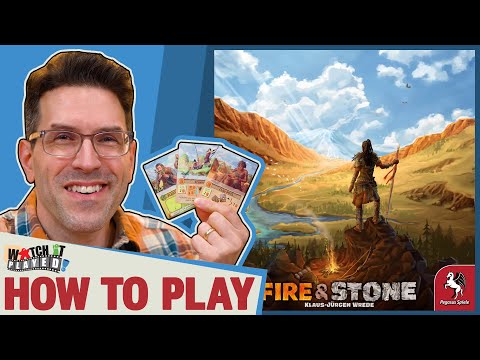









Fire & Stone Deep Dive
What the Community Thinks About Fire & Stone
Fire & Stone draws players into a Stone Age world of exploration and resource management. Reviewers highlight the satisfying combination of discovery mechanics, tribal development, and area control competition. The game's variable setup through randomized tokens creates a unique experience each time, while the designer's pedigree from Carcassonne sets high expectations that the game consistently meets. The blend of controlled progression, emergent strategy, and negotiation through shared space creates a gaming experience that resonates across experience levels.
Core Mechanics That Define Fire & Stone
Exploration and Tile Flipping
The heart of Fire & Stone lies in its discovery system. Players move scouts across a world map divided into three unlockable regions, revealing face-down tokens that represent different features: forests with animals, fire sites for cooking, gathering locations, huts for settlement, and caves with unique abilities. Each discovery offers immediate benefits and ongoing actions on future visits. This creates a push-your-luck element where timing and positioning matter significantly. Early exploration can yield powerful resources or unlock new map regions, while later visits to established areas provide reliable but modest returns. The system rewards both aggressive early scouting and patient exploitation of existing resources.
Resource Management and Tribe Development
Players collect food, animals, and tools to upgrade their tribal capabilities. The game uses a Bonanza-style mechanic where players gather multiple copies of resources to trigger escalating rewards on specialized tracks. Food is scarce and precious, limiting player options and forcing meaningful decisions about resource spending. Tools and inventions discovered during play provide permanent bonuses, abilities that persist for the remainder of the game. These discovered powers create emergent engines that compound throughout play, rewarding players who successfully chain discoveries into synergistic combinations.
The Fire & Stone Experience
A Game of Emerging Possibilities
Fire & Stone excels at creating moments of discovery and strategic tension. As players unlock new regions and gather resources, their available options expand dramatically. The variable setup means no two games follow identical patterns, keeping veteran players engaged. Cave tiles add surprise elements that alter future turns without overwhelming the base experience. These special cards represent the game's most innovative feature, though their effects are modest enough that multiple plays are needed to appreciate their full impact on strategy.
Pacing and Accessibility
The game moves briskly for its scope, typically completing in 45 to 60 minutes. Turns flow smoothly, especially at two players where downtime becomes minimal. Setup involves randomly placing tokens, which is more time-consuming than teaching the rules themselves. The design welcomes both casual players seeking family-weight fun and experienced gamers seeking deeper strategic layers in its area control and resource optimization. This accessible-yet-deep approach to game design reflects careful balancing throughout development.
What Makes Fire & Stone Stand Out
The Designer's Proven Track Record
Klaus Jürgen Wrede, the mind behind Carcassonne, brings decades of design experience to Fire & Stone. The game shares DNA with Wrede's classic, simple core rules that support surprising depth. Like Carcassonne, Fire & Stone excels at player counts from two to four by adjusting interaction and pacing without requiring complex scaling rules. Wrede's reputation for elegant systems serves Fire & Stone well, creating a game that teaches quickly but rewards strategic mastery over repeated plays.
Randomness as a Feature
The randomized token system is a deliberate design choice that keeps players engaged without predictability. Unlike pure area-control games where experienced players can calculate optimal lines, Fire & Stone rewards adaptability. Players must plan while remaining flexible enough to capitalize on fortunate reveals. This design choice makes the game accessible to newer players while preserving strategic depth for veterans. The system creates natural comebacks when one player's early lead becomes vulnerable to lucky discoveries for opponents.
Potential Drawbacks
Luck-Dependent Area Control
The area control mechanic hinges on where settlement tokens appear during exploration. Players cannot guarantee placement of huts where they desire; instead, huts appear only when corresponding tiles are revealed. This randomness can make private scoring objectives feel disconnected from player agency. A task requiring huts adjacent to mountains becomes challenging if mountains never appear as settlement locations, shifting the experience toward luck over planning. Some players may find this frustrating when their carefully-planned strategies are derailed by tile placement.
Modest Moment-to-Moment Excitement
While the overall game arc builds toward satisfying crescendos, individual discoveries can feel incremental. Revealing tokens is thematic but mechanically straightforward. The cave cards promise dramatic shifts but often deliver subtle tweaks rather than game-changing abilities. Players seeking constant narrative peaks may find stretches of reliable-but-unremarkable play between meaningful events. The pacing can feel slow during mid-game when players are grinding resources between major discoveries.
If You Enjoy Fire & Stone
Consider exploring Carcassonne for the designer's earlier masterwork of spatial building and area control. Cascadia offers tile-laying discovery without direct conflict. Hanza offers a similar blend of exploration and area control with less reliance on randomness. The game appeals equally to those seeking a family experience on a world map and players wanting portable area-control competition. Those drawn to Fire & Stone's mix of exploration and resource management will find kindred spirits in games like Roll Through the Ages and Lords of Waterdeep.
What Reviewers Are Saying
"In the stone age this means you'll be exploring new lands while hunting and gathering to survive and perhaps coming up with a few inventions to make your life easier."
— Watch It Played
"In Fire & Stone you are playing as different tribes, you are playing as a leader of a tribe and you are trying to build and up your tribe and survive."
— Grant Lyon
"Players lead their tribe through the stone age, they scout new lands, harvest nuts and mushrooms and finally build villages."
— Getting Games