







Mayor of Chicago Deep Dive
What the Community Thinks About Mayor of Chicago
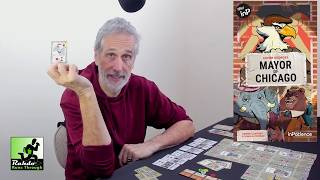
Reviewers who spent real time with Mayor of Chicago land on a shared verdict: this is a tight, thinky solo puzzle that punishes early mistakes and rewards patience. Sir Thecos called the finished experience "a really clever, tight, and very thoughtful solo game with a unique theme and a surprisingly deep puzzle," and awarded it a golden certificate as their personal Ace of Games. Rahdo Runs Through placed it on a top-10 most-anticipated list for 2026 and reported that both the solo mode and the two-player cooperative mode are excellent. Tabletop Tokki, who received a review copy from publisher inPatience, described being "enamored with the gameplay" even though the Chicago theme itself did not land for the host personally.
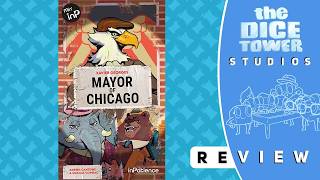
The disagreement is over polish, not substance. The Dice Tower's Mike Delisio scored it 7 out of 10 and argued it could easily be an 8.5 with some difficulty tuning, since the game is "far too difficult out of the box, even on the easiest level," and flagged iconography that could be cleaned up. Fellow Dice Tower host Z Garcia also gave it 7 out of 10, calling it "a really neat puzzle in a box with some personality" that "will punish you at first" before it rewards the effort. BoardGameCo added the game to a curated 200-game collection after a solo session, calling it "a much more satisfying solo game" than the title it displaced.
Core Mechanics That Define Mayor of Chicago
Three Ways to Play Every Card
Every turn starts with drawing a single card, and reviewers walk through the same core choice each time. As Tabletop Tokki explains during a teach, a player can expand the city grid by placing the card's map side into the leftmost open slot of a row or column, flip it over and place it as an assistant on a completed city block for a cost, or discard it entirely. Placing a card outside the leftmost available spot costs a point of corruption, a track that has to be paid down with money or votes at game end. Sir Thecos walks through the same structure, noting that discarding a card face up next to the opponent's card returns some cash but costs votes later, while discarding it on its neighborhood side avoids that penalty. Rahdo Runs Through frames the tension well: every card is either a city tile or a potential staff member, and a player can see the next city card coming but never knows what the following hire will be.
Icon Tracks That Reward Density
Once an assistant lands on a completed block, the surrounding city cards determine the payout. Tabletop Tokki lays out the scaling directly: matching one icon around the assistant yields one resource, two icons yield three, three icons yield five, and four matching icons yield eight, with flag symbols acting as wilds. Sir Thecos demonstrates the same system repeatedly, at one point covering three symbols for five resources and noting that certain assistants double whatever is collected. That doubling and stacking is what pushes players toward the game's tight resource swings, since popularity, power, booze, corruption, and votes all move off the same handful of icon clusters.
The Mayor of Chicago Experience
A Tense, Thinky Solo Puzzle
Sir Thecos describes the puzzle as "very very thinky and very hard, but in a good way," and highlights the specific feeling of watching a plan come together across a play. That same review notes losing every early game before the underlying planning started to click, which the channel frames as part of the appeal rather than a flaw. Rahdo Runs Through echoes the intensity, describing every decision as something that "will make or break you" given how fast money disappears and how six double-sided event cards trigger both mid-game and at the final tally.
An Interconnected Two-Player Co-op
Rahdo Runs Through spends significant time on the two-copy cooperative variant, playing it alongside another person and finding it "immensely satisfying." In that mode, only one copy of a given assistant card exists between the two decks, so both players are competing for cards like "Rose the Swan" while also trading money and booze back and forth to cover each other's campaigns. The review contrasts this directly with other solo games that were adapted into co-ops and "have failed," crediting the design for genuine interaction rather than two people quietly playing solitaire side by side.
What Makes Mayor of Chicago Stand Out
Multi-Use Cards in a Tiny Box
Tabletop Tokki singles out the cards themselves as the standout design choice, pointing to how the same deck handles city expansion, staff hiring, and discard-triggered engine effects "without a lot of rules or unnecessary components." Sir Thecos, who met designer Xavier Georges at Spiel and received a review copy from inPatience's Shadi Torbey, adds that the box is barely large enough to hold its contents yet contains "a lot of game in a very small box," with a rulebook glossary that explains every assistant and event clearly enough that the large number of symbols becomes easy to track once learned.
A Design Pedigree Reviewers Trust
Sir Thecos connects the game to designer Xavier Georges' other work, naming Ginkgopolis, Black Angel, and Carnegie as games that primed the channel to expect strong design here, concluding it may be one of the best games from inPatience and one of Georges' cleanest designs. Rahdo Runs Through makes a related point about the two-player co-op, comparing it to Shadi Torbey's Onirim series: games designed primarily for solo play whose co-op modes rarely feel like a sacrifice, which Rahdo says Mayor of Chicago also manages.
Potential Drawbacks
A Steep Learning Curve and Rough Difficulty Tuning
Both Sir Thecos and the Dice Tower agree the difficulty needs respect. Sir Thecos calls out "quite a steep learning curve" and admits to losing repeatedly before the puzzle clicked. Mike Delisio on the Dice Tower goes further, arguing the base difficulty is miscalibrated even at the easiest setting and that iconography could use cleanup, which is why the score landed at 7 rather than higher despite wanting to keep playing.
A Fiddly Resource Track and Limited Event Variety
Tabletop Tokki flags the resource track as "a bit fiddly, especially if you're playing in a tight space," and notes the game takes up a lot of table space overall, which the double-sided track only partially solves. Rahdo Runs Through's main complaint is variety: the same six event cards appear every game, and while their two-sided nature changes how they play out, the channel says it "would love to see some more variety from what they do."
If You Enjoy Mayor of Chicago
Sir Thecos points fans toward other designs from Xavier Georges, naming Ginkgopolis and Black Angel as favorites and singling out Carnegie as a standout among the designer's larger games. Rahdo Runs Through draws a different comparison for solo gamers who want dense, punishing decision spaces, placing this alongside Carson City, and compares its solo-to-co-op conversion to Shadi Torbey's Onirim series, which Rahdo credits with the same trick.
What Reviewers Are Saying
"I am enamored with the gameplay and the overall presentation really has grown on me. The fact that the cards are multi-use, with choosing each round for your assistant, discard abilities that trigger that engine that you can build up on your grid, and floor placement tableau building bonuses with making your map makes for some really cool interesting decisions without a lot of rules or unnecessary components."
— Tabletop Tokki
"All in all, Mayor of Chicago is a really clever, tight, and very thoughtful solo game with a unique theme and a surprisingly deep puzzle. It does a lot with very few cards, putting the city step by step, grouping and spreading symbols, deciding when to use characters, and trying to create just enough support to win this election. Keep in mind, it may take a play or two to fully click, and it's definitely challenging. It has definitely quite a steep learning curve."
— Sir Thecos
"I have to admit I would love to see some more of these event cards because it's always the same six card. It's just that they're all two-sided. And granted, it really makes the game different, depending on which two sides come up and what order they come up in. But I'd love to see some more variety from what they do."
— Rahdo Runs Through