


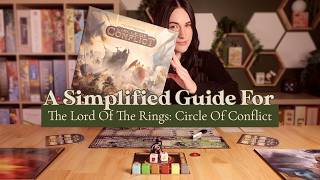
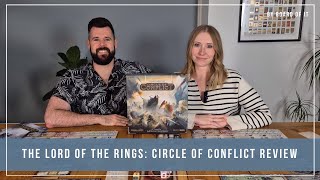


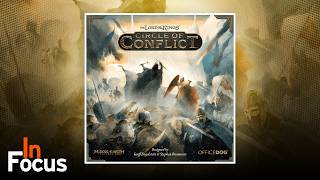
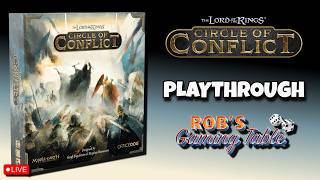



The Lord of the Rings: Circle of Conflict Deep Dive
What the Community Thinks About The Lord of the Rings: Circle of Conflict
The Lord of the Rings: Circle of Conflict has generated enthusiastic responses from the board game community, particularly from fans of both the Tolkien franchise and heavy roll-and-write games. Reviewers widely praise the game's thematic ambition and mechanical innovation, though reactions split between those who find it a compelling medium-weight experience and those who view the roll-and-write format as a limitation. The consensus among enthusiasts is clear: this is a game crafted with reverence for the source material by designers who take the IP seriously. For players who appreciate hidden information, asymmetric player interaction, and intricate spatial mechanics, Circle of Conflict delivers something distinctive in the roll-and-write landscape.
Core Mechanics That Define The Lord of the Rings: Circle of Conflict
Dual-Sided Player Boards and Asymmetric Interaction
The signature mechanic of Circle of Conflict is the innovation of simultaneous control over opposing factions. Each player commands both the Free Peoples on one side of their board and the Shadow forces on the other. This creates a circle of conflict where players battle their neighbors in all directions: your Free Peoples attack the Shadow of the player to your left, while your Shadow attacks the Free Peoples of the player to your right. Designers Steven Bonacore and Jeff Engelstein (published by Office Dog Games) have constructed this system to force constant strategic tension. Players cannot focus entirely on a single front; they must balance resources between two distinct military forces, each with separate objectives and scoring paths. This neighbor-only interaction model, reminiscent of Seven Wonders, keeps gameplay manageable while maintaining meaningful player competition.
Dice Allocation and Icon Management
The game uses a classical roll-and-write foundation: players roll dice, and each player allocates those shared results to different aspects of their player board. However, the execution diverges significantly from traditional genre entries. The core constraint is strict: one die must go to the Free Peoples side, one to the Shadow side. No choice there. The depth emerges in how players deploy the icons revealed on those dice. Throughout the game, players unlock nation dice (Gondor, Rohan, Elves for the free peoples; Mordor, Isengard, Southrons and Easterlings for the Shadow), expanding their tactical options. Each icon-driven action creates cascading consequences. Filling certain spaces grants additional icons; using those icons unlocks character abilities or military progress. This layering of small decisions into meaningful turns separates Circle of Conflict from simpler roll-and-writes.
The The Lord of the Rings: Circle of Conflict Experience
Epic Scope with Hidden Information Tension
Circle of Conflict plays like an epic military campaign compressed into a single board game session. Reviewers consistently describe the experience as intense and thematic, with the game delivering on the promise of controlling forces across Middle-earth. The hidden information element amplifies this: players keep their boards face-down, revealing actions only through the public phases. Your opponent does not know where you are moving the Fellowship on the map, how many hunt spaces you have filled, or which character abilities you have unlocked. This secrecy creates genuine tension during resolution phases when hidden information becomes critical. Players hunting for the Fellowship must ask specific location questions, and the hunted player must respond with truth. It is a form of hidden movement woven into a roll-and-write framework, requiring careful resource management and educated guesses about opponent positions.
Heavy Rule Complexity with Multiple Phase Types
The experience demands engagement from turn one. The game flow consists of eight phases each round, though most resolve quickly. The core phases (roll dice, allocate dice, use icons, public actions) drive meaningful choice. Battle resolution, when triggered, adds significant decision depth as players simultaneously deploy secret character abilities and calculate total army strength. Reviewers note that the first play through Circle of Conflict requires patience. Understanding the interaction between dice icons, space markings, and character abilities takes time. Yet once the relationships click, the game reveals itself as intricate rather than overcomplicated. The epic feel emerges partly because the game does not shy away from complexity; it fully commits to offering multiple strategic paths. Some players pursue aggressive military buildup, others focus on advancing their Fellowship toward Mount Doom, and still others concentrate on corrupting the opposing Fellowship through relentless hunting. All three paths remain viable to the final tally.
What Makes The Lord of the Rings: Circle of Conflict Stand Out
Authentic Thematic Integration
Reviewers repeatedly emphasize how thematically grounded Circle of Conflict feels. The game does not simply paste the Lord of the Rings name onto a generic system; it makes structural choices that reinforce the IP. Players control iconic characters (Gandalf, Aragorn, Frodo, Legolas) and deploy them with abilities that reflect their canonical roles. The map of Middle-earth grounds movement in recognizable locations. The two-sided battle system (Gondor vs. Mordor, Rohan vs. Isengard) mirrors the narrative structure of Tolkien's work. Even the victory point calculation method, which awards points for reaching distant locations, traveled paths, battle victories, and army strength, creates an experience where all the fictional elements serve mechanical purpose rather than decoration.
Neighbor-Focused Interaction in a Social Experience
The circular player interaction model removes the chaos of multi-player direct attack while preserving meaningful conflict. By limiting interaction to immediate neighbors, the game creates three simultaneous two-player dynamics within a larger game. This design choice elegantly sidesteps analysis paralysis. Players do not track four separate threat vectors; they focus on the two neighbors adjacent to them. Reviewers who value interactive play find this structure superior to games where each player operates in isolation. The fact that your decisions (especially character ability usage and army marshaling) directly influence what your neighbors can accomplish creates natural negotiation and strategic thinking around the table. Unlike completely open games, the circular structure ensures every action feels locally meaningful.
Potential Drawbacks
Streaming Difficulty and Limited Spectator Appeal
Circle of Conflict presents genuine challenges for content creators and large groups. Because players keep their boards hidden, most action occurs behind screens. Viewers of a live stream cannot see what is happening until information becomes public, which reduces real-time engagement. Rob's Gaming Table explicitly mentioned struggling to stream the game effectively due to the secret information requirement. For players accustomed to transparent board states, the game's hidden elements require trust and may create friction if players worry about mistakes going undetected.
Battle Resolution and Pacing Concerns
Multiple reviewers noted that battles, while mechanically sound, sometimes feel anticlimactic relative to the buildup. Additionally, some players feel the game is simply too long for a roll-and-write. Circle of Conflict typically runs 60 to 90 minutes, significantly longer than classic entries in the genre. For players expecting a quick filler game, the commitment required may disappoint. The intensity of decision-making throughout creates a full experience, but the pacing does not accommodate the more relaxed, casual play that some associate with roll-and-writes.
If You Enjoy The Lord of the Rings: Circle of Conflict
Players drawn to Circle of Conflict will find natural homes in other heavy roll-and-writes and asymmetric designs. Hadrian's Wall shares the weight and decision density, though it abandons the player-versus-player element. Twilight Inscription offers similar neighbor battles and military escalation, though with a different setting. War of the Ring provides the ultimate asymmetric Lord of the Rings experience for groups willing to dive deeper into grand strategy. For those seeking the hidden information and simultaneous choice elements without the roll-and-write frame, Descent and Doomwar deliver similar tension. The comparison games most frequently mentioned by reviewers include Seven Wonders (for its neighbor-only interaction model) and Twilight Inscription 2 (for its battle system and map-based progression).
What Reviewers Are Saying
"You will see they've taken the roll and write genre, I believe, to the next level with how much interaction there is and leveling up of characters and then going into battle. The battle element to me was really unique. It was really interesting that you had to do both sides for each of your opponents."
— Rahdo Runs Through
"There are many decisions and choices to be made and courses to take to victory. The Lord of the Rings: Circle of Conflict is a balancing act between not only yourself playing both the fellowship and the Shadow, but between you and the player to your right and left."
— BoardGameGeek
"And then eventually somebody will trigger a battle and there's all kinds of characters to both factions, which I think is another thing that makes it quite spicy. Because they have a lot of characters all with really interesting powers, all of which you want to use. And they can interact with all the different areas of the game."
— Board Of It