












Solar Titans Deep Dive
What the Community Thinks About Solar Titans
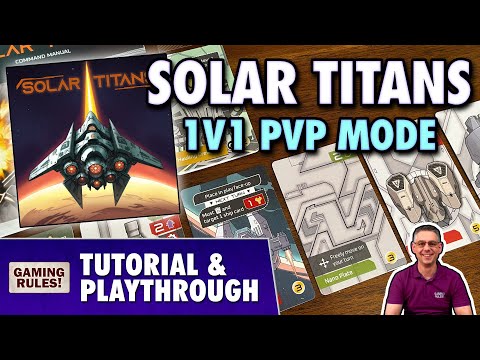
Solar Titans has earned consistent praise from reviewers as an innovative entry in the deck-building genre. The consensus centers on its distinctive hybrid design: a game that merges the deck-building core of titles like Dominion with a persistent, tactical ship-building tableau that evolves throughout play. Reviewers emphasize the game's versatility and elegance in equal measure. Rather than serving as a one-trick design, Solar Titans offers players multiple ways to engage with it, from competitive duels to cooperative modes and engaging solo play. Gaming Rules highlighted the sheer breadth of content on offer, noting that the game delivers "loads of different modes of play that all look quite interesting." Reviewers consistently describe the experience as surprisingly clever given its streamlined rule set, with Board Games UnLocked praising how "it's just clean, very minimalistic" while still delivering genuine depth. The solo variants have also impressed, with dedicated reviewers finding the automa opponent system "very well done" and the experience of playing against AI "seamless" in the way it flows during actual play.
Core Mechanics That Define Solar Titans
Deck Building with Persistent Ship Tableau
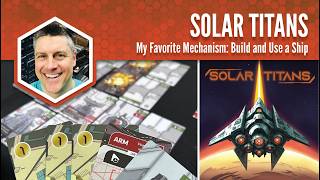
The heart of Solar Titans lies in its fusion of two distinct systems. Players begin with ten identical starting cards, drawing five each turn to generate resources and drive combat actions. What sets this apart from traditional deck builders is that purchased cards split their purpose: some remain permanently in your deck to generate resources, while others physically deploy onto your spaceship as weapons, armor, and specialized crew modules. This creates a genuine strategic tension. As Stonemaier Games explained, the core innovation is that "not only are you building a deck in the game and using that deck to generate resources and attack the opponent's ship, but you were also maintaining and adding on to a ship that's on the table that remains on the table during the game." Your deck powers your actions; your ship is what actually survives and wins battles. The dual purpose keeps both systems relevant throughout play, preventing the ship from becoming purely decorative flavor.
Field Repair Resources and Tactical Defense
Each player begins with exactly five field repair tokens, representing the only way to restore disabled ship components. This limited pool forces meaningful decisions: repair that critical targeting bay now, or conserve repairs for later when bigger threats emerge? Reviewers consistently noted how this mechanic generates interesting choices without overwhelming complexity. The Hungry Gamer appreciated that "you're kind of like oh do I want to keep repairing it cuz like you want to attack and you're kind of hitting that button where you're like okay well do I want to hold off until you can repair some of your better stuff or you just go to repair right away so you don't find yourself kind of behind." The limitation creates natural pacing and forces players to prioritize which ship systems matter most. Losing crew quarters means discarding two cards per turn, a crippling penalty that makes protecting the ship a defensive puzzle throughout the game, not just a cosmetic concern.
The Solar Titans Experience
Quick-Paced Dueling Tension
Solar Titans delivers the satisfaction of a duel that reaches conclusion in roughly 45 minutes. Reviewers repeatedly praised the game's speed relative to other competitive deck builders. The Hungry Gamer noted appreciation for games "when those go by relatively quickly because a lot of times I find with the longer ones if you start to lose you're just struggling for 45 minutes hoping maybe you catch up and you're probably not going to catch up." The quick pace means defeats don't linger, and comebacks remain possible but require excellent deck optimization. The game rewards building a lean, focused engine over bloated collection strategies. Board Games UnLocked described playing one game and then immediately wanting "to play it again," a sign that the experience felt complete and satisfying rather than exhausting or overly long.
Tactical Puzzle of Ship Layout
Each game begins with players randomly selecting from eight different ship layouts, each offering a unique configuration of starting parts. These layouts are not just cosmetic variations; they fundamentally reshape how you defend and how your opponent must attack. Ships can be up to five-by-five grids with maximum fifteen cards, and the layout determines which positions are exposed, which require flanking attacks, and which can be reinforced. Reviewing the solo variant, one analyst noted the "tactical thinking of maybe what you can attack with, what you might want to repair" as a core draw of the experience. The puzzle of deciding whether to build aggressively or defensively, whether to counter your opponent's visible threats or pursue your own offense, creates the game's strategic spine. Unlike pure deck builders where the only variable is card draw from a shuffled deck, Solar Titans adds the persistent question: given a ship layout and the available cards, what is the optimal attack or defense configuration right now?
What Makes Solar Titans Stand Out
Multiple Game Modes Built Into One Box
Solar Titans ships with more game configurations than most players will encounter in a year of regular play. It accommodates one versus one duels, two-player co-op against an automated opponent, 2v2 team games where each team commands a shared Titan ship, one versus two scenarios with asymmetric power levels, and a fully featured solo campaign mode. Gaming Rules emphasized this breadth in their sponsored coverage, stating that when "SunnySideUp Games contacted me, they wanted me to show off the team version of the game, the 2v2 mode. But having played it, I went, 'Oh, wait a minute. This game has loads of different modes of play that all look quite interesting.'" The solo automa system deserves special mention: it draws from the shared market deck to determine its actions, creating a system where players can predict upcoming opponent behavior and plan around it. Players are not reacting to randomness but to probabilistic scenarios they can reason about. This feels like playing a human opponent who follows transparent logic rather than consulting hidden AI rules.
Innovative Weapon and Targeting System
Rather than abstract damage, Solar Titans grounds all attacks in ship geometry and line-of-sight. Weapons vary in how they target: some fire straight down a column, others flank the sides, rare pierce cards penetrate through multiple defenses. Reviewers highlighted how "the different shooting methods, how it might be one that shoots kind of the column, hits the side, penetrates" creates ongoing decisions about how to position your ship and which targets to prioritize. The variety means players cannot simply ignore weapon diversity and buy the first strong card; instead, different weapons suit different ship layouts. A wide ship begs for flanking weapons. A deep column formation benefits from pierce damage. This creates a satisfying interplay between your ship's physical layout and the card synergies you can exploit. Stonemaier Games summarized the appeal: "deciding like which cards do you want to target, you generally go from the front down, but there are ways to target the sides."
Potential Drawbacks
Limited Time to Fire Acquired Weapons
One consistent observation across multiple reviews concerned the relatively brief window to use expensive cards. The Hungry Gamer noted a real concern: "You build this shock Cannon you want to use the shock cannons as many times as you can, you don't always get to do that." Players sometimes purchase a powerful weapon only to see the game end before they cycle through enough turns to fire it repeatedly. This is not a flaw in the design so much as an inherent reality of a 45-minute game: you cannot fully exhaust your purchased card synergies. It creates occasional bittersweet moments where a carefully assembled combo sits waiting in your discard pile as the final turn arrives. The game prioritizes pacing and competitive balance over the satisfaction of deploying your full arsenal, a trade-off most reviewers accepted willingly.
Uneven Card Variety Across Categories
While weapons offer solid variety in their attack patterns and costs, armor options are fewer and more standardized. Board Games UnLocked observed that "the armors not really, you know they can take two damage they can take three damage there's a couple that if it gets you know maybe gets blown up you get something or I don't know I just want a little bit more variety in the armors." The weapons themselves have clever nuances and special abilities; armor largely differs only by defense value. This is a minor gap rather than a critical flaw, but it does mean armor purchasing decisions carry less interest than weapon decisions. Reviewers suggested the game has clear expansion potential through new armor designs and additional ship layouts, a natural way to address this imbalance without rebalancing the core game.
If You Enjoy Solar Titans
Players drawn to Solar Titans typically appreciate competitive deck builders and games featuring tactical positioning. For those who enjoy the resource generation puzzle of Dominion but found it abstractly distant, Solar Titans offers the same economic satisfaction grounded in a tangible space: your ship. If you love Galaxy Trucker's puzzle of ship building and asymmetric configurations, Solar Titans delivers that satisfaction without the chaotic randomness, instead replacing it with calculated card-play decisions. The game also appeals to players who appreciate Critical Mass and other one-versus-one dueling games, offering superior balance and faster play. Those seeking engaging solo experiences will find the automa system rewarding and the multiple difficulty levels through special AI cards provide longevity for campaign play.
What Reviewers Are Saying
I like this mix of kind of Galaxy trucker as you're building your ship in whatever shape that you want mixed with deck building mixed with dueling game. I think that is rather unique and I think that actually works pretty darn well, especially because you kind of have the puzzle of how do you want to build your ship as you're going through the game directly in response to what type of weapons that they are getting.
— Hungry Gamer
Not only are you building a deck in the game and using that deck to generate resources and attack the opponent's ship, but you were also maintaining and adding on to a ship that's on the table that remains on the table during the game. It was really innovative. I don't think I've seen a deck builder quite like this in the past.
— Jamie, Stonemaier Games
This is a deck building game where the objective of the one versus one mode is to blow up your opponent's ship. But this game has multiple modes of play. It has solo mode, cooperative mode, 2v2 mode, 2v1 mode.
— Gaming Rules