
















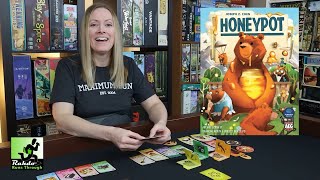

Honeypot Deep Dive
What the Community Thinks About Honeypot
Reviewers across multiple channels praise Honeypot as a clever, quick-playing set collection game that delivers engaging player interaction within a light 15 to 30 minute timeframe. The game's strength lies in its simultaneous play and mind-game elements, where players constantly evaluate opponents' strategies while building their own card sets. Fans highlight the game's accessibility to both casual and strategic players, along with its remarkable ability to create memorable moments at the table through psychological gameplay and careful card placement.
Core Mechanics That Define Honeypot
Folder Passing and Push-Your-Luck Reveals
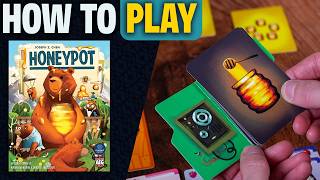
The signature mechanic involves simultaneous folder passing and card reveals. Each round, players receive six cards, arrange them into pairs inside colored folders, and pass these folders clockwise or counterclockwise to neighboring players. The receiving player reveals the top two cards and must decide whether to keep them or push their luck and reveal the next pair. If players pass all the way through, they must keep the final pair. This structure creates a continuous tension between risk and reward as players assess what cards opponents have placed for them.
Set Collection with Diminishing and Variable Returns
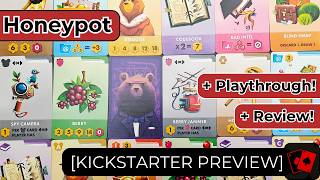
Players build tableau collections of multiple card types with scoring that varies dramatically by quantity. Berries score 2 points for one, escalating to 14 for four, but plummet to zero for five. Honey dippers score 6 for the first, then 3 for the second, and 0 for three or more. Code books award 7 points for a pair, also 7 for three (because you have two pairs), and 14 for four pairs. Disguises reward unique sets: collecting five different disguises earns the maximum 18 points. Good intel cards can form a set (values 1, 2, 3) for 3 bonus points on top of their face values. Bad intel works inversely: players who collect all three values (negative 1, 2, 3) negate the penalties entirely. Rubies scattered across cards count as a majority at game end, with the leader scoring 6 points, second place 4, third place 2, and others zero.
The Honeypot Experience
Psychological Gameplay and Mind Games
The core experience revolves around outsmarting opponents through folder setup. When arranging cards, players must anticipate their neighbors' risk tolerance and attempt to trap them with mediocre pairs while burying the worst cards at the bottom. Experienced players study their opponents and make calculated guesses about how far they will push their luck. One reviewer describes this as "guide their flips, bluff a little, and hope they reveal what you want them to reveal or not." The continuous mind-games create a layer of engagement that transcends simple card luck.
Emotional Rhythm and Table Energy
Honeypot oscillates between moments of victory and defeat in ways that keep the table engaged. Players experience the tension of pushing luck, the relief of landing good cards, and the humor of falling into traps opponents have set. Because the game ends quickly, even unlucky hands do not sap enjoyment for long, and the emotional ups and downs still feel meaningful within the 30-minute window. Reviewers note that even when luck isn't favoring you, the experience remains enjoyable rather than frustrating.
What Makes Honeypot Stand Out
Elegant Simultaneous Play Mechanics
Unlike many modern games that bog down in turn order delays, Honeypot's simultaneous folder arrangement phase keeps all players engaged at once. Everyone is planning and thinking during setup before reveals begin, creating a rhythm where downtime is minimal. The swiping token system adds another layer: after the active player reveals their pair, subsequent players in turn order can spend a swiping token to take their own turn from the remaining cards, adding strategic depth to the back-and-forth reveals without slowing overall game flow.
Clever Risk-Reward Design Across All Card Types
Each card type carries hidden strategic decisions. Taking negative intel cards actually makes sense if you believe you can complete the set and negate the penalties. Honeycomb rewards you with points but curses you with a negative "bees" token that passes to the next player who plays honeycomb, adding a hot-potato element. Action cards like blind swap and decoder offer paths to discard unwanted cards or gain swiping tokens. The bonus honey cards awarded to whoever accumulated the most bad intel each round provide a catch-up mechanism that keeps the game competitive for all players, not just those running ahead early.
Potential Drawbacks
Luck of the Draw in Card Distribution
While the push-your-luck mechanic allows some control over outcomes, the underlying card luck can overwhelm player decision-making. A player dealt an exceptionally weak or strong hand of six cards has limited options to recover or pivot by the folder-passing stage. Because players cannot see what cards opponents have when arranging folders, sometimes brilliant folder design gets undermined when the deck serves unlucky draws to opponents anyway.
Intense Player-to-Player Bluffing for Conflict-Averse Groups
The game's fun hinges on players actively attempting to deceive and trap one another. For groups uncomfortable with direct player conflict or who prefer cooperative play, the psychological mind-games may feel uncomfortably confrontational or manipulative rather than lighthearted. A reviewer noted the game can be "a little bit too cutthroat" for some playstyles, particularly among close friends and family trying to lay traps for each other.
If You Enjoy Honeypot
Try Forage, Honeypot's sibling release from Flatout Games, which combines rolling and tableau building in a foraging theme. If you love the set collection engine, explore Sushi Go, the canonical "I split you choose" game with simultaneous drafting and variable card values. For the push-your-luck element paired with combo-building, Joseph Z Chen's other design Fantastic Factories delivers puzzle-like tableau play with deeper economy building than Honeypot's lighter frame.
What Reviewers Are Saying
"You are playing mind games the whole time where you're like, how do I put something decently enticing on the top but not enticing enough that they want to keep that? Maybe they think there's probably something better underneath that. And then I screw them and I put something there that they don't want, and they're stuck with it."
— Grant's Gamerecks
"Playing against human players, this game can be a little bit too cutthroat for me and Jen, trying to lay traps for each other in the card folios that we make."
— Rahdo Runs Through
"Honeypot is a simple but quite clever set collection game with a charming presentation, a fun multiplayer idea, and a solo mode that plays fast and still offers meaningful decisions."
— Sir Thecos