







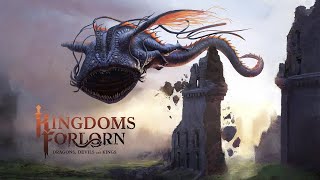


Kingdoms Forlorn Deep Dive
What the Community Thinks About Kingdoms Forlorn
Kingdoms Forlorn strikes a distinctive chord with reviewers: a dark, story-rich dungeon crawler that demands tactical skill in combat while rewarding emotional investment in character narratives. Board Games UnLocked and Meeple University highlight the game's ambitious scope, with reviewers consistently praising the intricate world-building and non-linear character progression, though they note the ruleset comes with a learning curve. The consensus centers on a game that offers profound depth and replayability for players willing to embrace its complexity, but one that requires patience during early sessions as the mechanics crystallize. Some reviewers mention frustration with rule clarity and the sheer volume of systems at play, yet these critiques never overshadow enthusiasm for the core experience. The game appeals to players seeking narrative-driven, solo-operative adventures that intersect in meaningful ways during cooperative clashes.
Core Mechanics That Define Kingdoms Forlorn
Dungeon Crawl
The heart of Kingdoms Forlorn is the delve, a scenario-driven adventure in which knights move through modular kingdom maps, exploring locations and uncovering narrative threads. The dungeon crawl loop centers on exploration: knights travel to new tiles, draw and resolve encounters from the exploration deck, and face both random tests and encounters tied to their personal character quests. The delves are non-linear, allowing each party to forge its own path through the kingdom while managing shared resources like threat and curse. Movement itself becomes strategic, with terrain, panzer gates (locked passages requiring keys), and backtracking penalties shaping decisions. This genre is built on the interplay of exploration, discovery, and escalating challenge, and Kingdoms Forlorn executes it with sophistication by making each knight's personal story intersect with the shared delve experience.
Grid-Based Clash Combat
When exploration gives way to battle, Kingdoms Forlorn transitions to clashes: grid-based tactical skirmish battles resolved through cooperative play. Clashes are designed to be dynamic and constantly escalate in severity, with enemies and knights both gaining resources as combat progresses. Knights roll dice to hit and dodge, manage armor and weapon choices, and spend tokens from a shared pool to power their attacks. The system incorporates damage resolution, armor tokens, keyword effects (piercer, knockback, and many others), and a hero arc mechanic where knights build passion to unlock new abilities while managing peril as they take wounds. Victories award wounds to enemies, progressively breaking them down; surviving knights defeat all enemies to win. The clash phase demands both tactical positioning and resource management, rewarding players who understand the synergy between individual knight abilities and collective strategy.
The Kingdoms Forlorn Experience
Epic Character Journeys
Kingdoms Forlorn treats each player knight as the protagonist of its own epic, with personalized story arcs that unfold through rich storybooks. As you progress through chapters, your knight discovers backstory through prologue passages, encounters tie-in events that shift narrative direction, and investigations uncover lore about the kingdom and your character's place in it. The game's non-linear campaign means knights can revisit kingdoms or pursue entirely different narrative paths based on choices made during delves. This layered storytelling gives weight to each session: success doesn't just mean defeating a boss; it means moving forward in a tale of redemption, ambition, rivalry, or survival. Reviewers highlight that the narrative depth feels genuine, not grafted on, because the story beats emerge organically from the exploration and encounter resolution systems.
Tactical Cooperation Under Pressure
While each knight has a personal story, the delve and clash phases demand tight cooperation. Players must manage shared threat and curse tracks that escalate pressure over time, balance exploration (seeking clues and loot) against the ticking clock of encounter decks, and coordinate combat tactics when monsters appear. The challenge feels genuine because the game doesn't telegraph solutions. Reviewers note that resource decisions matter deeply: spending a key to pass a gate now might mean being locked out of paths later, or spending heat to reroll a critical attack shapes the next clash. The experience oscillates between solo narrative discovery and cooperative problem-solving, creating moments of both personal triumph and shared crisis.
What Makes Kingdoms Forlorn Stand Out
Modular, Replayable Campaign Design
The game's architecture allows knights to join or leave a campaign, pursue investigations independently, and experience different narrative branches based on the order kingdoms are explored and choices made within them. This flexibility means no two campaigns play identically, and it enables players to adapt playtime by choosing focused delves or side investigations rather than committing to lengthy multi-session arcs. The modular design extends to the delve setup itself: different knights, different kingdoms, and different permanent changes from prior delves create emergent map layouts and encounter decks. Reviewers emphasize that this replayability feels substantial, not cosmetic; each path through a kingdom reveals different story passages and encounter opportunities.
Polished Mercenary and Loot System
Between delves, knights build their characters through a mercenary hiring system (temporary combat allies with specialized abilities), gear upgrades, and merchant transactions. This progression loop gives players agency over power levels and playstyle without reducing the challenge of the core game. Mercenaries add tactical depth by offering conditional benefits: a mage grants movement flexibility during delves and repositioning during clashes, while a bard manages heat accumulation. The loot deck delivers meaningful rewards: not empty victory points, but consumables, gear cards, and unlocks that tangibly shift how future delves unfold. Reviewers highlight that this between-delve economy rewards planning without creating a progression treadmill that overshadows the narrative experience.
Potential Drawbacks
Dense Ruleset and Mechanical Friction
Kingdoms Forlorn is mechanically rich to the point that early sessions invite frequent rulebook consultation. Reviewers report instances where keyword interactions, rule ambiguities, or complex resolution steps slow play, particularly around encounter rules, deep fog mechanics, and certain mercenary abilities. The learn-to-play guide helps considerably, but the core rulebook requires study. This friction doesn't soften the appeal for experienced gamers, yet it remains a barrier for casual players or those preferring streamlined designs. Some reviewers suggest that a few mechanical clarifications or a glossary of keywords would have accelerated adoption substantially.
Exploration Pacing and Setup Overhead
The delve phase can feel protracted when rolling through multiple small exploration encounters or managing modular map pieces. Reviewers note that the flow of exploration, while narratively satisfying, sometimes tips toward tedium if the party is unlucky with encounter draws or if certain mechanics (like managing panzer gates and keys, or resolving multiple simultaneous encounters) consume table time. The setup for clashes is also non-trivial, requiring careful board construction and monster placement. These concerns are secondary to overall enthusiasm but worth noting for players with limited time budgets or those seeking snappier session pacing.
If You Enjoy Kingdoms Forlorn
Players drawn to Kingdoms Forlorn's tactical combat and modular exploration will find familiar satisfaction in Oathsworn: Into the Deepwood, which pairs dungeon crawling with rich narrative and card-driven mechanics. If you relish the character progression and sense of epic struggle, Kingdom Death: Monster offers a complementary experience with intense boss battles and campaign persistence, though darker in tone. For those valuing the non-linear, choice-driven narrative experience, Chronos New Dawn delivers branching story paths and scenario-based adventures. The strategic depth of mercenary deployment and tactical positioning echoes elements in ATO (Against the Odds), another scenario-heavy cooperative game. Finally, players who appreciate Kingdoms Forlorn's blend of solo narrative and cooperative challenge will find echoes in Always Sunny, which similarly balances personal story with shared mechanical pressure.
What Reviewers Are Saying
"Clashes in kingdom forlorn are designed to be dynamic and to constantly escalate in severity. As a knight you gain passion each time you attack which moves you up on your heroic arc unlocking more abilities and icons. As you lose vigor you will trigger new steps in your peril arc giving you more capacity for heat which you can gain in order to reroll failed d10s. There is a challenging tactical cooperative battle at play where players use their effects to add helpful tokens into the shared night pool which the whole team can use either passively or by spending the tokens to boost the outcomes of their attacks."
— Meeple University
"We are using the squires. Originally I think we were going to kind of two-hand it, but then in the learn to play, which is very nice, teaches you how the squires work. And I actually kind of like the ease of, they're super simple. And that way we can really take ownership for our individual knights, and our individual stories will move forward faster versus four separate knights running."
— Board Games UnLocked
"Kingdom's forlorn is an immersive game with dungeon crawling grid-based battle and role-playing character development elements. As you progress you'll explore your knight's backstory with a range of twists and emotions deeper than your average role-playing experience all emerging as you play."
— Meeple University